

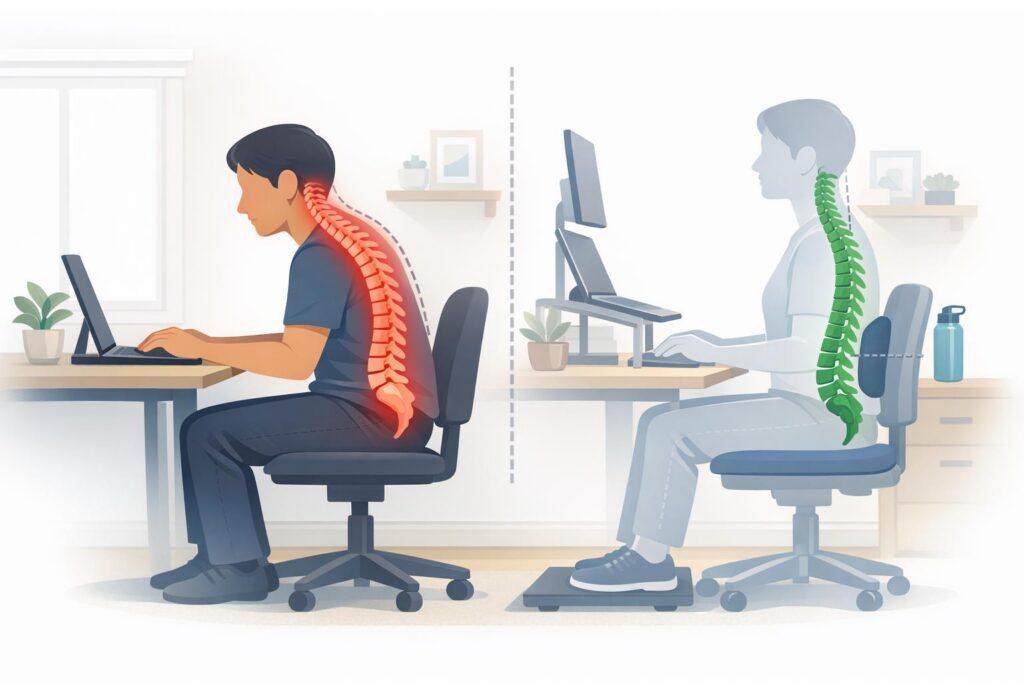
Poor ergonomics can harm your posture and spine, leading to back pain, neck tension, and long-term spinal damage. Australians spend over 10 hours a day sitting, often in positions that strain the spine. Key issues include forward head posture, slouching, and incorrect lifting techniques. These habits can cause spinal disc pressure, muscle imbalances, and alignment problems, which may result in chronic pain and limited mobility.
Simple Tips to Protect Your Spine:
- Set up an ergonomic workspace: Adjust your chair, monitor, and keyboard for proper alignment.
- Take movement breaks: Stand or stretch every 30–60 minutes.
- Strengthen your posture: Focus on core and upper back exercises, like wall angels and shoulder blade squeezes.
- Consider chiropractic care: It may help ease discomfort and improve spinal alignment.
Addressing these issues early can reduce discomfort and protect your spinal health for years to come.
The Perfect Ergonomic Desk Setup To Avoid Back & Neck Pain
sbb-itb-585d67d
Poor Ergonomic Habits That Affect Your Spine
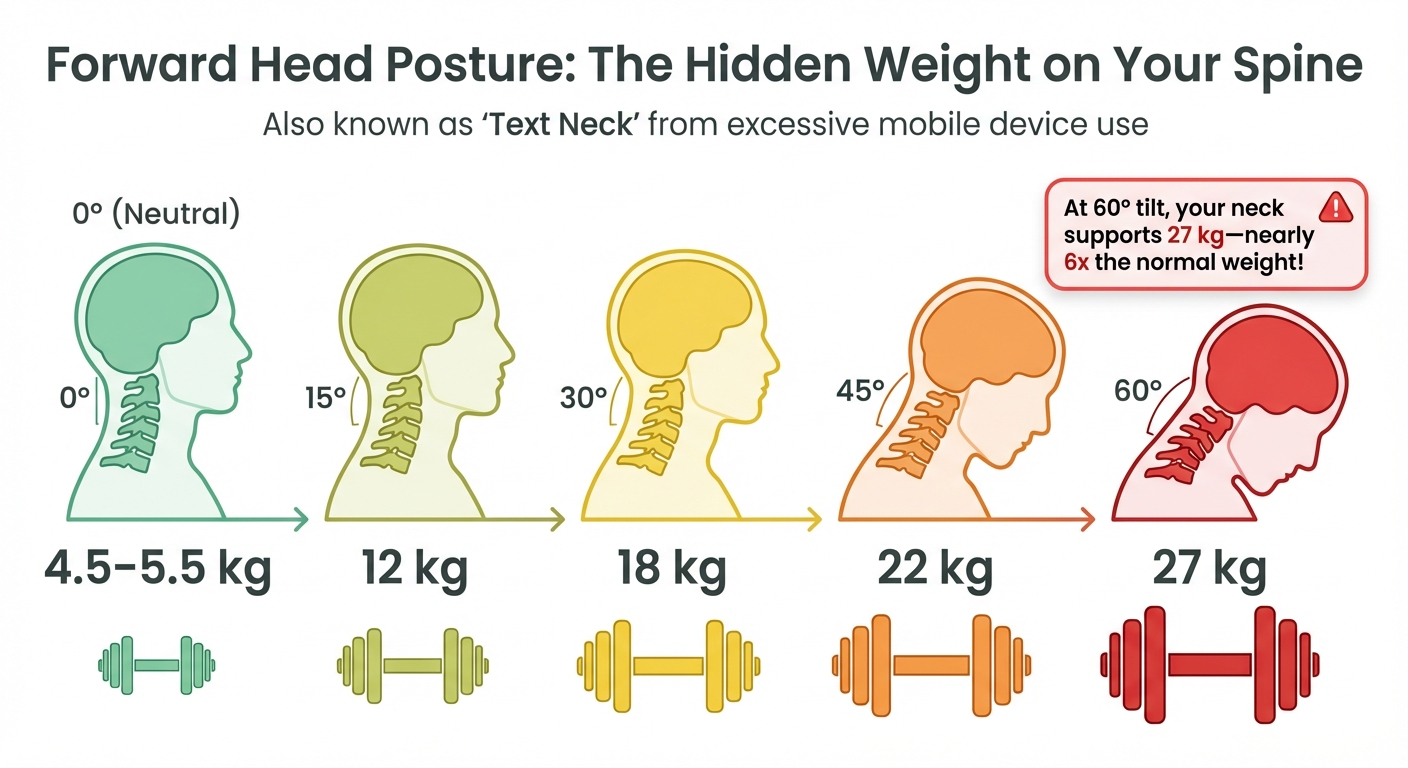
Forward Head Posture Impact on Spine Load by Angle
Everyday routines can place unnecessary stress on your spine, often without you realising it. These habits tend to develop gradually, and by the time discomfort becomes noticeable, the damage may already be underway.
Forward Head Posture from Screen Use
Leaning your head forward to read a screen significantly increases the load on your neck. While your head weighs around 4.5–5.5 kg in a neutral position, tilting it forward amplifies the strain:
| Head Tilt Angle | Load on Spine |
|---|---|
| 0 Degrees (Neutral) | 4.5–5.5 kg |
| 15 Degrees | 12 kg |
| 30 Degrees | 18 kg |
| 45 Degrees | 22 kg |
| 60 Degrees | 27 kg |
This posture, often referred to as "text neck," is a common result of excessive mobile device use. Working on laptops without external keyboards or monitors can also encourage a hunched posture, putting strain on your neck, back, and wrists. According to research published in BioMed Research International, "alteration of head and neck positions had an immediate negative impact on respiratory function." This shows that forward head posture doesn’t just affect your spine – it can also disrupt your breathing. Over time, these misalignments can lead to chronic spinal issues.
Rounded Shoulders from Slouching
Slouching, another common habit, disrupts the natural alignment of your spine. Sitting with rounded shoulders creates uneven pressure and contributes to muscle imbalances. For many people, particularly those with desk jobs, this is an everyday reality. With nearly half of working-age adults spending most of their day seated, it’s easy to see how this posture becomes a problem.
Reaching for items placed too far away adds to the strain, forcing your spine into awkward positions repeatedly. Similarly, cradling a phone between your ear and shoulder places unnatural stress on your neck muscles. Over time, these habits can lead to lasting spinal misalignment and discomfort.
Incorrect Lifting Methods
Spinal strain isn’t limited to sitting; poor lifting techniques can also take a toll. Improper form when lifting objects puts undue stress on your lower back, increasing the risk of injuries like disc bulges, annular tears, and herniated discs. A herniated disc pressing on the sciatic nerve can cause sciatica, a sharp, radiating pain that affects the back, hips, and legs.
Repeatedly lifting with poor posture can also lead to nerve pain, tendonitis, and joint damage, further stressing your musculoskeletal system. Proper lifting techniques are essential to prevent these issues and protect your spine from unnecessary wear and tear.
How Poor Ergonomics Damages Posture and Spine Health
Daily habits of poor posture do more than cause temporary discomfort – they can lead to long-term damage to your spine.
Increased Pressure on Spinal Discs
Spinal discs are like shock absorbers between your vertebrae, helping with movement and cushioning impact. But poor posture, especially a forward head tilt, places excessive strain on these discs. For every 2.5 centimetres your head moves forward from its neutral position, your spine feels an extra 4.5 kilograms of pressure. At a 60-degree tilt, your neck ends up supporting a massive 27 kilograms instead of its usual 4.5–5.5 kilograms.
Over time, this added pressure can lead to disc damage, including bulging, drying out, or even tears and herniation. These issues often result in chronic pain and reduced mobility, making everyday tasks far more challenging.
Muscle Imbalances and Ongoing Tension
Poor posture disrupts the balance between muscle groups. For instance, slouching or leaning forward causes some muscles to tighten and shorten, while others overstretch and weaken. This imbalance is especially common in the upper body, where tight chest muscles and weak upper back muscles lead to upper crossed syndrome. This condition creates a cycle of muscle fatigue, poor circulation, and altered shoulder movement.
These imbalances don’t just affect alignment – they can lead to ongoing stiffness, limited range of motion, and persistent discomfort, making even simple movements feel like a struggle.
Long-Term Spinal Alignment Problems
Ignoring postural issues can result in more severe problems involving tendons, ligaments, and joints. As your spine shifts out of proper alignment, nerve compression becomes a real concern. This can cause sharp or burning pain, tingling, or muscle weakness. For example, in the lower body, it may show up as sciatica, while in the upper body, it could lead to pain radiating through the shoulders, arms, or hands.
Spinal misalignment doesn’t just affect your muscles and nerves – it can even impact your breathing. Research highlights how poor head and neck positioning can reduce respiratory efficiency. The longer these patterns go unchecked, the harder they are to correct, which is why addressing posture early is so important for preserving spinal health and overall function. Understanding these risks is the first step towards finding practical ergonomic solutions.
Solutions to Improve Your Ergonomics
Improving your ergonomics can help reduce spinal strain and support better posture. By tweaking your workspace and incorporating movement into your routine, you can maintain proper spinal alignment and reduce discomfort.
How to Set Up an Ergonomic Workspace
Start by selecting a chair that offers good lumbar support to maintain your spine’s natural S-curve. Adjust the height so your feet rest flat on the floor, with your knees bent at a 90-degree angle. This setup helps minimise lower back pressure during long hours of sitting.
Position your keyboard and mouse at elbow height to keep your wrists neutral and shoulders relaxed. Your monitor should be about an arm’s length away (50–100 centimetres) with the top of the screen at or just below eye level. If you’re using a laptop, a laptop stand paired with an external keyboard can prevent hunching. Adding a sit-stand desk to your workspace allows you to alternate between sitting and standing, which can further reduce strain. Accessories like footrests or vertical mice can also make a difference.
Taking Regular Movement Breaks
Australians spend an average of over 10 hours a day sitting, which puts constant pressure on the spine. To counteract this, aim to change your position every 20–30 minutes and stand for at least one to two minutes every 30–60 minutes. These small changes can improve circulation and ease spinal compression.
Incorporate short movement breaks into your day. For instance, shoulder rolls, back extensions, or even a quick walk around the room can help release tension. The 20-20-20 rule is another practical tip: every 20 minutes, focus on an object 6 metres (20 feet) away for 20 seconds. Not only does this reduce eye strain, but it also encourages you to reset your posture. Pairing these breaks with specific exercises can further strengthen your posture.
Exercises to Support Posture and Strength
Strengthening your core and upper back is key to counteracting poor posture. Focus on core exercises that engage the transversus abdominis, a deep muscle that acts like a natural brace for your spine. Aim for 12–15 slow, controlled repetitions.
For your upper back, try shoulder blade squeezes: sit upright, pull your shoulders back, and squeeze your shoulder blades together for five seconds before releasing. Another helpful exercise is wall angels. Stand with your back against a wall and slowly slide your arms up and down, keeping them in contact with the wall. This movement helps correct rounded shoulders and forward head posture.
Incorporate stretches to relieve tension in areas like the neck, chest, and hamstrings. For example, to ease neck tension, gently pull your right elbow across your chest with your left hand and hold for 20 seconds, then switch sides. Dynamic movements, such as walking meetings or standing during phone calls, can often be more effective than simply relying on an ergonomic chair to solve posture issues.
How Chiropractic Care May Support Spinal Health
If poor ergonomics are putting strain on your spine, chiropractic care might help ease musculoskeletal discomfort. Through spinal adjustments and manual techniques, practitioners aim to improve joint mobility, reduce stiffness, and address alignment issues. Here’s a closer look at how these adjustments can help restore movement and support spinal health.
Restoring Spinal Joint Movement
Chiropractic adjustments are often used to improve movement in spinal joints that have become restricted, often due to poor posture. For instance, research highlights that tilting your head forward by 60 degrees can place as much as 27 kg of pressure on the cervical spine. These adjustments may help relieve nerve irritation and enhance spinal function, which can be particularly beneficial for those stuck in static, misaligned positions.
To create a tailored treatment plan, practitioners assess both static and dynamic postures. This evaluation includes examining spinal curves, weight distribution, and movement patterns. For example, if someone has rounded shoulders and a forward head posture, adjustments might focus on improving mobility in the upper back and neck to address these specific issues.
Working Alongside Ergonomic Changes
While chiropractic care can address spinal alignment and mobility, combining it with ergonomic improvements often delivers the best results. Adjustments can help realign the spine, but sustaining these benefits requires healthy habits, particularly in your workspace. Many practitioners provide advice on ergonomics, movement strategies, and posture awareness to complement hands-on treatments.
A practical tip often shared is the 20-8-2 rule: sit with good posture for 20 minutes, stand for 8 minutes, and move around for 2 minutes during every 30-minute work period. This approach helps reduce the strain on your spine and encourages better spinal health between chiropractic visits.
Tailored Care for Individual Needs
Chiropractic care is highly adaptable and can be customised to address your specific needs, whether it’s tech neck from excessive screen time, lower back pain and sciatica from sitting too long, or muscle imbalances caused by repetitive tasks. Practitioners may also recommend exercises to strengthen your core and postural muscles, addressing issues often associated with what some call Home Office Syndrome.
The beauty of chiropractic care lies in its flexibility – it fits seamlessly into even the busiest lifestyles. The focus remains on gentle, nervous-system-centred treatments that work hand-in-hand with your broader wellness practices, all delivered in a supportive and non-intimidating way.
Conclusion
Your spine is the backbone – literally – of your daily life, but poor ergonomics can put unnecessary strain on it. With Australians spending more than 10 hours a day sitting, the impact on posture and spinal health is hard to ignore. The good news? Small, practical tweaks can make a noticeable difference.
Take a moment to assess your workspace. Adjust your monitor so it’s at eye level, keep your keyboard and mouse in a neutral position, and make sure your feet are flat on the floor. Break up long sitting periods with movement every 30 to 60 minutes, and try the 20-20-20 rule to ease eye and neck strain. These simple steps can help ease the load on your spine and reduce muscle imbalances caused by sitting too long.
If you’re noticing neck stiffness, frequent headaches, or difficulty sitting upright, it might be time to rethink your setup. Chiropractic care could complement your efforts by improving joint mobility and addressing underlying issues. When combined with ergonomic changes and targeted exercises, this approach can support your spinal health over the long term.
Taking care of your spine isn’t just about avoiding pain – it’s about maintaining comfort and mobility for the future. Whether you’re dealing with tech neck from long hours at a desk, managing lower back tension as a busy parent, or simply aiming to stay active and balanced, these proactive steps can help. By making ergonomic adjustments and seeking support like chiropractic care when needed, you can keep your spine healthy and strong for years to come.
This information is general and not intended as a substitute for medical advice. Chiropractic care focuses on musculoskeletal health, and results may vary. Always consult a qualified healthcare professional for personalised guidance.
FAQs
How do I know if my desk setup is causing my pain?
If you’re experiencing discomfort in areas like your neck, shoulders, back, or spine, your desk setup might be part of the problem. Poor ergonomics – like a monitor that’s too high or low, or a chair that doesn’t support your posture – can lead to strain and bad habits over time.
Making adjustments can make a big difference. Simple fixes like ensuring your chair provides proper support, setting your desk at the right height, and positioning your monitor at eye level can improve posture. Also, don’t forget to take regular breaks to move and stretch – it helps reduce stiffness and tension.
However, if the pain doesn’t go away, it’s a good idea to reach out to a healthcare professional. They can provide advice tailored to your specific needs.
What are the warning signs that poor posture is becoming serious?
Poor posture can sometimes signal more serious concerns. Watch for signs like ongoing upper back pain, frequent headaches, limited lung capacity, muscle tightness, nerve-related discomfort, or noticeable shifts in spinal alignment. If these problems persist despite self-care efforts or ergonomic changes, it might be time to consult a professional.
When should I see a chiropractor for posture or back pain?
If you’re dealing with ongoing discomfort, stiffness, or aches that don’t seem to improve with self-care, it might be worth considering a visit to a chiropractor. Everyday habits like sitting for long periods, repetitive motions, or the effects of stress can often lead to issues such as back or neck pain. Chiropractors specialise in assessing the spine and offering gentle, research-backed care aimed at improving posture and managing these symptoms. Getting evaluated early could help prevent potential complications and make daily life more comfortable.