

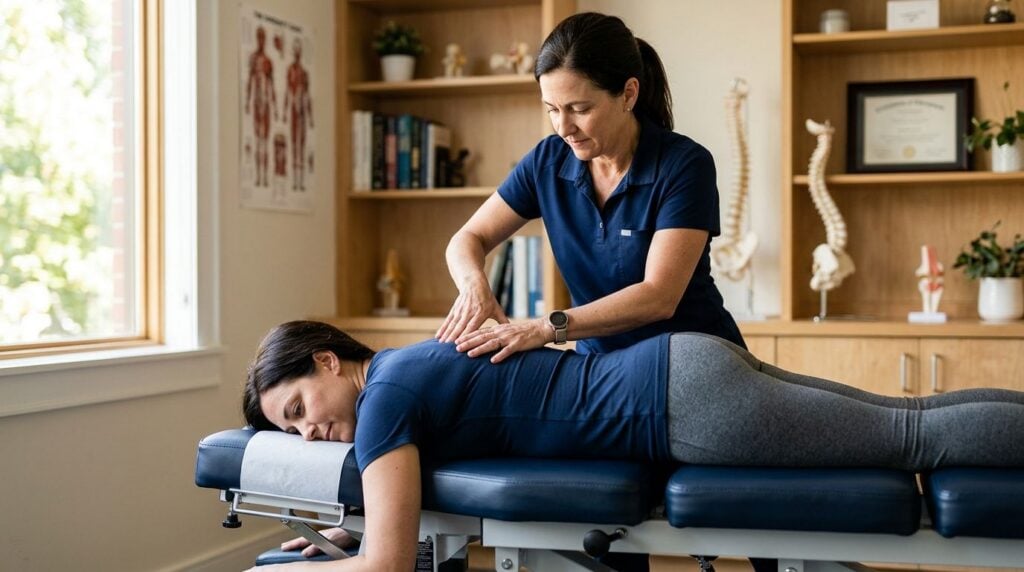
Adults with scoliosis often want to know which chiropractic approach fits their curve, their pain pattern and their daily life, rather than a one-size-fits-all adjustment. This guide compares five chiropractic techniques for adult scoliosis discussed in Australian clinics in 2026, what each one involves, and where a GP or specialist referral matters more than an adjustment.
- Chiropractic techniques for adult scoliosis are generally discussed as supportive care for comfort and mobility, not curve correction.
- Diversified adjustments are the most widely used starting point for adults with mild-to-moderate curves in 2026.
- Instrument-assisted adjusting suits adults wanting a lower-force option or managing reduced bone density.
- Flexion-distraction and scoliosis-specific exercise integration pair chiropractic care with active self-management.
- Curve progression should be monitored by a GP or specialist, not managed by chiropractic care alone.
Why this matters
Scoliosis in adults falls into two broad groups: curves first identified in adolescence that carried into adulthood, and de novo degenerative curves that develop later as spinal discs and joints change with age. Neither group is the same as a teenager's growing spine, and the goals of care shift accordingly — comfort, mobility and function matter more than curve correction once bone growth has stopped.
A chiropractic clinic in Bondi Junction will typically start with a postural and spinal assessment before recommending any technique, because the right approach depends on curve location, muscle tension patterns, joint stiffness and any existing disc changes. There is no single chiropractic technique that fits every adult with scoliosis, which is why this comparison ranks approaches by who they suit, not by which one wins outright.
What makes a chiropractic technique appropriate for adult scoliosis
- Assessment first — the technique should follow a spinal and postural assessment, not replace one
- Force level matched to the patient — lower-force options matter for adults with osteoporosis risk or joint sensitivity
- Integration with exercise — approaches that pair with active movement tend to support daily function better than passive care alone
- Clear monitoring pathway — any approach should sit alongside GP or specialist monitoring of curve progression, not instead of it
- Comfort with individual anatomy — asymmetric curves respond differently on the concave versus convex side, and technique should account for that
Chiropractic techniques for adult scoliosis at a glance
| Technique | Best for | Standout feature | Key limitation |
|---|---|---|---|
| Diversified technique | General mobility support in mild-to-moderate curves | Widely taught, adaptable manual adjustment | Higher-velocity input may not suit every adult |
| Gonstead-style assessment and adjustment | Detailed segment-by-segment assessment | Structured analysis of each vertebral level | Time-intensive; not universally offered |
| Flexion-distraction / spinal decompression | Adults with disc-related discomfort alongside a curve | Low-force, table-assisted movement | Requires specific equipment and repeat visits |
| Instrument-assisted adjusting | Adults preferring lower-force care or with reduced bone density | Precise, adjustable-force delivery | Less segmental correction per session than manual work |
| Scoliosis-specific exercise integration | Adults wanting an active self-management component | Pairs manual care with take-home movement work | Needs patient consistency between visits |
1. Diversified technique: best for general mobility support
Diversified technique is the manual adjustment most people picture when they think of chiropractic care — a hands-on, high-velocity, low-amplitude movement applied to a specific joint. For adults with mild-to-moderate scoliosis, it is commonly discussed as a way to support joint mobility and reduce localised muscle tension around the curve, following an individual assessment.
Diversified technique pros:
- Widely taught and available across Australian clinics
- Adaptable to different spinal regions and curve patterns
- Often combined easily with soft tissue work in the same visit
Diversified technique cons:
- Higher-velocity input isn't preferred by every adult, particularly those with joint sensitivity
- Not appropriate without an assessment confirming suitability for the specific curve
- Does not address underlying disc or nerve-related symptoms on its own
Best for: adults with a known, stable scoliotic curve seeking general spinal mobility support. Verdict: worth discussing at your first assessment.
2. Gonstead-style assessment and adjustment: best for detailed segmental analysis
Gonstead-style care layers a structured analysis — visual, motion and sometimes imaging-based — onto each vertebral segment before any adjustment is made. For an asymmetric spine, this level of segment-by-segment detail can matter more than it would for a straight spine, since curve levels don't behave uniformly.
Gonstead-style pros:
- Detailed, segment-specific assessment before any adjustment
- Useful when curve levels behave differently on each side of the spine
- Often paired with clear before-and-after positional checks
Gonstead-style cons:
- Sessions can run longer than a standard adjustment visit
- Not every clinic offers this specific analysis method
- Still requires separate imaging and GP oversight for curve progression tracking
Best for: adults wanting a highly structured, segment-level assessment approach. Verdict: consider if your curve affects multiple spinal levels differently.
3. Flexion-distraction / spinal decompression: best for concurrent disc discomfort
Flexion-distraction uses a specialised table that gently flexes and distracts the spine while the chiropractor applies a controlled, low-force movement. It's frequently discussed for adults with scoliosis who also have disc-related discomfort, since it avoids the twisting force some other techniques apply.
Flexion-distraction pros:
- Low-force delivery suits adults with disc or joint sensitivity
- Table-assisted movement reduces reliance on manual thrust alone
- Can be adjusted in range and pressure session to session
Flexion-distraction cons:
- Requires specific equipment not every clinic has
- Typically needs a series of visits rather than a single session
- Doesn't replace the need for a GP to assess disc-related symptoms directly
Best for: adults whose scoliosis is accompanied by disc-related back pain. Verdict: worth asking about if disc symptoms sit alongside your curve.
4. Instrument-assisted adjusting: best for lower-force preference
Instrument-assisted adjusting uses a small, spring-loaded or electronic tool to deliver a controlled, low-force impulse to a specific spinal segment. It's often raised as an option for adults who are uncomfortable with manual thrust techniques, or who have reduced bone density where a gentler approach matters more.
Instrument-assisted pros:
- Precise, repeatable force that can be adjusted to the individual
- No twisting or high-velocity component
- Often more comfortable for adults new to chiropractic care
Instrument-assisted cons:
- Delivers less segmental movement per session than manual adjustment
- May need more frequent visits to achieve a similar mobility goal
- Still requires a full assessment to confirm it suits the specific curve
Best for: adults preferring a lower-force technique or managing bone density concerns. Verdict: consider if manual adjustment feels too firm for your comfort.
5. Scoliosis-specific exercise integration: best for active self-management
This approach pairs in-clinic chiropractic care with a structured, take-home exercise component designed around the specific curve pattern — asymmetric strengthening, breathing-based positioning work, and targeted mobility drills. Programs like stretches for scoliosis relief sit alongside this kind of approach, giving adults something to do between visits rather than relying on adjustments alone.
Exercise integration pros:
- Gives the patient an active role between clinic visits
- Targets muscle asymmetry that adjustment alone doesn't address
- Supports daily function and posture awareness over time
Exercise integration cons:
- Requires consistency at home to see any change in comfort
- Progress depends on the individual's baseline mobility and adherence
- Not a substitute for medical monitoring of curve progression
Best for: adults who want a self-management component alongside chiropractic visits. Verdict: worth discussing if you want more than a passive adjustment plan.
How this comparison was built
Each technique above was assessed against the same five criteria: whether it follows a proper spinal assessment, how the force level suits different adults, whether it integrates with exercise, whether it fits alongside medical monitoring, and how well it adapts to asymmetric anatomy. No technique here is presented as a way to correct or resolve a scoliotic curve — the ranking reflects fit for comfort and mobility goals, discussed following an individual assessment, not clinical superiority.
Adults considering any of these approaches should read how to choose the right chiropractor for your condition before booking, since the right fit depends heavily on curve type, age and any coexisting conditions like osteoporosis or disc degeneration.
Which chiropractic technique should you choose?
For most adults starting out, diversified technique following a full spinal assessment is the common entry point discussed in 2026. Adults with disc-related discomfort alongside their curve often raise flexion-distraction specifically. Those wanting a gentler starting point, or managing bone density concerns, tend to ask about instrument-assisted adjusting. None of these replace a GP or specialist for monitoring whether a curve is progressing — that conversation needs imaging and clinical follow-up outside a chiropractic visit.
Discuss your options with a chiropractor
Assessment-based care plans discussed following an individual consultation.
FAQ
What is the best chiropractic technique for adult scoliosis?
There isn’t one technique that suits every adult with scoliosis — diversified adjustment is the most common starting point discussed in 2026, but flexion-distraction, instrument-assisted adjusting and exercise-based approaches each suit different curve patterns and preferences. A spinal assessment determines which approach may be appropriate.
Can chiropractic care straighten a scoliotic curve in adults?
Chiropractic adjustments are not shown to correct a structural scoliotic curve in adults, since bone growth has typically stopped. Care is generally discussed as support for comfort, mobility and posture, with curve monitoring left to a GP or specialist.
Is chiropractic care safe for someone with scoliosis?
Suitability depends on the individual’s curve, bone density and any coexisting conditions, which is why a full assessment happens before any technique is chosen. Discuss your specific history, including any osteoporosis risk, with a chiropractor and your GP.
How often do adults with scoliosis need chiropractic visits?
Visit frequency depends on the technique chosen and the individual’s goals, and is set following the initial assessment rather than a fixed schedule. Some adults pair less frequent clinic visits with daily home exercises.
Does scoliosis get worse with age in adults?
Some adult curves stay stable for decades, while degenerative curves can develop or progress later in life as spinal discs and joints change. Any suspected progression should be assessed by a GP or specialist with imaging, not judged by symptoms alone.
What’s the difference between chiropractic care for teenage scoliosis and adult scoliosis?
Teenage scoliosis care often focuses on monitoring curve progression during growth, while adult care focuses on comfort and function since the spine has finished growing. The two situations need different assessment approaches and different monitoring schedules.
Do I need a doctor’s referral before seeing a chiropractor for scoliosis?
A referral isn’t always required to book a chiropractic assessment, but ongoing GP or specialist involvement matters for monitoring curve progression over time. Discuss your full history, including any prior imaging, at your first visit.
Can exercise alone manage adult scoliosis symptoms?
Targeted exercise can support muscle balance and mobility around a curve, and is often discussed alongside chiropractic care rather than as a standalone option. Consistency at home tends to matter more than the specific program chosen.
One last thing
The biggest mix-up adults make with scoliosis and chiropractic care isn't about technique — it's assuming any single approach will change the shape of the curve itself. In 2026, the more useful question to bring to a first visit is which technique fits your comfort level and daily routine, and who is tracking your curve on imaging over time. That second part sits with a GP or specialist, not a chiropractic clinic.
Related guides
- Chiropractic care for scoliosis in teenagers
- How to know when back pain needs a chiropractor vs a doctor


