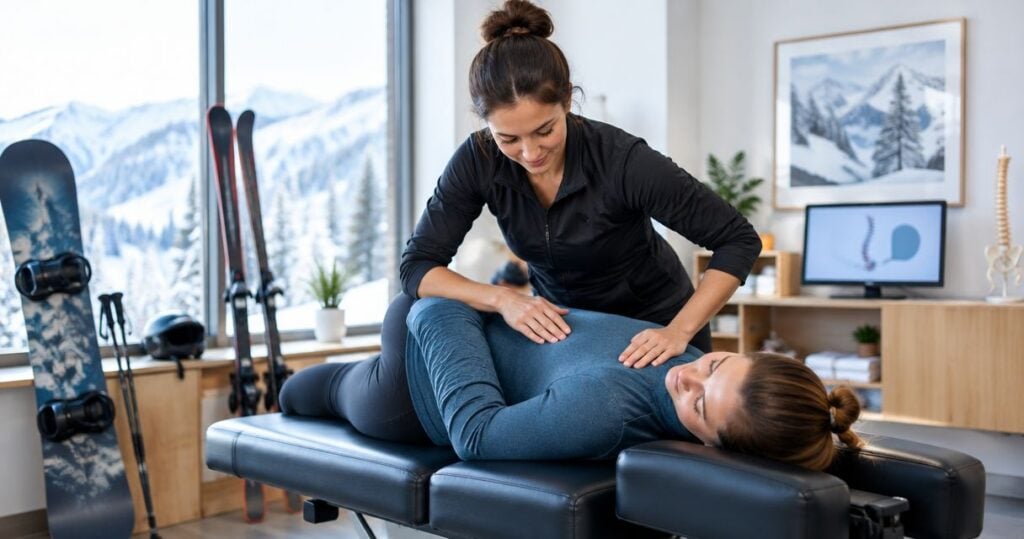
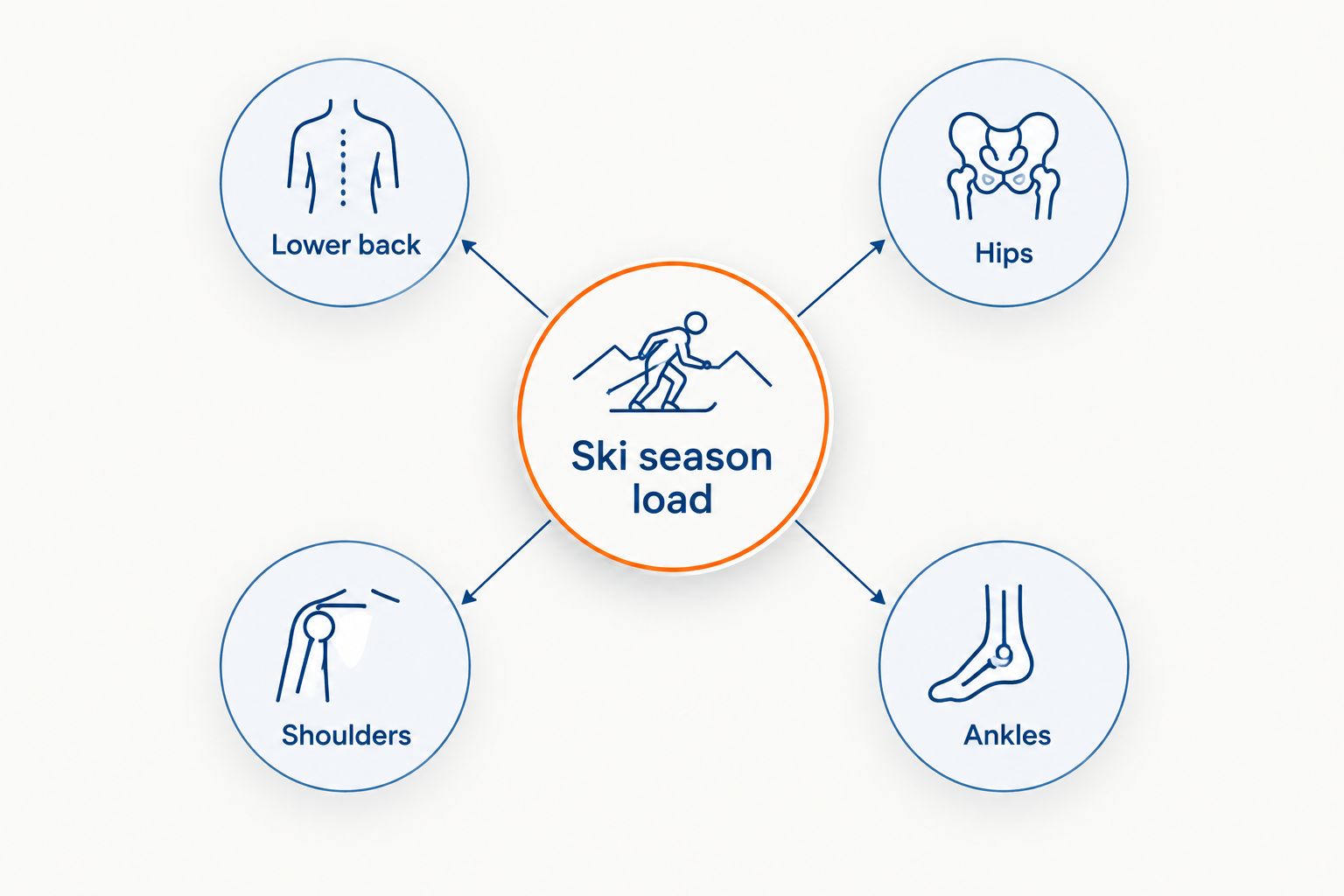
A chiropractor for skiers and snowboarders looks at the movement restrictions and load patterns that build up from repeated flexion, rotation and impact on the slope, with the aim of helping riders start ski season 2026 with better range of motion in the hips, lower back and shoulders. Skiers and snowboarders carry different demands to most weekend athletes: boot-locked ankles, long lift-line standing, asymmetric gear carrying and multi-day trips with no built-in rest day.
- A chiropractor for skiers focuses on pre-season movement assessment and post-trip recovery planning, not on-mountain trauma care.
- Boot-locked ankles push extra rotation demand into the hips and lower back across a ski day.
- Strength and mobility work in the 6-8 weeks before ski season 2026 does more for load tolerance than anything done during the trip.
- Any fall involving a suspected fracture, head knock or loss of sensation needs urgent medical review, not a chiropractic appointment.
- MyChiro’s process for this group starts with a history and movement assessment before any care plan is discussed.
Why chiropractic care matters for skiers and snowboarders
Skiing and snowboarding load the body differently to running or gym training. The chiropractic clinic in Bondi Junction sees this pattern often in patients who ski or board on weekends through winter: stiffness that shows up two or three days after a trip rather than during it.
Ski boots fix the ankle in a near-static position for most of the day on snow. That restriction doesn't disappear – it transfers up the chain into the hips and lower back, which end up doing rotation work the ankle would normally share. Carrying a boot bag or pack on one shoulder at the lift line for hours adds an asymmetric load on top of that, which is why shoulder and upper back stiffness after a ski trip is common even without a fall.
None of this is urgent on its own. It becomes worth a conversation with a health professional when stiffness carries into normal daily activity weeks after the snow has melted, or when one side of the body consistently feels tighter or weaker than the other.
Assess your movement pattern before the season
A baseline check before the first day on snow gives you something to compare against if stiffness shows up mid-season.
- Check hip internal and external rotation on each side while standing on one leg.
- Test thoracic rotation by crossing your arms and rotating the torso while keeping the hips still.
- Note any old ankle, knee or shoulder injury that has changed how you load one side.
- Time how long you can hold a partial squat (ski stance) before the lower back rounds.
Build hip and thoracic rotation
Most of the rotation a ski turn demands should come from the hips and thoracic spine, not the lower back.
- Add 90/90 hip switches and thread-the-needle stretches most days of the week.
- Work on ankle dorsiflexion drills, since a stiff ankle pushes extra rotation demand upward.
- Include a rotational medicine ball throw or cable chop once basic mobility improves.
- Watch for compensation through a stiff lower back instead of the hips during rotation drills.
Strengthen the posterior chain and core
Hamstrings, glutes and a stable core absorb the repeated landings and direction changes that skiing and snowboarding demand.
- Deadlift variations or bodyweight hip hinges to build hamstring and glute capacity.
- Side planks and bird-dogs for rotational core control through moguls and turns.
- Step-downs and single-leg squats to match the uneven loading of carving.
- Build strength volume across 6-8 weeks before the first day on snow, not in the fortnight before a trip.
Warm up dynamically before each run
A cold body absorbs less load before it starts sending signals of overuse.
- Leg swings, walking lunges and hip circles for 5-10 minutes before the first lift.
- Use dynamic movement rather than static stretching before skiing, since dynamic movement primes tissue for load better.
- Repeat a shorter version of the warm-up after lunch, since morning mobility gains fade across a cold day.
Check your stance, boots and pack load
Equipment setup changes how load moves through the body on every run.
- Get boots checked for canting and forward lean that force compensation through the knees and lower back.
- Alternate which shoulder carries a boot bag or backpack through the day.
- Hinge from the hips to fasten boots or bindings instead of twisting through the lower back.
- Review pole length – poles that are too long push the shoulders and thoracic spine into extra flexion on traverses.
Pace multi-day trips and build in recovery
A five-day trip skied at full intensity every day rarely goes as well as one with a lighter day built in.
- Schedule at least one lighter day across a five-day trip rather than five full days back to back.
- Prioritise sleep and hydration at altitude – both affect how tissue recovers overnight.
- Use evenings for gentle mobility work, not only apres activities.
- Treat pain that worsens day over day, rather than settling with rest, as a signal to change the plan.
“If pain gets worse each day of a ski trip instead of settling overnight, that trend matters more than the pain itself.”
Get a professional assessment if stiffness or pain persists
This is where a chiropractor for skiers fits into the plan – after the free and low-cost steps above, not before them.
- Book a chiropractic assessment if lower back, hip or shoulder stiffness carries into non-ski days weeks after a trip. MyChiro's process reviews history, movement and any red flags before any care plan is discussed.
- See a GP or emergency department directly for any fall involving a suspected fracture, head knock or loss of sensation – this needs urgent medical review, not a chiropractic appointment.
- Bring a note of which runs, turns or movements reproduce the stiffness; it speeds up the assessment.
- Mention any existing diagnosis, such as a disc bulge or prior surgery, before an adjustment is considered.
Comparing your options for ski-season readiness
| Option | Best for | Key limitation |
|---|---|---|
| Self-guided mobility and strength program | Skiers building a pre-season base with no current pain | No clinical check on old asymmetries or injuries |
| Ski-specific strength coaching | Riders wanting sport-specific conditioning | Coaches don't assess or manage musculoskeletal pain |
| Physiotherapy-led rehab | Recovering from a diagnosed injury or post-surgical return to snow | Focused on rehab protocols rather than ongoing movement checks |
| Chiropractic assessment and care | Recurring stiffness, restricted rotation or a history of lower back strain | Not appropriate for acute trauma, suspected fracture or head injury |
Book a Movement Assessment
Discuss ski-season readiness with a registered chiropractor.
Common mistakes skiers and snowboarders make
- Skipping hip and thoracic mobility work before the first day on snow, then wondering why turn three feels stiffer than turn one.
- Loading gear on one shoulder for hours at the lift line without alternating sides.
- Jumping straight into full days on the mountain without graded intensity across a multi-day trip.
- Ignoring early stiffness signals and pushing through several more runs on the same tender area.
- Treating a fall with a suspected head knock or fracture as "just sore" instead of getting urgent medical review.
FAQ
What does a chiropractor for skiers actually do?
A chiropractor for skiers assesses movement restrictions in the hips, lower back and shoulders that build up from repeated flexion, rotation and impact on snow. Following a history and movement assessment, a management plan can be discussed with a qualified health professional.
Can chiropractic care help with lower back stiffness after a ski trip?
Chiropractic assessment can identify movement restrictions that may be contributing to lower back stiffness after skiing. Whether adjustments or other care are appropriate depends on a full clinical history and assessment.
Should I see a chiropractor before ski season starts?
A pre-season assessment can establish a baseline for hip and thoracic rotation and flag old asymmetries before the first day on snow. Many skiers pair this with the mobility and strength steps outlined above.
Is chiropractic care suitable for snowboarders with shoulder pain?
Shoulder stiffness in snowboarders is often linked to asymmetric gear carrying or falls onto an outstretched arm. An assessment can help work out whether the pattern is muscular, joint-related, or needs a referral for imaging.
What’s the difference between chiropractic care and physiotherapy for ski-related pain?
Physiotherapy typically centres on rehab protocols for a diagnosed injury, while chiropractic assessment looks broadly at movement and joint restriction. Both can be discussed with a qualified health professional depending on the presentation.
When should ski-related pain be assessed by a doctor instead of a chiropractor?
Any fall involving a suspected fracture, head knock, numbness or loss of sensation needs urgent medical review, not a chiropractic appointment. Persistent but non-traumatic stiffness is a more typical reason to book a chiropractic assessment.
How many chiropractic visits does a skier typically need?
The number of visits depends on the individual assessment findings and how the body responds over time; this is discussed directly with the treating chiropractor rather than set in advance.
Can pre-season strength training reduce ski-related back strain?
Building hamstring, glute and core strength over 6-8 weeks before ski season 2026 gives the lower back more support for absorbing landings and direction changes. This is one of the lowest-cost steps available before the season starts.
One last thing
Ski boots lock the ankle in a fixed position for most of the day on snow, and that restriction has to go somewhere – it usually shows up as extra rotation demand through the hips and lower back by the second or third day of a trip. Loosening the ankle and hip before the first run of the day matters more than any stretch done after skiing that same day. Heading into ski season 2026, that single habit is worth more than most of the gear upgrades riders spend on each year.
Related guides
- Chiropractic care for golfers with lower back pain
- How to safely return to exercise after a back injury
- Chiropractic care for rock climbers with shoulder strain