
Yes—chiropractic care and pain medication may be considered within the same care plan, but suitability depends on your symptoms, medicines and individual assessment. Tell the chiropractor what you take, and ask your pharmacist or prescribing clinician about medicine-specific precautions. Do not stop, increase or reschedule medication simply because you are considering an adjustment.
- Can chiropractic care combine with pain medication? Sometimes, following assessment and a medicine-specific discussion with your pharmacist or prescriber.
- Mychiro provides chiropractic care in Bondi Junction; medication decisions belong with your prescribing clinician or pharmacist.
- Bring your medicine list, including non-prescription painkillers, supplements and any recent dose changes.
- Combining approaches does not establish that an adjustment is appropriate or that medication can be reduced.
Why this matters
Taking a painkiller does not, by itself, answer whether spinal manipulation is appropriate. The reason for your pain, your medical history and the proposed procedure all matter. A medication review and a chiropractic assessment address different questions.
For your 2026 appointment preparation, start with accurate information rather than changing your usual routine. This guide to preparing for your first chiropractor appointment provides a starting point for organising questions. Your pharmacist or prescriber should address questions about taking, withholding or changing a medicine.
Can chiropractic care combine with pain medication?
Taking pain medication does not automatically rule chiropractic care in or out. A discussion about combining them should establish what medicine you take, why you take it and whether the proposed care is appropriate following assessment.
The Australian Commission on Safety and Quality in Health Care's Low Back Pain Clinical Care Standard describes assessment, shared decision-making and review as parts of care for low back pain. It does not provide individual clearance for an adjustment or a particular medicine combination. Medicine-specific information belongs in the Therapeutic Goods Administration's Consumer Medicine Information and a discussion with your pharmacist or prescriber.
| Part of the plan | What it contributes | What it does not establish |
|---|---|---|
| Medication review | Checks medicine instructions, precautions and possible interactions | Whether spinal manipulation is appropriate |
| Chiropractic assessment | Considers your history, symptoms and proposed chiropractic care | Permission to change a prescribed medicine |
| Shared care discussion | Clarifies responsibilities and information to share | A guaranteed outcome from combining approaches |
| Follow-up review | Checks changes in symptoms, function and adverse effects | A reason to continue an unchanged plan indefinitely |
These are complementary responsibilities, not interchangeable permissions. You can attend an assessment without agreeing to an adjustment, and you can ask for time to discuss the proposed plan with another health professional.
What should I tell the chiropractor about my medication?
Bring the actual packaging, a pharmacy list or a clear record of everything you take. Include occasional medicines. A painkiller taken only before work or exercise still belongs in the discussion.
For your 2026 medicine list, record:
- Medicine name: Include the active ingredient where available, not just the brand.
- Dose instructions: Copy the label or prescription rather than relying on memory.
- Actual use: Explain how you take it, including occasional extra or missed doses.
- Reason for use: Say who recommended it and what it was prescribed or purchased for.
- Other products: Include vitamins, herbal products, creams and non-prescription medicines.
- Recent changes: Mention new medicines, changed instructions and suspected adverse effects.
Do not leave out a medicine because it seems unrelated to back or neck pain. The clinician needs your broader history, not only the products you associate with the current complaint.
Healthdirect's medicines information and the TGA's Consumer Medicine Information explain why active ingredients and instructions matter. Use the leaflet for your particular product; a general article cannot replace it.
Why advice about combining care varies
There is no universal waiting period between taking a painkiller and having an adjustment. A timetable alone cannot determine suitability. Ask for advice about the actual medicine and proposed procedure rather than applying someone else's instructions.
The discussion depends on:
- The medicine involved: Different active ingredients carry different warnings and precautions.
- The reason for your symptoms: Similar pain descriptions do not establish the same diagnosis.
- Your health history: Previous surgery, relevant diagnoses and other medicines belong in the assessment.
- Current symptoms: New or changing symptoms can require medical assessment before manual care is considered.
- The proposed procedure: Ask what is being suggested, why, and what alternatives exist.
- Your preferences: You can decline a procedure or request further explanation before deciding.
Neither “I take medication” nor “I prefer not to take medication” is enough to choose a care plan. The decision should address your circumstances and include the option of no chiropractic procedure.
How do I coordinate the discussion with my healthcare team?
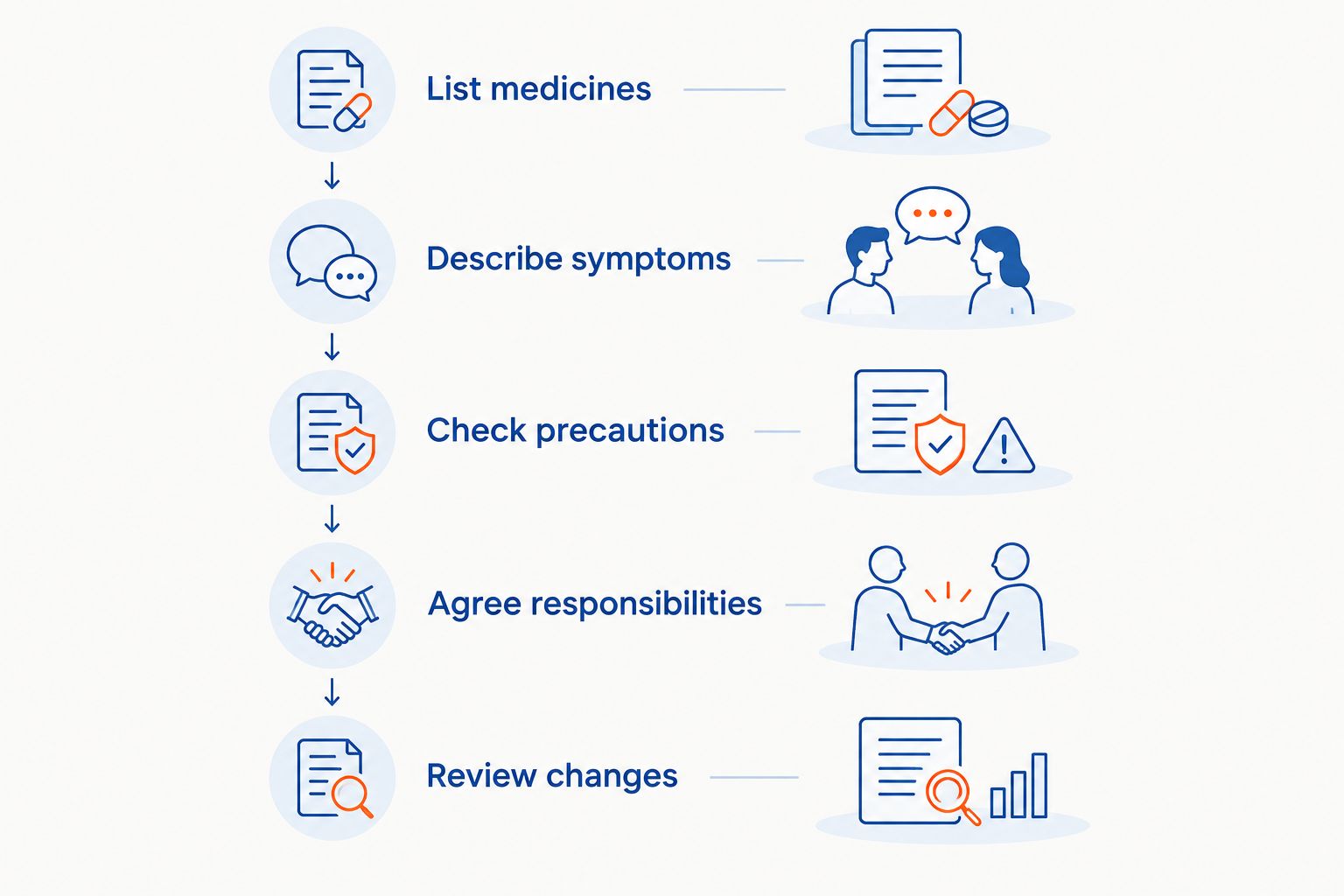
Use a short sequence so that medicine advice and manual-care advice do not become mixed messages. For a 2026 care discussion, keep a written record you can update rather than relying on separate recollections of each appointment.
- List medicines. Record prescribed and non-prescription products, their instructions and how you actually use them. Take the list to each relevant appointment.
- Describe symptoms. Explain when symptoms began, what has changed and which activities are difficult. Include symptoms that do not seem connected to the painful area.
- Check precautions. Ask your pharmacist or prescriber whether your medicines raise any relevant concerns. Ask the chiropractor about the proposed procedure's risks, alternatives and suitability.
- Agree responsibilities. Establish who handles medication questions, who reviews the proposed chiropractic care and what information should be shared with your consent.
- Review changes. Agree what to do if symptoms change, a medicine is changed or you experience a possible adverse effect. Do not assume the original plan still applies.
Bring conflicting advice back to the professionals involved. If one instruction appears to contradict another, ask them to clarify the difference before acting; do not choose whichever instruction sounds more convenient.
Should I stop pain medication before an adjustment?
Do not stop prescribed medication for an adjustment without advice from the prescribing clinician. If you are unsure about an over-the-counter product, ask a pharmacist about that specific medicine and your circumstances.
A request to assess your symptoms does not justify independently changing your medication. Tell the chiropractor what you took and when, so the assessment can be interpreted with that information available.
There is no general instruction to arrive “without painkillers” or to take an extra dose beforehand. If you receive such an instruction, ask which medicine it concerns, the reason for it and whether your prescriber or pharmacist should confirm it.
Can I take pain medication after an adjustment?
Medication after an adjustment requires the same product-specific precautions as medication at any other time. Follow your existing prescription or label instructions and ask a pharmacist or prescriber if you are uncertain. An adjustment is not permission to take an additional dose or combine products.
Do not automatically label new symptoms as expected soreness. Describe what has changed to an appropriate health professional, especially if symptoms are severe, unusual or worsening. Seek urgent medical assessment for the warning signs described below rather than relying on another dose to settle them.
When asking for advice, explain the procedure you had, when symptoms began and which medicines you have already taken. That information is more useful than asking whether any painkiller is generally acceptable after chiropractic care.
Does combining chiropractic care and medication mean I need less medication?
Combining chiropractic care and medication does not establish that you need less medication. Any change should follow a medicine review with the prescribing clinician, taking your condition, response and potential risks into account.
Do not use an appointment, an adjustment or a temporary change in symptoms as a medication-reduction schedule. Some medicines require a planned approach to dose changes. Your prescriber can explain whether that applies to your medicine.
For a 2026 review, bring concrete observations: activities you can manage, symptoms that persist and any suspected adverse effects. Ask what those observations mean for the plan rather than deciding in advance that either medication or appointments must continue.
When should medical assessment come before chiropractic care?
Urgent symptoms need medical assessment, not an adjustment appointment. Australian Healthdirect guidance identifies serious symptoms accompanying back pain that require urgent attention, including new bladder or bowel problems and numbness around the groin or saddle area.
Seek urgent medical care for new or progressive limb weakness, particularly alongside those symptoms. Back pain after significant trauma, or back pain with fever and feeling unwell, also warrants prompt medical assessment rather than assuming it is a routine musculoskeletal problem.
Call 000 for a medical emergency, including severe breathing difficulty or suspected overdose with serious symptoms. Do not drive yourself if a medicine has made you drowsy or otherwise impaired; follow its warnings and obtain appropriate help.
These examples are not a complete screening checklist. If you are uncertain about a new or worsening symptom, contact a medical professional rather than using this article to clear yourself for manual care.
What can you discuss at Mychiro?
Mychiro provides chiropractic care and spinal adjustments in Bondi Junction, Sydney. If you are considering chiropractic care at Mychiro, bring your medicine list and any relevant advice from your pharmacist or prescribing clinician.
Ask whether the proposed care may be appropriate following assessment, what its limitations are and what alternatives you can consider. Chiropractic care does not replace medicine-specific advice, and an assessment does not oblige you to proceed with an adjustment.
Useful questions include: “What information do you need from my GP?”, “What are the risks and alternatives?” and “What would make you recommend medical review instead?” A clear explanation should help you decide without promising a particular result.
FAQ
Can chiropractic care combine with pain medication on the same day?
Same-day use requires individual advice; there is no universal timing rule that establishes suitability. Tell the chiropractor what you took and ask your pharmacist or prescriber about medicine-specific precautions.
Should I tell my chiropractor about non-prescription painkillers?
Yes, include non-prescription painkillers in your medicine list, even if you take them occasionally. Include supplements and other products so the relevant health professionals have an accurate record.
Should I take an extra painkiller before my appointment?
Do not take an extra dose simply to prepare for an appointment. Follow your prescription or label instructions and ask your pharmacist or prescriber if you need clarification.
Can a chiropractor tell me to stop my prescribed pain medicine?
Discuss stopping or changing a prescribed pain medicine with the prescribing clinician. A chiropractic appointment does not replace a medication review.
What if my pharmacist and chiropractor give different advice?
Ask the professionals involved to clarify the advice before acting on conflicting instructions. With your consent, they can share relevant information about the medicine and proposed procedure.
Can I discuss my medicines at Mychiro?
Bring your medicine list when discussing chiropractic care at Mychiro. Direct questions about prescribing, dose changes and medicine interactions to your prescribing clinician or pharmacist.
Does less pain mean I can stop my medication?
Less pain alone does not establish that you should stop medication. Ask your prescriber how changes in symptoms should inform your medicine plan.
One last thing
Write down the active ingredient, not just the packet name. Different branded products can contain the same ingredient, so the packaging name alone is not enough for a medicine discussion. Ask your pharmacist to check any uncertainty before combining products.
Keep your 2026 medicine record current whenever instructions change. The useful next step is an accurate list and clear professional advice—not automatically adding an adjustment or removing a medicine.
Related guides
- What to expect from spinal manipulation
- How chiropractors coordinate with GPs on imaging referrals
- How to combine chiropractic care with physiotherapy in one plan