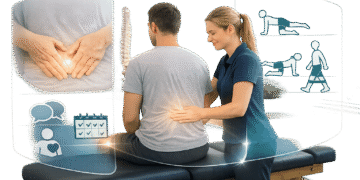

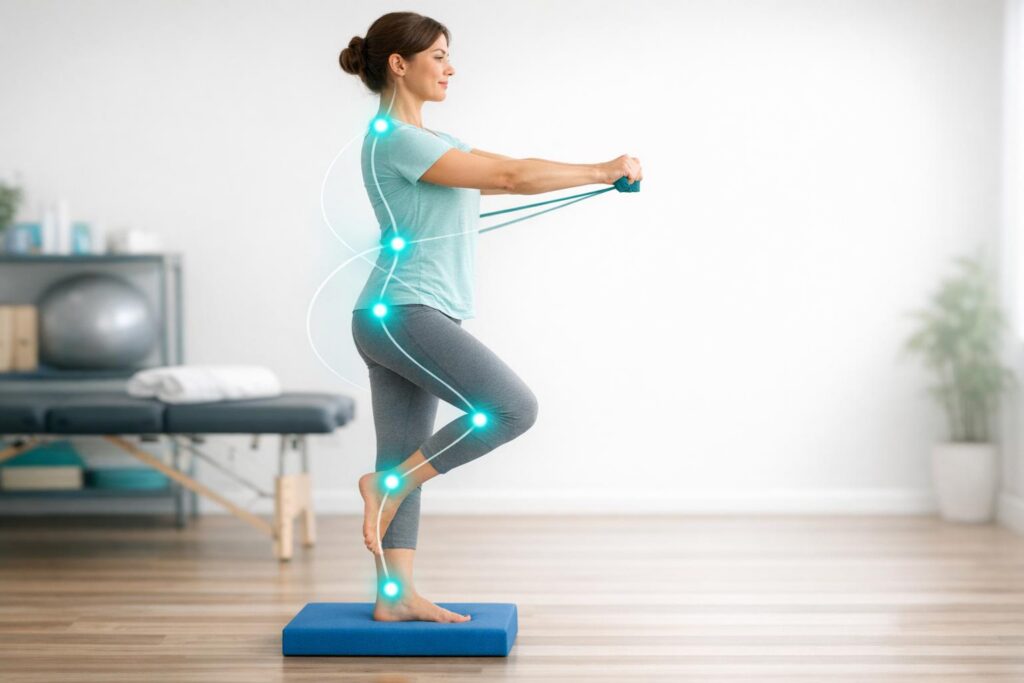
Neuromuscular re-education (NMR) can help reduce chronic pain by addressing poor movement patterns and improving muscle coordination. It retrains how the brain communicates with muscles, focusing on timing, force, and proper alignment instead of just muscle strength. This approach can lead to better movement, less pain, and improved daily function.
Key Points:
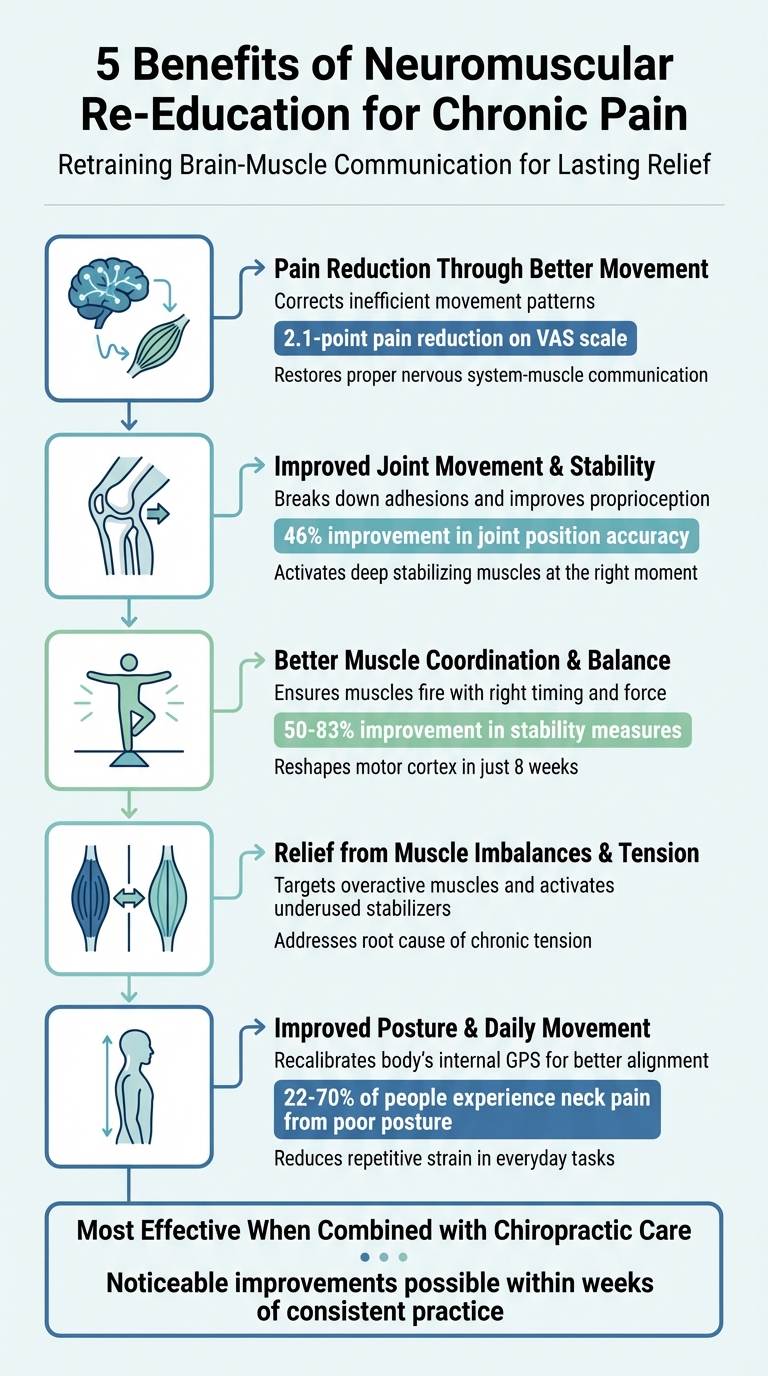
- Pain Reduction: Corrects inefficient movement patterns to ease chronic pain.
- Joint Stability: Breaks down adhesions and improves proprioception for smoother motion.
- Muscle Coordination: Restores proper muscle timing and balance for safer movements.
- Reduced Tension: Targets muscle imbalances to relieve stiffness and prevent re-injury.
- Posture Improvement: Recalibrates body awareness to support better alignment in daily tasks.
This therapy is especially effective when combined with chiropractic care, offering a tailored approach to managing chronic pain. Regular practice can lead to noticeable improvements in movement and quality of life within weeks.
5 Benefits of Neuromuscular Re-Education for Chronic Pain Relief
Neuromuscular Re education
sbb-itb-585d67d
1. Reduced Pain Through Better Movement Patterns
Chronic pain often lingers not because of ongoing tissue damage but due to inefficient movement patterns. Over time, the brain’s motor cortex can experience "smudging" – a form of neural reorganisation that disrupts precise control over body movements. Neuromuscular re-education targets this issue, helping to restore proper communication between the nervous system and muscles. By refining these connections, it can lead to noticeable pain relief, as recent studies suggest.
Take, for example, a randomised controlled trial from August 2021 in Tehran. Researchers Ehsan Alvani, Hossein Shirvani, and Alireza Shamsoddini focused on military personnel suffering from chronic non-specific low back pain, a condition responsible for about 20% of musculoskeletal disorder-related disabilities in this group. Participants in the intervention group engaged in 60-minute neuromuscular exercise sessions three times a week for eight weeks. These sessions included movements like the McGill curl-up, bird-dog stretches, and "Tai Chi Warrior" stances. The results? A 2.1-point reduction in pain intensity (measured on the Visual Analogue Scale) and a 7-point improvement on the Oswestry Disability Index. Additionally, participants showed improvements in balance and reduced proprioception errors.
"A brain that is constantly processing a pain experience does not have the opportunity to maintain circuitry for fine motor control, postural control, language, and even emotions." – Jo Nijs et al., Pain in Motion Research Group
This research highlights how neuromuscular re-education can alleviate pain by correcting inefficient movement patterns. When muscles and joints are used in proper alignment, physical strain decreases. Adopting a time-contingent approach – performing exercises for a set duration regardless of discomfort – can help retrain the body to move more safely and efficiently. This strategy may also interrupt the nervous system’s pain pathways, promoting a smoother recovery and better overall movement.
2. Improved Joint Movement and Stability
Chronic pain doesn’t just limit joint movement because of the initial injury – it also leads to the build-up of scar tissue and cross-fibre adhesions over time. These adhesions act like roadblocks, stopping joints from moving smoothly and fully. Neuromuscular re-education aims to break down these adhesions through deep manual therapy, helping to restore the tissue’s natural length and tension. But here’s the catch: removing these physical barriers is just the beginning. The brain also needs to relearn how to use this newly available range of motion effectively. This step is crucial for improving proprioception, which is the body’s ability to sense joint position and movement.
Proprioception plays a vital role in joint stability. When chronic pain disrupts sensory feedback, joints become more prone to instability and further injury. Research suggests that proprioceptive training can improve joint position sense accuracy by about 46%. Additionally, motor control exercises have been shown to improve stability measures by anywhere from 50% to 83%.
Another key focus of neuromuscular re-education is activating deep stabilising muscles, like the multifidus and transversus abdominis. These muscles are designed to engage milliseconds before movement even starts. This precise timing is critical for maintaining joint stability. A physical therapist from GoodHands Physical Therapy explains it best:
"Traditional PT asks ‘Can this muscle contract strongly?’ Neuromuscular re-education asks ‘Can this muscle contract at exactly the right moment, with exactly the right force, in perfect coordination with surrounding muscles?’"
This shift from strength alone to timing and coordination reduces strain on joints and avoids compensatory movement patterns that could prolong pain. The process taps into neuroplasticity – the brain’s ability to rewire itself – to better coordinate muscle activation.
The benefits of improved joint stability don’t stop at the clinic. Home exercises can build on these gains, ensuring long-term stability. Adding proprioceptive challenges like balance boards or foam pads to your routine can make simple exercises more effective. Mirrors or video feedback can also be incredibly useful for spotting and correcting poor movement patterns on the spot. These tools reinforce the brain’s new neural pathways, supporting stable and pain-free joints in everyday life.
3. Better Muscle Coordination and Balance
Improving movement patterns and joint stability is only part of the picture. Muscle coordination plays a huge role in achieving efficient, balanced movement. Chronic pain can throw a wrench into the connection between your brain and muscles, leading to inefficient movement patterns that often linger long after the initial injury has healed. Neuromuscular re-education taps into the brain’s ability to adapt – known as neuroplasticity – to help restore these connections.
This approach ensures that muscles fire at the right time, with the right amount of force, and in sync with surrounding muscles. Why does this matter? When pain disrupts this timing, superficial muscles tend to take over, resulting in awkward and overly cautious movements. This not only feels unnatural but also increases the likelihood of re-injury.
The science backs it up. Studies show that targeted neuromuscular training can reshape motor cortex organisation in as little as eight weeks. Proprioceptive training, which helps your body regain its sense of limb positioning, can improve joint position accuracy by about 46%. Meanwhile, motor control exercises can enhance stability by 50% to 83%, and functional balance tests often show gains of 45% to 60%.
These aren’t just clinical numbers – they translate into real-world benefits. Using tools like mirrors or video feedback during exercises allows your brain to see and correct inefficient movement patterns. This kind of practice can make everyday activities safer and more fluid, whether you’re carrying groceries, playing with your kids, or walking on uneven footpaths.
4. Relief from Muscle Imbalances and Tension
Once joint stability and coordination improve, the focus shifts to tackling muscle imbalances to ease chronic tension and pain. These imbalances often occur when certain muscles become overactive while deeper stabilising muscles, like the multifidus, remain underused. This mismatch can lead to awkward compensatory movements, increasing the risk of further injury over time.
One effective method to address this is neuromuscular re-education, which uses deep manual therapy to target cross-fibre adhesions and scar tissue within muscles. These adhesions, sometimes lingering for years after an injury, can lock muscles into a state of chronic tension. By applying firm, precise pressure, practitioners work to restore the natural texture, length, and tension of these muscles. This can be particularly helpful for persistent stiffness in areas like the neck, shoulders, or lower back.
A crucial part of this process involves retraining neural pathways to restore balance between muscle groups. The goal is to activate the underused deep stabilisers while calming overactive superficial muscles that often cause spasms. This targeted approach goes beyond just stretching tight muscles or strengthening weak ones, addressing the root cause of chronic tension more effectively.
It’s important to resolve these adhesions before exploring other treatments. For example, attempting joint manipulation without first addressing restricted soft tissue can sometimes worsen the issue. While the process may cause mild tenderness as adhesions break down, this is a normal and temporary step in the healing journey.
5. Improved Posture and Daily Movement
Neuromuscular re-education doesn’t just ease muscle tension – it also helps rebuild proper posture and improve how you move throughout your day. Chronic pain can disrupt the brain’s control over posture, a phenomenon sometimes called "smudging" in the motor cortex. This can lead to habits like slouching in your chair, awkward lifting techniques, or a persistent forward head posture.
This method works by recalibrating your body’s "internal GPS" – the proprioceptive system that helps you sense your joints’ positions. With better awareness, you can move more efficiently during everyday tasks like reaching for something, bending to pick up an object, or maintaining proper alignment while sitting at your desk. This can cut down on repetitive strain from poor movement patterns.
Another key focus is activating deep stabilising muscles, such as the transversus abdominis and multifidus, which naturally engage to support the spine. Through task-specific training, you learn to use these muscles correctly during activities like lifting, sitting, or walking. Research shows that with consistent practice, you can make noticeable improvements in motor control.
For example, between 22% and 70% of people experience neck pain, often linked to poor posture during desk work. Neuromuscular re-education targets these compensatory patterns, promoting neutral spinal alignment to reduce the strain that builds up over the workday.
Practitioners often use visual feedback, like mirrors or video, to help you spot and correct poor movement patterns. Some also include "motor imagery", where you mentally rehearse movements to improve your execution. These techniques help bridge the gap between isolated exercises and real-world movements.
When combined with chiropractic care, these posture improvements create a solid foundation for better movement in daily life.
Combining Neuromuscular Re-Education with Chiropractic Care
Pairing neuromuscular re-education with chiropractic care can bring a more comprehensive approach to managing chronic pain by addressing both movement patterns and joint function.
Neuromuscular re-education works on retraining the communication between your brain and muscles, while chiropractic adjustments focus on restoring joint mobility and spinal alignment. Together, these methods tackle two key aspects of chronic pain: mechanical restrictions in the joints and faulty movement patterns. This combination can provide a more holistic strategy for pain relief.
The order of treatment plays a crucial role. Soft tissue adhesions should be addressed before spinal manipulations to maximise effectiveness. As highlighted by Team PainAssist, "the adhesions in the muscles, tendons, etc. should be treated first before doing any manipulation." Neuromuscular techniques can help release these restrictions, preparing the body for chiropractic adjustments and potentially making them safer and more effective.
Research supports this integrated approach, showing that combining nervous system education with motor control training can lead to greater pain reduction than using either method alone. This is particularly important for those with chronic pain, where the brain may develop "central sensitisation", a state of heightened sensitivity to pain signals. Chiropractic care provides mechanical input to the nervous system, while neuromuscular re-education works on correcting motor control issues that often accompany this condition.
For example, Dr Steve in Bondi Junction offers chiropractic care focused on the nervous system, which can complement movement retraining as part of a personalised treatment plan. By addressing joints, soft tissue, and neural pathways together, this integrated approach helps reduce the likelihood of falling back into old, compensatory movement patterns.
The ultimate aim is lasting improvement, not just short-term relief. When your joints move freely and your nervous system effectively coordinates muscle function, maintaining better posture and movement quality becomes much more achievable. This builds on the improved movement and posture discussed earlier, creating a foundation for long-term change.
Conclusion
The techniques covered here illustrate how neuromuscular re-education works hand-in-hand with musculoskeletal care to address chronic pain. By retraining movement patterns, improving muscle coordination, and enhancing joint stability, this approach offers a way to alleviate chronic pain without simply masking its symptoms.
Studies show that targeted neuromuscular training can lead to noticeable changes in motor cortex organisation within just eight weeks of consistent practice. This underscores the brain’s remarkable ability to adapt and rewire itself.
Because chronic pain is complex, it’s essential to have a thorough evaluation by a qualified healthcare professional – such as a chiropractor or physiotherapist – who can create a personalised treatment plan. As Jo Nijs and colleagues from the Pain in Motion Research Group emphasise:
"In the treatment of CSP [Chronic Spinal Pain], it is crucial not to initiate motor control training before the patient has adopted adaptive pain beliefs."
Achieving success often involves a combination of supervised sessions and regular home exercises to strengthen new neural pathways and reduce the risk of setbacks. This integrated strategy forms the foundation for better movement and lasting pain relief.
If chronic pain is affecting your life, and you’re looking for a natural, evidence-based approach, consulting a qualified healthcare provider can help you explore whether this method aligns with your needs.
This information is general and does not replace professional medical advice. Chiropractic care focuses on musculoskeletal health, and individual results may vary. Always consult a qualified healthcare provider before making decisions about your health.
FAQs
What does neuromuscular re-education involve?
Neuromuscular re-education works to rebuild the connection between muscles and nerves, aiming to improve movement and coordination. Through specific, targeted exercises, it helps retrain movement patterns, refine motor control, and tackle challenges like soft tissue adhesions. This approach encourages the body’s natural healing processes, promoting better mobility, balance, and overall movement efficiency. It can also play a role in managing chronic pain by addressing underlying dysfunctions.
How long does it take to notice changes?
Changes resulting from neuromuscular re-education typically require consistent treatment over several weeks. While some studies indicate that noticeable progress may emerge around the eight-week mark, the timeframe can differ significantly from person to person.
Is chiropractic care safe?
Chiropractic care is widely regarded as safe when carried out by a properly qualified practitioner. Methods such as neuromuscular re-education aim to enhance movement and posture, potentially benefiting overall musculoskeletal health. However, it’s essential to consult with a healthcare professional to assess whether chiropractic care aligns with your individual needs and circumstances.