

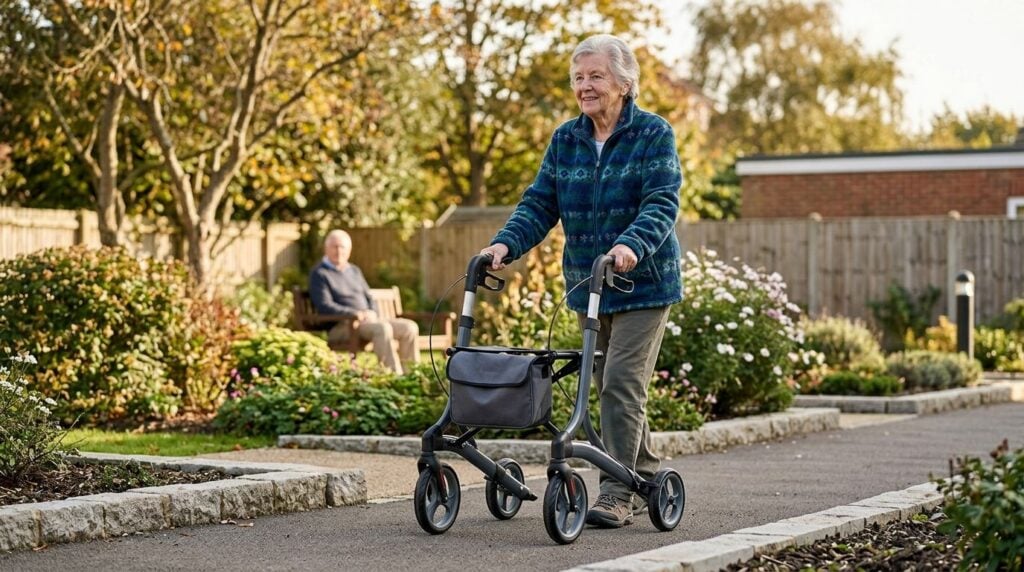
Choosing between a cane, a walker and a rollator comes down to how much stability you need and where you'll use the aid most. A four-wheel rollator suits most older adults managing back pain and mild balance changes in 2026, a standard pick-up walker suits higher fall risk after surgery or a recent fall, and a single-point cane suits people who mainly need light reassurance on familiar ground.
- A four-wheel rollator is the best walking aid for elderly back support for most active seniors managing balance and posture together.
- A standard walker without wheels gives the most stability but is heavier and harder to manoeuvre through doorways.
- Quad canes and single-point canes suit mild to moderate balance changes, not significant fall risk.
- Height fit matters more than brand — a poorly adjusted aid can add strain to the lower back instead of easing it.
- Sudden or worsening balance loss should be checked by a GP or chiropractor before buying any walking aid.
Why this matters
Back pain and balance changes tend to show up together as people move through their 60s, 70s and 80s, and the wrong walking aid can make both worse rather than better. A cane set too low forces you to stoop forward, loading the lumbar spine with every step. A walker that's too heavy to lift over a kerb gets left in the hallway within a fortnight.
The right aid does two jobs at once in 2026: it widens your base of support to reduce fall risk, and it keeps your spine in a more neutral position while you walk. Getting the fit and type wrong undermines both. If balance changes have come on suddenly, that's worth raising with a GP or chiropractor before you buy anything — see how to improve balance and prevent falls as you age for background on what typically drives balance decline.
What makes the best walking aid for elderly back support
- Correct height fit — canes should sit at wrist-crease height with the elbow slightly bent; walkers should sit at hip level
- Base of support — three or four points of contact reduce tip risk more than a single-point cane
- Grip and handle design — ergonomic handles reduce strain on the wrist and shoulder over a full day of use
- Device weight — lighter frames are easier to lift and carry but usually trade off some stability
- Terrain fit — wheeled aids roll better outdoors; non-wheeled walkers grip better on slick indoor floors
- Foldability and storage — aids that fold flat are easier to fit in a car boot or narrow hallway
Walking aids at a glance
| Aid | Best for | Standout feature | Key limitation |
|---|---|---|---|
| Four-wheel rollator | Outdoor stability and stamina | Built-in seat for rest breaks | Bulkier to store and lift into a car |
| Standard pick-up walker | Maximum stability after a fall or surgery | Four fixed points of ground contact | Slower gait pattern, no wheels to roll |
| Two-wheel front walker | Indoor mobility in tight spaces | Front wheels glide through doorways | Less stable on outdoor kerbs and gravel |
| Quad cane | One-sided weakness or moderate imbalance | Wider base than a single-point cane | Bulkier and heavier than a standard cane |
| Single-point cane | Mild balance support, still walking independently | Lightest and most portable option | Minimal support if a fall risk is more than mild |
| Trekking or stability poles | Maintaining fitness on daily walks | Engages the arms for a more upright posture | Not a substitute for a walker if balance is compromised |
1. Four-wheel rollator: best walking aid for outdoor stability and stamina
A rollator has four wheels, hand brakes and usually a fold-down seat, which makes it the aid most older adults reach for when they're managing both back discomfort and general balance changes together. The seat matters more than it looks — being able to sit down mid-walk reduces the temptation to keep pushing through fatigue, which is when posture tends to slip and the lower back takes the load.
Rollator pros:
- Rolls smoothly over footpaths, ramps and shopping centre floors
- Built-in seat allows rest breaks without finding a bench
- Hand brakes give control on slight inclines
- Basket or pouch attachments carry small items hands-free
Rollator cons:
- Heavier and bulkier than a cane, harder to lift into a car boot
- Wheels can roll away on uneven ground if brakes aren't engaged
- Not ideal for narrow indoor hallways or tight bathrooms
Best for: older adults who walk regularly outdoors and want a seat option built in. Verdict: recommended for most active seniors managing back pain and mild balance changes together in 2026.
2. Standard pick-up walker: best walking aid for maximum stability after a fall or surgery
A standard walker has four legs with no wheels, so you lift and place it with each step. That slower, deliberate movement is exactly why it's often suggested following a fall, a hip or knee procedure, or a period of higher fall risk — four fixed points of ground contact offer more resistance to tipping than any wheeled aid.
Standard walker pros:
- Maximum stability of any aid on this list
- No wheels to roll unexpectedly on sloped or wet surfaces
- Widely available through pharmacies and equipment suppliers
Standard walker cons:
- Slower gait, since the frame must be lifted rather than rolled
- Harder to manoeuvre through doorways and around furniture
- Can be tiring on the shoulders over longer distances
Best for: people recovering from a fall, fracture or surgery who need the highest level of stability while mobility improves. Verdict: recommended following a fall or surgery, ideally after a GP or physiotherapist has reviewed your gait.
3. Two-wheel front walker: best walking aid for indoor mobility in tight spaces
This version has two wheels on the front legs and rubber tips on the back, giving a smoother, more continuous gait than a standard walker while still offering more resistance than a full four-wheel rollator. It suits people who spend most of their day at home navigating hallways, kitchens and bathrooms.
Two-wheel walker pros:
- Glides more smoothly than a lift-and-place walker
- Narrower turning circle than most rollators
- Rear rubber tips add resistance on slick indoor flooring
Two-wheel walker cons:
- Less stable outdoors on kerbs, gravel or grass
- No seat option in most models
- Still requires enough grip strength to steer with two wheels moving
Best for: people who need an aid mainly indoors, in apartments or homes with tighter floor plans. Verdict: a solid indoor option, worth pairing with a rollator for outings.
4. Quad cane: best walking aid for one-sided weakness or moderate imbalance
A quad cane has four small feet arranged in a wider base than a standard cane, giving noticeably more side-to-side stability. It's commonly discussed for people managing weakness or reduced sensation on one side of the body, where a single point of contact isn't enough support.
Quad cane pros:
- Wider base offers more stability than a single-point cane
- Stands upright on its own when set down
- Adjustable height on most models
Quad cane cons:
- Heavier and bulkier to carry than a standard cane
- Four feet need a flat surface to sit evenly — awkward on uneven ground
- Can feel unwieldy for people with limited grip strength
Best for: people with weakness affecting one side who need more support than a single-point cane provides. Verdict: situational — worth discussing with your GP or physiotherapist first, since the right base width depends on the specific balance issue.
5. Single-point cane: best walking aid for mild balance support while walking independently
A single-point cane is the lightest and most familiar option, offering a small amount of extra contact with the ground for people who are largely steady but want reassurance on stairs, uneven footpaths or longer outings.
Single-point cane pros:
- Lightest and most portable aid on this list
- Inexpensive and widely available
- Easy to fold or hook over an arm when not in use
Single-point cane cons:
- Minimal support if balance changes are more than mild
- Easy to use on the wrong side or at the wrong height, which can strain the back and shoulder
- No seat or storage features
Best for: people who are largely steady on their feet but want light support for longer walks or uneven ground. Verdict: fine for mild support — skip it and step up to a quad cane or walker if balance changes are more noticeable.
6. Trekking or stability poles: best walking aid for maintaining fitness on daily walks
A pair of adjustable poles used two-handed encourages a more upright posture than a single cane and engages the arms during a daily walk, which some older adults prefer over a single-sided aid. They're better suited to people without significant balance impairment who are walking for fitness and general mobility rather than fall prevention.
Stability poles pros:
- Encourages a more upright, symmetrical posture than a one-sided cane
- Engages the upper body during the walk
- Lightweight and easy to pack for travel
Stability poles cons:
- Two hands are occupied, which rules out carrying bags easily
- Not a substitute for a walker or rollator if balance is genuinely compromised
- Takes some practice to use both poles in rhythm
Best for: older adults walking regularly for fitness who want extra postural support rather than fall-risk mitigation. Verdict: a reasonable choice for active seniors without significant balance impairment; skip if you've had a recent fall.
How we ranked these
Each aid was matched against the six criteria above — fit, base of support, grip design, weight, terrain and storage — rather than ranked on a single scale, because a rollator that's excellent outdoors is the wrong choice for someone navigating a small apartment. The ranking reflects distinct use cases rather than a single best-to-worst order.
Which walking aid should you choose?
If you're unsure where to start in 2026, a four-wheel rollator covers the widest range of everyday situations for someone managing back pain alongside mild balance changes — it rolls, it has a seat, and the four-point base reduces tip risk without the bulk of a full standard walker. Step up to a standard pick-up walker if you've had a recent fall or surgery and stability matters more than speed. Step down to a single-point cane only if you're genuinely steady and just want light reassurance.
Whatever you choose, get the height checked rather than guessing — a cane or walker set even a few centimetres wrong can add strain to the lower back instead of reducing it. Ongoing stiffness in the hips, knees or spine that affects your gait is also worth raising separately; see chiropractic care for seniors with joint stiffness for related reading, and if a fracture history is part of the picture, chiropractic care for osteoporosis patients covers bone health considerations that can affect walking aid choice.
Discuss your posture and mobility
MyChiro in Bondi Junction can talk through gait and back concerns following an assessment.
FAQ
What’s the best walking aid for elderly back support?
A four-wheel rollator suits most older adults managing back pain alongside mild balance changes in 2026, because it combines a wide base of support with a seat for rest breaks. People with higher fall risk after surgery may be better matched to a standard pick-up walker instead.
Is a rollator better than a cane for balance?
A rollator offers more stability than a single-point cane because it has four points of ground contact instead of one. A cane is better suited to mild balance changes where full independence in walking is otherwise intact.
How do I know if I need a walking aid?
Frequent stumbling, reluctance to walk outdoors, or holding onto furniture and walls around the house are common signs worth raising with a GP or chiropractor. A formal gait assessment can identify which type of aid, if any, actually fits the issue.
What height should a walking cane be?
A cane should sit at wrist-crease height when your arm hangs naturally by your side, with a slight bend at the elbow when holding the handle. A cane set too low forces forward stooping, which adds strain to the lower back.
Can a walking aid help with lower back pain?
A correctly fitted walking aid can reduce the load on the lower back by improving posture and widening the base of support during walking. An incorrectly fitted aid can do the opposite, so getting the height and type checked matters more than the brand.
Are quad canes better than single-point canes?
Quad canes offer a wider base and more side-to-side stability, which suits people managing weakness on one side of the body. Single-point canes are lighter and better suited to mild balance support rather than significant instability.
Should I see a chiropractor or GP before choosing a walking aid?
Sudden or worsening balance changes are worth a GP assessment first to rule out an underlying cause. A chiropractor can be part of an ongoing conversation about posture, joint stiffness and gait once any red-flag issues have been assessed.
How often should a walking aid be reassessed?
Height and fit are worth rechecking any time footwear changes significantly or after a change in weight or posture. Reviewing the aid annually, or sooner after a fall, keeps the fit matched to current needs.
One last thing
The single detail most people skip: rubber ferrule tips on canes and walkers wear down faster than they look like they do, and a worn tip is one of the most common causes of an unexpected slip in 2026. Check the tread on the tip every few months, the same way you'd check a shoe sole — it's a five-second look that matters more than any feature on the frame itself.
Related guides
- Chiropractic care for seniors with joint stiffness
- Best walking shoes for people with lower back pain
- How to manage joint stiffness as you age