


Start with a lace-up work boot when you want adjustable fastening; compare side-zip boots for access, elastic-sided boots for pull-on use, wide-fit boots for forefoot room, and removable-footbed boots for an existing prescribed insert. These are footwear choices, not recommendations for managing back pain: assess fit and workplace requirements separately from your symptoms.
- Mychiro’s work boot guide helps tradies compare footwear features without promising changes in back pain.
- Lace-up work boots suit adjustable fastening; side-zip work boots add another way to put boots on.
- Compare toe room, heel fit, fastening and documented workplace protection before choosing a pair.
- Discuss persistent back or foot pain with a qualified health professional rather than relying on footwear claims.
Why this matters
Searching for work boots for back pain combines two different decisions: choosing suitable work footwear and deciding whether your symptoms need assessment. A boot’s fit, fastening and protective features do not establish what is causing your pain.
For your 2026 shortlist, describe your work before comparing footwear. Include the surfaces, tasks, protective equipment requirements and socks you actually use, rather than choosing from a comfort slogan alone.
Mychiro is a chiropractic clinic and wellness centre in Bondi Junction, Sydney. This work boot guide provides a shopping framework, not an individual footwear prescription or a recommendation for chiropractic adjustments.
What to look for in work boots
Use these six criteria before considering the options below. A boot that misses a mandatory workplace requirement should leave your shortlist, regardless of how it feels in the shop.
- Workplace requirements: Ask your employer or site supervisor which protective features and documentation apply to your role.
- Toe-box fit: Check the space around your toes, including the shape of any protective cap.
- Heel fit: Notice slipping, rubbing or pressure while you walk and turn.
- Adjustable fastening: Decide whether you need to change tension across the top of your foot.
- Insert compatibility: If you already use a prescribed insert, check it inside the actual boot rather than assuming compatibility.
- Task compatibility: Consider kneeling, crouching, climbing and driving where these are part of your work and permitted during fitting.
Treat fit as something to check, not something a label guarantees. Terms such as comfort, anatomical and supportive do not tell you whether a particular boot suits your foot or your job.
Work boot options at a glance
These categories overlap: a wide-fit boot can also have laces, a side zip and a removable footbed. The order below starts with fastening, then addresses more specific fitting requirements; it is not a ranking of clinical outcomes.
| Work boot option | Suited for | Feature to check | Main limitation |
|---|---|---|---|
| Lace-up work boot | Adjusting fastening across the foot | Position and adjustment of laces | Requires access to the laces |
| Lace-up, side-zip work boot | Using a zip after setting lace tension | Both closures and the fit when closed | Zip access does not establish fit |
| Elastic-sided work boot | Pull-on use without laces | Opening, heel fit and elastic panels | Limited fastening adjustment |
| Wide-fit work boot | Comparing additional forefoot room | Actual internal shape, not just the width label | Extra width does not guarantee toe-cap clearance |
| Removable-footbed work boot | Checking an existing prescribed insert | Available space with the insert fitted | A removable footbed does not guarantee compatibility |
1. Lace-up work boots: for adjustable fastening
A lace-up work boot lets you change fastening tension along the laced area. This gives you a way to compare different settings during a fitting rather than accepting one fixed opening.
Start here if you want to adjust how the boot closes over your foot. Do not assume that tightening the laces compensates for an unsuitable size or shape.
Lace-up work boot pros:
- You can loosen or tighten the laced area.
- You can reopen the fastening fully for another fitting attempt.
- You can compare tension settings while wearing your work socks.
Lace-up work boot cons:
- Putting the boot on requires managing the laces.
- Loose lace ends need securing before work.
- Fastening adjustment cannot change the protective cap’s internal shape.
Suited for: Tradies who want control over fastening tension and can comfortably reach the laces.
During your 2026 fitting, walk and turn with the laces secured as you intend to wear them. If the boot only feels acceptable when left unusually loose, compare another size or shape rather than assuming the fastening solves the mismatch.
Verdict: Hold until the fit and required protective features are confirmed.
2. Lace-up, side-zip work boots: for another access point
A lace-up, side-zip work boot combines adjustable laces with a zip opening. You can set the laces, then check whether the zip gives you a practical way to put the boot on and remove it.
Assess both closures. A convenient zip does not tell you whether the boot fits around the heel, instep or toes.
Side-zip work boot pros:
- The zip provides an opening separate from the laces.
- The laces still allow fastening adjustment.
- You can compare access with the zip open and fit with it closed.
Side-zip work boot cons:
- There is another closure to inspect and maintain.
- The closed zip area needs checking for rubbing or pressure.
- Not every side-zip boot has the same opening or internal shape.
Suited for: Tradies who want a zip opening while retaining laces for adjustment.
Try the boot without forcing your foot through the opening. Check that the zip closes normally with your chosen socks and any prescribed insert in place; do not use the zip to pull an overly tight boot together.
Verdict: Hold if access is convenient but the closed boot presses or rubs.
3. Elastic-sided work boots: for pull-on use
An elastic-sided work boot uses stretch panels rather than laces to accommodate entry. Its suitability depends on the boot’s shape and how it fits once your foot is inside.
Choose this category for the pull-on design, not because it carries a general promise about back support. Compare the opening and heel fit carefully.
Elastic-sided work boot pros:
- There are no laces to tie.
- There are no loose lace ends to secure.
- The pull-on design offers a different fastening arrangement to compare.
Elastic-sided work boot cons:
- You cannot adjust tension with laces.
- An opening that is easy to enter does not guarantee a suitable heel fit.
- A close-fitting opening can make putting the boot on difficult.
Suited for: Tradies who prefer pull-on footwear and find a suitable fit without adjustable laces.
Check both boots while walking, turning and performing permitted fitting movements. If you repeatedly grip with your toes to keep a boot in place, or struggle to get your foot through the opening, compare another shape rather than accepting the inconvenience.
Verdict: Skip a pair whose pull-on design comes with an unacceptable fit.
4. Wide-fit work boots: for comparing forefoot room
A wide-fit work boot is an option to investigate when the standard-width version feels cramped. The label is a starting point; you still need to check the space inside the specific boot.
Pay particular attention to the protective cap. A wider upper does not, by itself, establish the amount or shape of room around your toes.
Wide-fit work boot pros:
- It gives you another width option to compare.
- It lets you investigate width without automatically choosing a longer size.
- You can assess forefoot room separately from heel fit.
Wide-fit work boot cons:
- Width labels do not replace an actual fitting.
- Extra forefoot room can coexist with an unsuitable heel fit.
- The protective cap can still feel restrictive.
Suited for: Tradies comparing additional forefoot space while retaining an appropriate overall fit.
For a 2026 comparison, record the exact model and size you try. Do not carry your conclusion about one wide-fit boot across to another model, even when the packaging uses similar wording.
Verdict: Hold until the toes and heel both fit acceptably.
5. Removable-footbed work boots: for an existing prescribed insert
A removable-footbed work boot allows the original footbed to be taken out. That creates an opportunity to check an existing prescribed insert, but it does not establish compatibility.
Bring the insert and any fitting instructions from its prescriber. Ask the footwear manufacturer about permitted modifications and any implications for the boot’s documented protective features.
Removable-footbed work boot pros:
- You can inspect the space beneath the original footbed.
- You can check your existing insert inside the actual boot.
- You can compare the resulting fit before committing.
Removable-footbed work boot cons:
- The boot can still lack sufficient internal space.
- An insert can change how your heel and toes sit inside the boot.
- Compatibility requires more than matching the insert’s length.
Suited for: Tradies who already have a prescribed insert and need to check its fit in work footwear.
Do not assume you should stack an insert over the supplied footbed. Follow the prescriber’s instructions and check the manufacturer’s guidance rather than improvising a combination in the shop.
Verdict: Wait for compatibility advice if the intended arrangement is unclear.
A fitting sequence you can use
Use the same sequence for every shortlisted pair. Keep your 2026 fitting notes focused on observable details rather than a general impression that one boot feels supportive.
- Site requirements: Confirm the required protective features before trying footwear.
- Work socks: Wear the socks you intend to use at work.
- Both boots: Try 2 boots, not just the display boot on one foot.
- Movement check: Walk, turn and try relevant movements where the retailer permits them.
- Fit notes: Record pressure, rubbing, slipping and any questions before choosing.
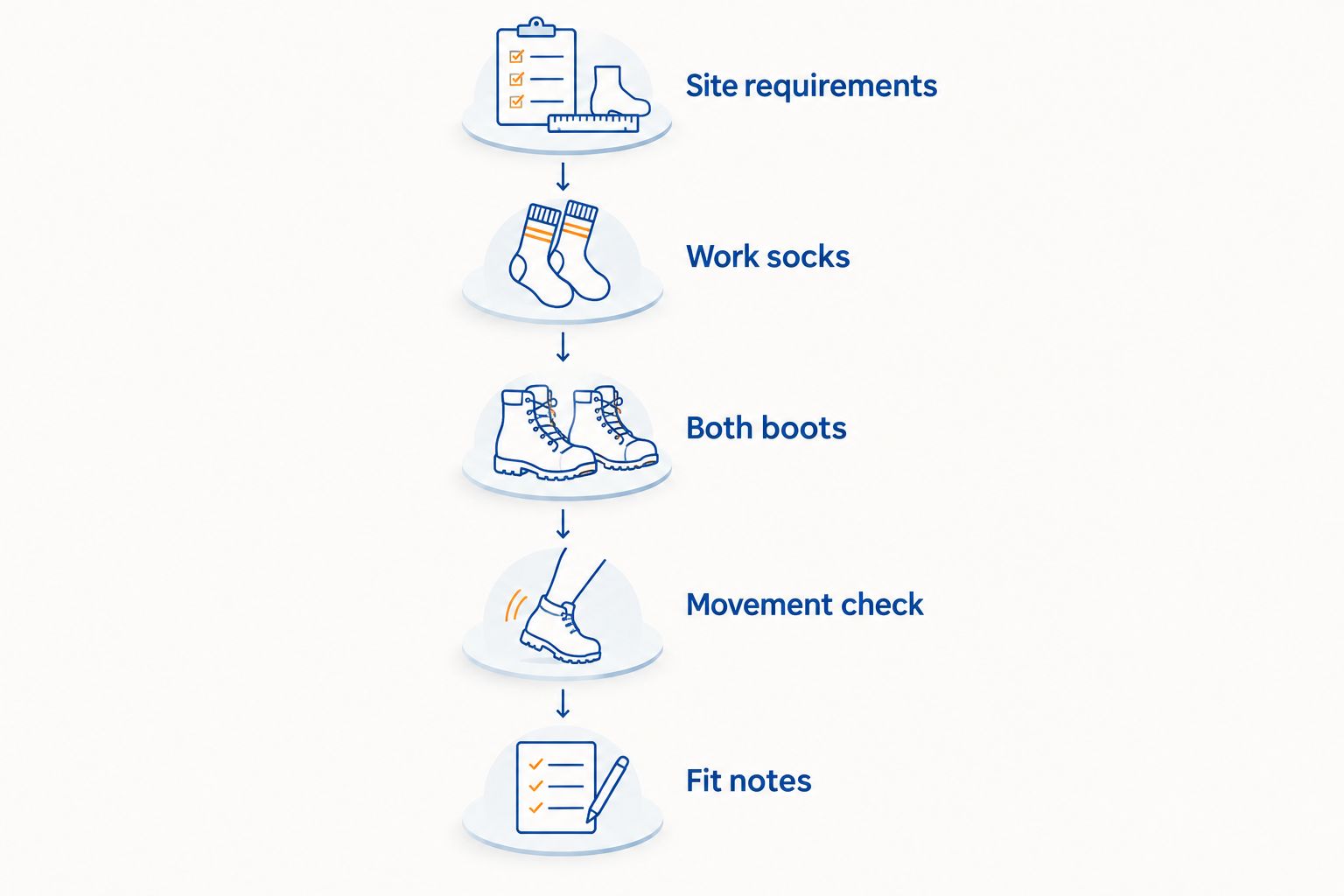
Make 3 checks before leaving: toes, heels and fastening. If you are comparing 2 pairs, repeat the same movements in each rather than judging one while seated and the other while walking.
Do not dismiss pain or marked pressure as proof that a boot needs breaking in. Stop the fitting and reconsider the size, shape or option; a retail fitting is not a clinical assessment.
How these options are ordered
The categories follow a decision sequence: adjustable fastening, alternative access, pull-on use, additional width and existing-insert compatibility. They are not scored for pain relief, and no model-specific testing or clinical comparison is claimed.
Mychiro’s work boot guide separates footwear features from healthcare decisions. Use the table to narrow your shopping questions, not to infer that one category changes spinal alignment or addresses the cause of your symptoms.
Which work boot option should you choose?
If you are undecided, begin by trying a lace-up work boot that meets your site requirements, then compare alternatives against the same fitting checklist. Move to a different category for a specific reason: access, pull-on preference, width or insert compatibility.
For a 2026 purchase, keep the decision grounded in the actual pair. A familiar brand, a supportive-sounding label or a colleague’s preference cannot substitute for checking your own fit and job requirements.
If back or foot pain is persistent, worsening or interfering with daily activities, discuss it with a qualified health professional. Do not postpone that discussion while repeatedly changing boots or adding inserts.
FAQ
Which work boots should I choose if I have back pain?
Choose work boots by workplace requirements and individual fit, rather than assuming a boot category will address back pain. Discuss persistent or worsening symptoms with a qualified health professional.
Are lace-up work boots more suitable than elastic-sided boots?
Lace-up work boots offer fastening adjustment, while elastic-sided boots offer a pull-on design. Compare the actual fit of each rather than treating either closure as a clinical feature.
Should I choose steel or composite toe caps for back support?
Choose protective toe caps according to your workplace requirements and the documentation for the specific boot. Toe-cap material does not establish that a boot will address back pain.
Can I put my prescribed orthotics into work boots?
Check the arrangement with your prescriber and the footwear manufacturer. A removable footbed does not guarantee that your prescribed insert fits or is an appropriate modification.
Should I buy a larger size to get more width?
Compare width options and boot shapes rather than automatically choosing a longer size. Check toe room and heel fit together in both boots.
What should I take when trying on work boots?
Take your work socks, workplace footwear requirements and any existing prescribed inserts with their fitting instructions. Try both boots and use the same movement checks for every pair.
When should I seek advice rather than keep changing boots?
Seek advice from a qualified health professional when pain persists, worsens or interferes with daily activities. Footwear shopping cannot establish the cause of back or foot pain.
One last thing
Check the boot you will actually wear, not just its category. A wide-fit, side-zip boot with a removable footbed still needs the same toe, heel and fastening checks as a plain lace-up pair.
Keep a short note of what did not fit. That gives your next fitting a useful starting point instead of another round of guessing.
Related guides
- Ergonomic setups for shift workers with back pain
- Lower back pain when sitting: causes and practical steps
- How to prepare for your first chiropractor appointment