
A weak core can be one possible contributor to difficulty with physical tasks, but core weakness alone does not establish the cause of lower back pain. Pain, reduced activity and muscle capacity can influence each other, so a short plank hold or tired abdominal muscles cannot diagnose your back problem. The next step depends on your symptoms, daily limitations and whether medical assessment is needed—not simply on doing more abdominal exercises.
- Can a weak core cause lower back pain? Core weakness alone does not establish the cause.
- Mychiro is a chiropractic clinic in Bondi Junction, Sydney; this guide explains core strength without diagnosing your symptoms.
- Core strength, endurance and movement coordination describe different abilities; a plank is not a diagnostic test.
- New bladder changes, saddle numbness or rapidly worsening leg weakness require emergency medical assessment.
Can a weak core cause lower back pain?
Reduced trunk muscle capacity can be relevant to lower back pain, but the relationship is not a simple chain of weak muscles causing pain. Someone with back pain might move less, brace differently or stop exercising; finding reduced strength afterwards does not establish which came first.
An association is not proof of an individual cause. An assessment needs to consider your history and function rather than attach a diagnosis to your appearance, posture or exercise performance.
If you are considering exercise, the guide to strengthening your core without straining your lower back covers a related question. Exercise selection still needs to reflect your circumstances.
| Finding or observation | What it tells you | What it does not establish |
|---|---|---|
| Your abdominal muscles tire during an exercise | That exercise challenges your current capacity | That abdominal weakness caused your pain |
| Your back hurts after sitting | Sitting is associated with your symptoms | That your core has stopped working |
| You find lifting difficult | That task needs further discussion or assessment | Which muscle or structure explains the difficulty |
| You can hold a demanding plank | You can perform that particular task | That every possible cause of back pain is excluded |
The Australian Commission on Safety and Quality in Health Care’s Low Back Pain Clinical Care Standard provides an Australian framework for assessment, information, activity and review. It does not replace an individual examination.
Why this matters
Calling your back “weak” can turn a symptom into an assumption about your whole body. Before accepting that label, ask what was assessed, what the finding means and how it changes the proposed plan.
For this 2026 guide, the practical distinction is between identifying a capacity you might work on and claiming to have identified the cause of pain. Those are different conclusions. You deserve an explanation that makes that distinction clear.
What does a weak core actually mean?
Your core is not just the visible abdominal muscles. It includes muscles around the trunk that participate in movement, breathing and managing physical demands.
In everyday conversation, “weak core” often bundles several abilities together. Ask which ability is being discussed before choosing an exercise programme.
Strength: producing force
Strength describes your ability to produce force against resistance. A clinician might consider it when discussing lifting, carrying or returning to a particular activity.
Difficulty with a task does not automatically identify a strength deficit. Pain, unfamiliarity, confidence and the demands of the task also need consideration.
Endurance: sustaining effort
Endurance describes your ability to sustain or repeat an effort. You might manage a movement initially but find it harder as a task continues.
That observation can inform an assessment, but it is not a diagnosis. There is no universal plank duration that separates a healthy back from a painful one.
Coordination: organising movement
Coordination describes how you organise movement for a task. It is different from producing the greatest possible force or keeping your abdomen tense continuously.
An assessment can explore how you move without assuming there is only one acceptable technique. A movement that needs adjustment for your current symptoms is not necessarily a permanently harmful movement.
Why the relationship between core capacity and pain varies
A useful discussion looks beyond abdominal strength. These factors help explain why people with similar exercise abilities can have different experiences of back pain:
- Task demands: Carrying shopping, working at a desk and lifting at the gym involve different physical demands.
- Recent activity changes: A change in workload or training provides context for when symptoms began.
- Pain-related limits: Pain can affect how much effort you produce during an assessment.
- General health: Your health history and medicines can change which assessments or activities are appropriate.
- Sleep and psychological factors: Sleep difficulties, distress and beliefs about movement belong in a broader pain assessment.
- Symptom pattern: The location, duration and progression of symptoms help determine whether further investigation is needed.
This is part of a biopsychosocial approach: considering physical, psychological and social circumstances together. It does not mean your pain is imaginary or that every factor applies to you.
The useful question is not just whether your core is weak, but whether a particular finding changes what you should do.
How should you approach suspected core weakness?
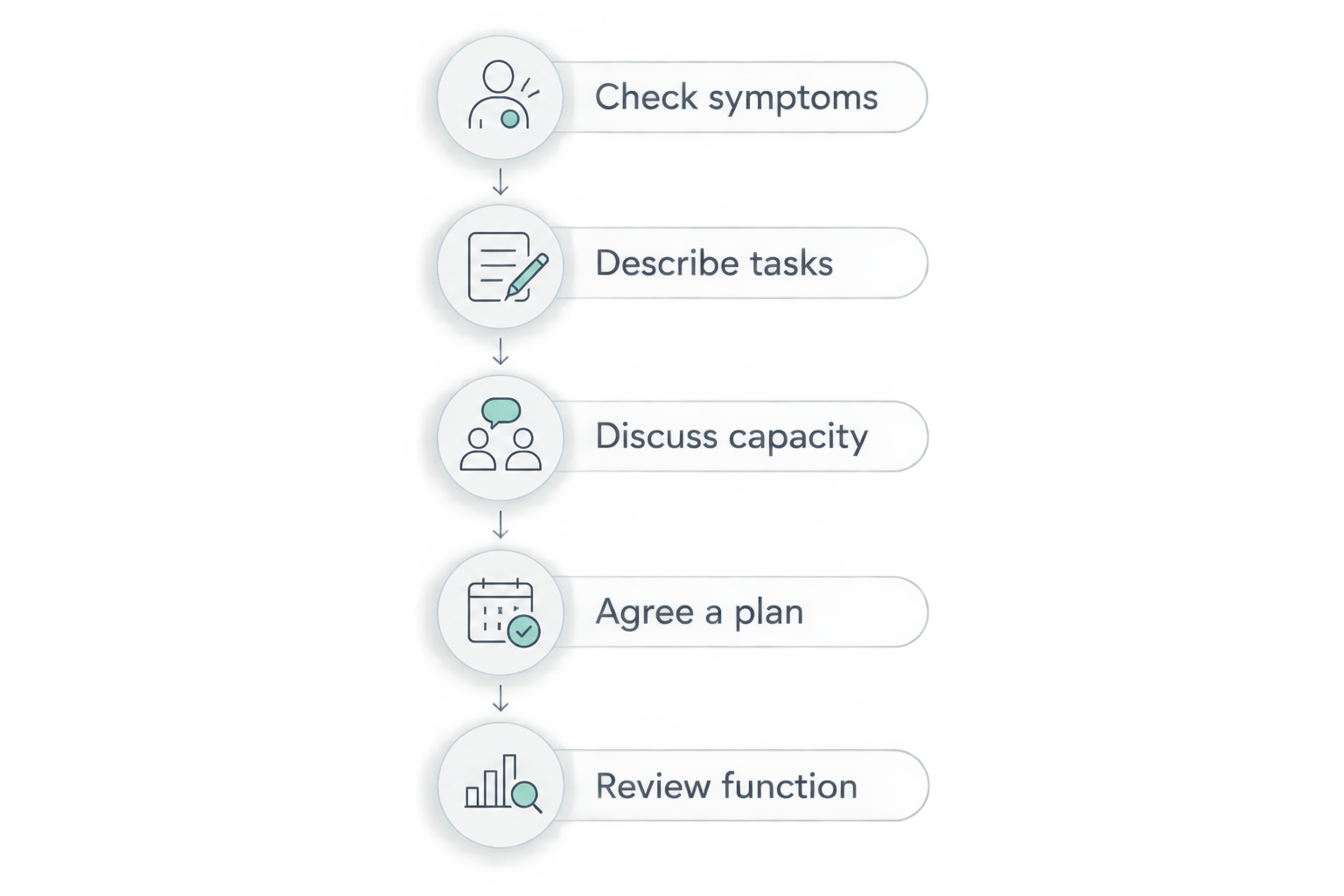
Use the following sequence to prepare for a discussion with a qualified health professional. It is a way to organise information, not a home diagnostic test or an exercise prescription.
- Check symptoms. Note where the pain is, when it began and whether it is changing. Seek medical advice for concerning symptoms rather than testing yourself harder.
- Describe tasks. Identify the activities you are struggling with, such as dressing, walking, sitting or lifting. Describe the limitation rather than guessing which muscle caused it.
- Discuss capacity. Ask whether strength, endurance, coordination or another issue needs assessment. Mention relevant health conditions and previous advice.
- Agree a plan. Ask what each proposed activity is intended to address, what alternatives exist and what would prompt a change.
- Review function. Decide how progress will be assessed using activities that matter to you, not only an exercise score.
For a 2026 appointment, a short written account of your symptoms and goals is more useful than arriving with a self-diagnosis. Include what you have already tried and whether anything changed.
You do not need to perform a maximum-effort plank before seeking advice. A symptom history does not require you to provoke your pain.
Does strengthening your core help lower back pain?
Exercise can form part of care for lower back pain, but that does not mean every person needs isolated core exercises. The Australian Low Back Pain Clinical Care Standard supports advice about activity and self-management within an individually appropriate plan.
The World Health Organization’s guideline on chronic primary low back pain also considers structured exercise within broader care. Its scope is chronic primary low back pain in adults, not every new episode or every possible cause of back pain.
Neither source justifies promising that a particular abdominal exercise will resolve your symptoms. Choosing an exercise and identifying the cause of pain are separate decisions.
How do different activity options compare?
The following comparison explains purposes and limitations, not a ranking. Suitability depends on assessment, preferences and your current circumstances.
| Activity option | What it involves | Potential role to discuss | Limitation |
|---|---|---|---|
| Trunk-focused exercise | Exercises that challenge muscles around the trunk | Addressing an identified trunk capacity goal | Does not establish or address every possible contributor to pain |
| General resistance exercise | Resistance-based movements involving different muscle groups | Working towards broader physical tasks | Exercise choice and loading need individual consideration |
| Walking or other aerobic activity | Sustained movement chosen around your circumstances | Maintaining or rebuilding general activity | Does not specifically assess trunk strength |
| Task practice | Practising an activity relevant to daily life or work | Connecting a plan with a functional goal | The task might need modification or supervision |
Avoid treating an online routine as a compulsory starting point. Ask how an activity fits your goal, what response should prompt adjustment and when the plan should be reviewed.
How do I know whether my core is weak?
You cannot reliably diagnose the cause of lower back pain with a home core test. Difficulty with a plank, sit-up or balance exercise describes performance on that task, not a complete assessment of your back.
A health professional can discuss whether testing is relevant and explain its limitations. Ask how the result would change your care before accepting a label such as “unstable” or “switched off”.
Should I keep my core tight all day?
Keeping your core tightly braced all day is not a general requirement for managing back pain. Instructions for a particular exercise or lifting task should not automatically become rules for every waking moment.
If you have been given a bracing cue, ask when to use it and when to relax. You should understand its purpose rather than feel responsible for monitoring your abdomen constantly.
How long does it take for core exercises to change back pain?
There is no single exercise timetable that predicts an individual’s back pain. Starting symptoms, health history, activity demands and the reason for the programme all affect how a plan is reviewed.
For your 2026 exercise plan, agree on review criteria rather than a promised recovery date. Discuss daily function, tolerability and whether the plan remains appropriate—not just whether you can hold an exercise longer.
When should back pain receive medical assessment?
Do not assume new or worsening symptoms come from a weak core. Seek emergency medical assessment for new loss of bladder or bowel control, numbness around the genitals or anus, or rapidly worsening leg weakness.
In Australia, call 000 for an emergency. These symptoms require medical assessment, not an online exercise routine or a routine chiropractic appointment.
Back pain after significant trauma, with fever or feeling seriously unwell, or alongside a history of cancer also warrants prompt medical advice. These features do not establish a diagnosis, but they change the assessment needed.
If pain persists, worsens or interferes with everyday activities, discuss it with your GP or another appropriately qualified health professional. Mention any new symptoms rather than waiting for a planned exercise review.
Where does chiropractic care fit?
Mychiro is a chiropractic clinic and wellness centre in Bondi Junction, Sydney. Mychiro provides chiropractic care and spinal adjustments; that service description does not establish that an adjustment is appropriate for your symptoms or will strengthen your core.
If you are considering chiropractic care at Mychiro, ask about assessment findings, alternatives, risks and referral where indicated. Do not assume that a chiropractic service replaces medical assessment or an individually appropriate activity plan.
FAQ
Can a weak core cause lower back pain even if I exercise?
Regular exercise does not establish or exclude the cause of lower back pain. Core capacity is only one consideration, and assessment should include your symptoms, health history and daily limitations.
Does a short plank mean my back is unstable?
A short plank does not diagnose spinal instability. Plank performance reflects that particular task and needs interpretation in context.
Should I do sit-ups when my lower back hurts?
Sit-ups are not a compulsory exercise for lower back pain. Discuss exercise selection with a qualified health professional, particularly if the movement brings on or worsens symptoms.
Do I need a scan to check for a weak core?
A scan is not a routine test of core strength. The Australian Low Back Pain Clinical Care Standard advises against routine imaging without a clinical indication; a clinician can explain whether imaging is relevant to your presentation.
What should I ask before starting core exercises in 2026?
Ask what the exercise is intended to address, how it relates to your goals and when to review it. Also ask what symptoms should prompt you to stop or seek further advice.
When should I get urgent help instead of doing core exercises?
Seek emergency medical assessment for new bladder or bowel control changes, saddle-area numbness or rapidly worsening leg weakness. In Australia, call 000 for an emergency.
One last thing
A stronger plank and a clearer explanation of your pain are not the same result. Before starting a programme, write down the everyday activity you want to return to and ask how progress towards it will be assessed.
For your 2026 notes, record the task, what currently limits it and any relevant symptom changes. That keeps the discussion focused on your life rather than an arbitrary exercise target.
Related guides
- Lower back pain when sitting: causes and practical steps
- Returning to exercise after a back injury
- How to prepare for your first chiropractor appointment
- When back pain needs a chiropractor or a doctor