

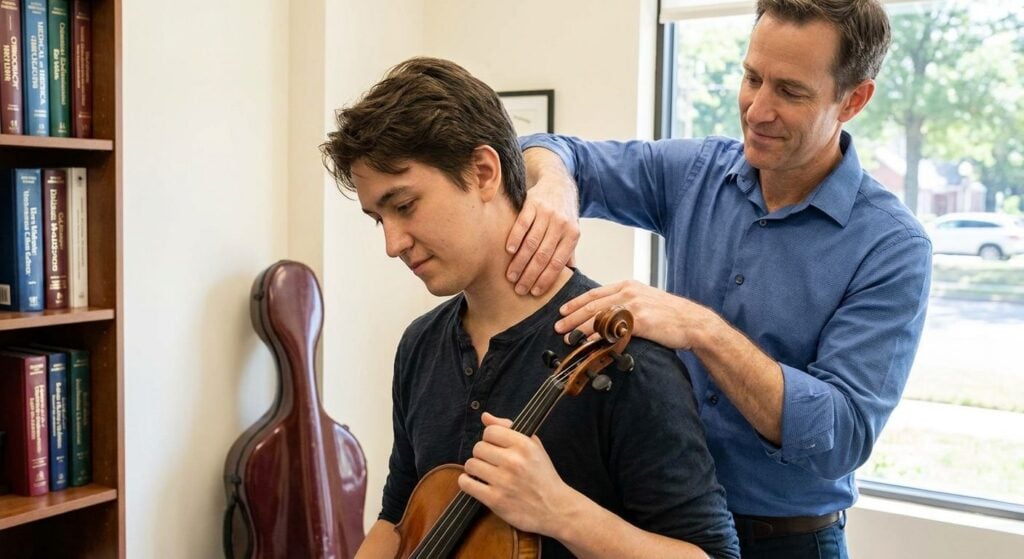
Chiropractic care for musicians deals with the neck, shoulder and upper-back strain that builds from repetitive playing positions, long rehearsal blocks and instrument-specific posture — think a violinist's tilted head, a guitarist's forward hunch or a drummer's rotated torso. Musicians carry loads that are asymmetric and sustained in a way most desk workers never experience, so generic posture advice often misses the specific joints and muscle groups doing the overtime.
- A chiropractor for musicians looks at instrument-specific posture, not generic desk ergonomics — assessment first, plan second.
- Violinists, guitarists and pianists load the neck and shoulders asymmetrically; symmetric stretching routines can miss the actual strain pattern.
- Self-directed posture breaks and targeted stretching are the first step; a chiropractic assessment can be discussed if strain persists into 2026 rehearsal seasons.
- MyChiro in Bondi Junction offers postural assessments that can be booked directly without a GP referral.
- Ignoring early stiffness until a concert or exam is the most common mistake musicians make with neck and shoulder strain.
Why chiropractic care matters for musicians
Musicians hold static, often asymmetric positions for hours — a violinist's head tilt against the chin rest, a cellist's rounded shoulders, a pianist's forward neck lean over a keyboard. These postures repeat daily across practice, rehearsal and performance, and the muscles that stabilise the neck and shoulder blade end up doing isometric work most bodies aren't built to sustain for that long.
Unlike a one-off gym injury, musician strain tends to build slowly across a term or tour schedule and often gets ignored until it interferes with technique. A postural assessment through MyChiro can map which side and which joints are under the most sustained load before a minor ache turns into something that limits practice time.
The difference between a musician's strain and a typical office worker's neck pain is asymmetry and repetition volume — a right-handed violinist loads the left shoulder and neck differently to how a desk job loads both sides roughly evenly. A generalist ergonomic checklist built for office chairs and monitors doesn't account for that.
Step 1: Map your practice posture
Before changing anything, work out where the strain actually sits. Musicians often assume the pain is coming from the instrument hold when it's actually a compensating muscle group further along the chain.
- Film a 5-minute practice session from the side and from behind to see head tilt and shoulder height
- Note which side of the neck or upper back feels tighter at the end of a session
- Track how many hours you practice per day across a typical week in 2026
- Compare posture on your "good" instrument days versus long rehearsal or exam-prep days
- Write down where tension sits immediately after playing versus the next morning
Step 2: Build movement breaks into rehearsal
Static holding is the core issue, so the first fix is simply not holding the position continuously.
- Set a timer for 20-25 minutes and stand, roll the shoulders and drop the chin to chest
- Change practice order so the most physically demanding piece isn't always last when fatigue peaks
- Swap seated and standing practice where the instrument allows it
- Add a short walk between rehearsal blocks longer than 90 minutes
- Avoid stacking back-to-back sessions on the same repertoire without a break day
Step 3: Stretch the muscles your instrument overworks
Generic stretching routines aimed at general stiffness often miss the specific muscles musicians overload — upper trapezius, levator scapulae and the rotator cuff depending on instrument.
- Chin tucks and gentle side-neck stretches for violin, viola and flute players
- Doorway chest stretches for guitarists and pianists who round forward
- Shoulder blade squeezes for drummers and brass players carrying instrument weight
- Overhead reaches similar to the routines in shoulder stretches for repetitive strain, which cover comparable overhead loading patterns
- Wrist and forearm stretches for string and keyboard players, since forearm tension often refers pain up into the shoulder
Step 4: Adjust your instrument setup and seating
Small equipment changes can shift load away from an already strained area.
- Check chin rest and shoulder rest height on string instruments — a chin rest too low forces more neck tilt
- Adjust guitar strap length so the instrument doesn't pull one shoulder forward
- Use an adjustable piano bench height rather than a fixed stool
- Check music stand height so you're not craning the neck down or up to read
- Review case and instrument carrying habits — alternating shoulders for heavy cases reduces one-sided load
Step 5: Strengthen the muscles that support your posture between sessions
Stretching loosens tight muscles; strengthening gives the neck and shoulder blade something to hold posture with when you're not actively thinking about it.
- Scapular retraction exercises to support upright shoulder position
- Deep neck flexor holds, done slowly and without strain
- General postural strength work, similar to the approach in core strengthening routines, which support the trunk that the neck and shoulders sit on
- Light resistance band rows two to three times a week
- Avoid heavy overhead lifting on the same days as long rehearsal blocks
Step 6: Get a postural assessment if strain isn't settling
If strain persists past a few weeks of adjusted posture, breaks and stretching, a chiropractic assessment can be discussed with a qualified health professional to look at spinal alignment, joint mobility and muscle imbalance specific to your instrument. This may be appropriate following a physical assessment rather than assumed from symptoms alone.
- Bring your instrument or describe your typical playing position to the assessment
- Mention practice hours per week and any recent change in repertoire or performance schedule
- Ask what a reassessment timeline might look like if a plan is discussed
- Flag any numbness, tingling or weakness down the arm — these need broader medical assessment, not just postural review
- Keep a symptom diary in the weeks before your appointment so patterns are easier to identify
Step 7: Track flare-ups against your performance calendar
Musicians often notice strain spikes around exams, auditions and tour dates when practice hours jump. Matching a symptom log to your calendar helps identify whether the cause is volume, a specific piece, or posture drift under pressure.
Comparison of options for musicians managing neck and shoulder strain
| Option | Best for | Key limitation |
|---|---|---|
| Self-directed stretching and posture breaks | Early or mild stiffness, ongoing prevention | Requires consistency; won't address a joint or muscle issue that needs hands-on assessment |
| Ergonomic and instrument setup changes | Musicians whose strain traces to equipment (strap, chin rest, bench height) | Doesn't resolve strain that predates the setup issue |
| Chiropractic postural assessment | Persistent or one-sided strain not settling with self-care | Assessment-based; any plan depends on individual findings, not a fixed protocol |
| Allied health (physiotherapy) | Musicians also managing a diagnosed injury or post-surgical recovery | Best coordinated with a GP referral for injury-specific cases |
Common mistakes musicians make with neck and shoulder strain
- Ignoring stiffness until a concert or exam week — by the time performance pressure hits, there's no time left to address the underlying posture issue calmly.
- Treating both sides the same — a right-handed violinist or a guitarist favouring one strap side needs an asymmetric approach, not a mirrored routine.
- Copying a desk-worker ergonomic checklist — monitor height and chair advice doesn't map onto an instrument hold.
- Skipping warm-up before long rehearsal blocks, similar to the pattern covered in general repetitive strain guidance, where cold muscles under repetitive load are more prone to strain.
- Assuming pain will resolve on its own during a break week — strain that's built up over months of rehearsal rarely settles in a few days off; a proper assessment can identify whether the pattern needs more than rest.
Book a postural assessment
Same-day appointments available at the Bondi Junction clinic.
FAQ
Can a chiropractor help musicians with neck and shoulder strain?
A chiropractic assessment can look at spinal alignment, joint mobility and posture patterns specific to your instrument, and any care plan is built around individual assessment findings. It’s one option alongside stretching, posture breaks and ergonomic setup changes.
Which instruments cause the most neck and shoulder strain?
Violin, viola and flute players commonly report neck-side strain from head tilt, while guitarists and pianists report forward-shoulder rounding. The pattern depends on hold position and practice volume, not the instrument alone.
How many practice hours per day is too many for a musician’s posture?
There’s no fixed hour limit — what matters is whether posture breaks and stretching are built into long sessions. Musicians practicing multiple hours without breaks tend to report more strain regardless of total daily volume.
Is stretching enough for musician neck and shoulder strain, or do I need an assessment?
Stretching and posture breaks address mild, early stiffness. If strain persists past a few weeks of self-care, a chiropractic or physiotherapy assessment can be discussed to check for an underlying joint or muscle issue.
Do I need a GP referral to see a chiropractor for musician-related strain?
A chiropractic assessment can generally be booked directly without a GP referral. A referral becomes relevant if there’s a suspected injury, numbness, or symptoms outside typical muscular strain.
Can changing my instrument setup reduce neck and shoulder strain?
Adjusting chin rest height, strap length or bench height can shift load away from an overworked area, particularly when the strain traces directly to equipment position. It won’t address strain that predates the setup issue.
How do I know if my neck or shoulder pain needs more than a chiropractor?
Numbness, tingling or weakness down the arm needs broader medical assessment beyond postural review. General muscular tightness and stiffness tied to practice posture is more typically the scope a chiropractic assessment covers.
Should string players and keyboard players use the same neck stretches?
No — string players tend to need side-neck and chin-tuck stretches for head tilt, while keyboard players benefit more from chest-opening and shoulder blade stretches for forward rounding. Matching the stretch to the actual hold position matters more than following a generic routine.
One last thing
Most musicians treat neck and shoulder strain as a symptom to push through rather than a posture pattern to map — filming a practice session from the side for five minutes tells you more about where the load actually sits than a week of guessing from where it hurts. Do that before your next long rehearsal block in 2026 and you'll know exactly which step above to start with.
Related guides
- Shoulder stretches for repetitive strain
- Chiropractic care for tennis elbow and repetitive strain
- How to choose the right chiropractor for your condition