

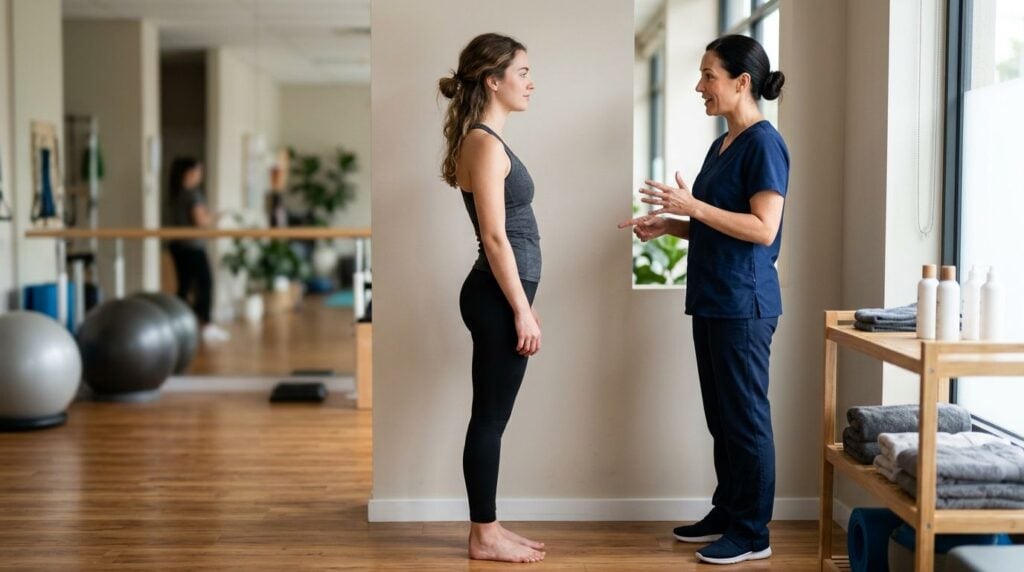
Sway back posture describes a standing pattern where the pelvis pushes forward past the ankles while the upper back leans backward to balance it out, flattening the natural curve of the lower spine. It's one of four postural types documented in physiotherapy literature, alongside ideal alignment, kyphosis-lordosis and flat back, and spotting it doesn't automatically mean something is wrong. Tight hip flexors, a weak core and long stretches of sitting are the contributors most often raised with a health professional in 2026.
- Sway back posture involves the pelvis shifting forward of the ankles while the lower back curve flattens out.
- It’s one of four postural types used in physiotherapy assessment, alongside ideal alignment, kyphosis-lordosis and flat back.
- Tight hip flexors, a weak core and prolonged sitting are common contributors worth raising with a health professional.
- A chiropractor at MyChiro in Bondi Junction can assess posture and spinal alignment as part of a general musculoskeletal review.
Why This Matters
Posture patterns like sway back don't always come with obvious discomfort, which is one reason they can go unnoticed for years. The pattern can look upright or even relaxed from the front, while a side view shows the hips sitting ahead of the shoulders and the knees locked back.
Left unexamined, the compensations that go with it — a flattened lower back, extra rounding through the upper back, tight hip flexors — tend to build up gradually across years of desk work, driving or standing shifts. A general musculoskeletal assessment at MyChiro in Bondi Junction can identify where a person's standing alignment sits relative to these four postural types, which is the starting point before anything else gets discussed.
What Is Sway Back Posture, Exactly?
Physiotherapy assessment groups standing posture into four broad types: ideal alignment, kyphosis-lordosis, flat back and sway back. Each type describes where the pelvis, rib cage and head sit relative to a vertical line running roughly through the midpoint of the ankle joint.
| Postural Type | Pelvis Position | Spinal Curves | Common Presentation |
|---|---|---|---|
| Ideal alignment | Neutral, stacked over ankles | Normal cervical, thoracic and lumbar curves | Ears, shoulders, hips and ankles roughly in line |
| Kyphosis-lordosis | Anterior tilt | Increased lumbar curve, increased thoracic curve | Arched lower back, rounded upper back |
| Flat back | Posterior tilt, pelvis shifted back | Reduced lumbar curve, reduced thoracic curve | Flattened lower back, upright torso |
| Sway back | Pelvis shifted forward of ankles, hips extended | Flattened lumbar curve, increased thoracic curve | Hips forward, knees locked back, upper back leaning behind the hips |
Sway back sits apart from the other three because the pelvis translates forward as a whole rather than just tilting. The hip joint ends up in extension, the knees often hyperextend to hold balance, and the ribcage drifts backward so the head can stay over the feet. The spine itself still has the same 33 vertebrae as any other posture — five of them forming the lumbar section — the sway back pattern just changes how those segments stack relative to one another.
“Sway back posture is a description of alignment, not a diagnosis on its own.”
Common Signs of Sway Back Posture
A side-on view is the easiest way to spot the pattern — front-on photos tend to hide it because the shoulders and hips can still look level. Signs commonly associated with sway back posture include:
- Hips positioned in front of the shoulders and ankles when viewed from the side
- Knees that lock or hyperextend backward while standing still
- A flattened curve through the lower back
- Increased rounding through the upper back and shoulders
- Head carried forward of the torso
- Weight resting more on the heels than through the midfoot
None of these signs alone confirms sway back posture. A side-view check against a plumb line or a doorframe edge is how the pattern actually gets identified, and that's best worked through with a qualified health professional rather than judged from a single photo.
Why Sway Back Posture Develops
The pattern usually builds up gradually across months or years rather than appearing overnight. Factors most often raised during postural assessments include:
- Prolonged sitting with a posterior pelvic tilt — slouching in a chair for hours trains the pelvis to sit further back, which can carry over into how a person stands
- Tight hip flexors and hamstrings — restricted muscle length at the front and back of the hip changes where the pelvis sits relative to the ankles
- Weak core and gluteal muscles — reduced control through the abdominals and glutes makes it harder to hold a neutral pelvis under load
- Habitual standing with hips pushed forward — leaning into one hip or resting into the hip joints over long shifts reinforces the pattern over time
- Footwear and desk setup habits — heel height and desk height both influence where the pelvis and shoulders sit through the day
- General fatigue during long shifts — tired postural muscles default to positions that need less active control, which often looks like sway back by the end of a workday
Working through lower crossed syndrome patterns and strengthening your core without straining your lower back are two areas that regularly come up once these contributors are on the table with a health professional.
Talk to a Chiropractor About Your Posture
General musculoskeletal assessments are available at MyChiro in Bondi Junction.
What to Discuss With a Health Professional
A useful conversation about sway back posture usually covers more than the alignment itself. Points worth raising include:
- How long the pattern has likely been present, and whether it's changed recently
- Any history of lower back, hip or knee discomfort, even mild or occasional
- Occupation and daily routine — long periods of sitting, standing or driving all matter
- Activity level, including whether hip flexors or hamstrings feel consistently tight
- Footwear choices, particularly heel height worn for most of the day
- Any previous injuries to the hip, knee or lower back region
Bringing this context to an assessment in 2026 gives a clearer picture than the posture alone, since the same visual pattern can have different drivers from one person to the next.
Is Sway Back Posture the Same as Lordosis?
No — sway back posture and lordosis, more precisely the kyphosis-lordosis pattern, are different postural types. Lordosis-dominant posture involves an anterior pelvic tilt with an increased curve through the lower back, while sway back posture flattens that same curve and shifts the whole pelvis forward rather than just tilting it.
The two patterns can look similar from a distance because both involve the pelvis moving out of a neutral position, but a side-view check against a plumb line usually tells them apart. Some people show features of both patterns depending on which muscle groups are tighter or weaker, including uneven hip height or a leg length difference that changes how weight sits through each side.
Can Sway Back Posture Cause Back Pain?
Sway back posture doesn't automatically cause back pain, and plenty of people hold the pattern without reporting any discomfort. Where pain does show up, it's usually linked to the muscle imbalances that accompany the posture — tight hip flexors, reduced core control and extra sustained load through the lower back and hips.
Whether a particular case of back pain connects to postural alignment is something to work through with a qualified health professional, since back pain has many possible drivers beyond posture alone, including disc changes, joint irritation and muscle strain.
How Is Posture Assessed by a Chiropractor?
A postural assessment typically starts with a side, front and back view of a person standing naturally, often checked against a plumb line or grid to see where the ears, shoulders, hips, knees and ankles line up relative to one another. A chiropractor may also check hip and knee range of motion, muscle length through the hip flexors and hamstrings, and core activation as part of a broader musculoskeletal review.
At MyChiro in Bondi Junction, a general assessment looks at how the spine, pelvis and surrounding joints are working together, and any exercises or care options are discussed on an individual basis following that assessment. There's no single approach that applies to every case of sway back posture in 2026, since the contributing factors differ from person to person.
FAQ
What is sway back posture?
Sway back posture is a standing pattern where the pelvis shifts forward of the ankles and the lower back curve flattens while the upper back leans backward. It’s one of four postural types described in physiotherapy assessment, alongside ideal alignment, kyphosis-lordosis and flat back.
Is sway back posture the same as lordosis?
No, sway back posture and the kyphosis-lordosis pattern are different postural types. Lordosis-dominant posture increases the lower back curve, while sway back flattens it and shifts the whole pelvis forward.
Can sway back posture cause back pain?
Sway back posture doesn’t automatically cause back pain, and many people hold the pattern without discomfort. Where pain is present, it’s usually connected to the muscle imbalances that come with the pattern rather than the alignment alone.
How is sway back posture assessed?
Sway back posture is assessed with a side, front and back view of a person standing naturally, often checked against a plumb line. A chiropractor or other health professional may also check hip range of motion and core activation as part of a broader review.
What exercises are discussed for sway back posture?
Core strengthening, hip flexor stretching and glute activation are commonly discussed for sway back posture, though any exercise plan should follow an individual assessment rather than a generic routine.
Is sway back posture common in 2026?
Sway back posture remains one of the four postural types regularly identified in physiotherapy and chiropractic assessments in 2026, alongside ideal alignment, kyphosis-lordosis and flat back.
Can a chiropractor help with sway back posture?
A chiropractor can assess posture and spinal alignment as part of a general musculoskeletal review and discuss options on an individual basis. Any care plan depends on the specific findings of that assessment.
Does sway back posture affect the knees?
Sway back posture often involves the knees locking or hyperextending backward to help keep balance while the hips sit forward. This is one of the visual signs checked alongside pelvis and spine position during assessment.
One Last Thing
Sway back posture is easy to miss in a mirror because it can look upright, even relaxed, from the front. The giveaway shows up from the side: hips sitting ahead of the shoulders, knees locked back, and the ribcage drifting behind the hips to keep the head balanced over the feet. If a side-view check is worth doing, a plumb line or a doorframe edge in a photo is a simple starting point before raising it with a health professional in 2026.
Related Guides


