

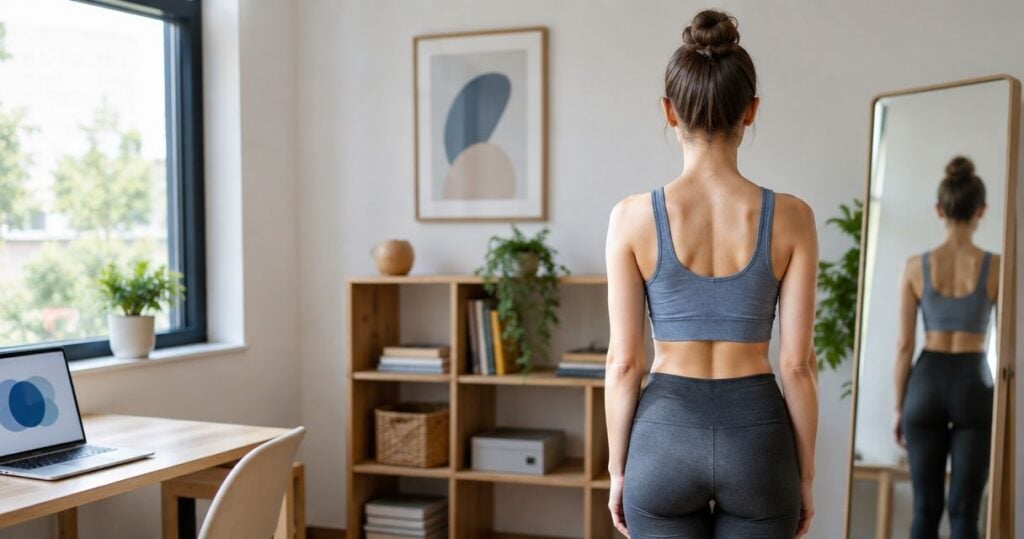
A forward bend test, standing side-on and front-on in a mirror, and a simple photo comparison are the three checks that make up how to check for scoliosis at home in 2026. None of these can confirm scoliosis on their own — a visible rib hump, uneven shoulders, or an asymmetric waistline only tells you a professional assessment and possibly an X-ray are worth arranging.
- The forward bend test (Adam’s test) is the core at-home scoliosis check: look for a rib hump or uneven back shape.
- A home check can flag possible signs only — confirming scoliosis needs imaging and a qualified health professional.
- Uneven shoulders, hips, or a shifted waistline are the visual signs worth acting on.
- Clinically, a spinal curve of 10 degrees or more on X-ray (the Cobb angle) is what defines scoliosis.
- Teenagers going through a growth spurt are the group most worth checking regularly through 2026.
Why this matters
Scoliosis is a sideways curve of the spine that's often first noticed by a parent, a partner, or the person themselves during a mirror check rather than during a medical visit. Published scoliosis research puts the prevalence at roughly 2 to 3 percent of adolescents, and the curve frequently develops during a growth spurt with no pain at all. That's exactly why a home check matters: the earlier a possible curve is spotted, the sooner it can be discussed with a GP or chiropractor, rather than being noticed years later once it's more visible.
A home check is a screening step, not a diagnosis. If anything below looks off, the next move is a professional assessment — chiropractic care for scoliosis in teenagers covers what that assessment process can look like for younger patients specifically.
How to check for scoliosis at home
Do this in a well-lit room, in front of a full-length mirror, wearing underwear or tight-fitting clothing so the spine and shoulders are visible.
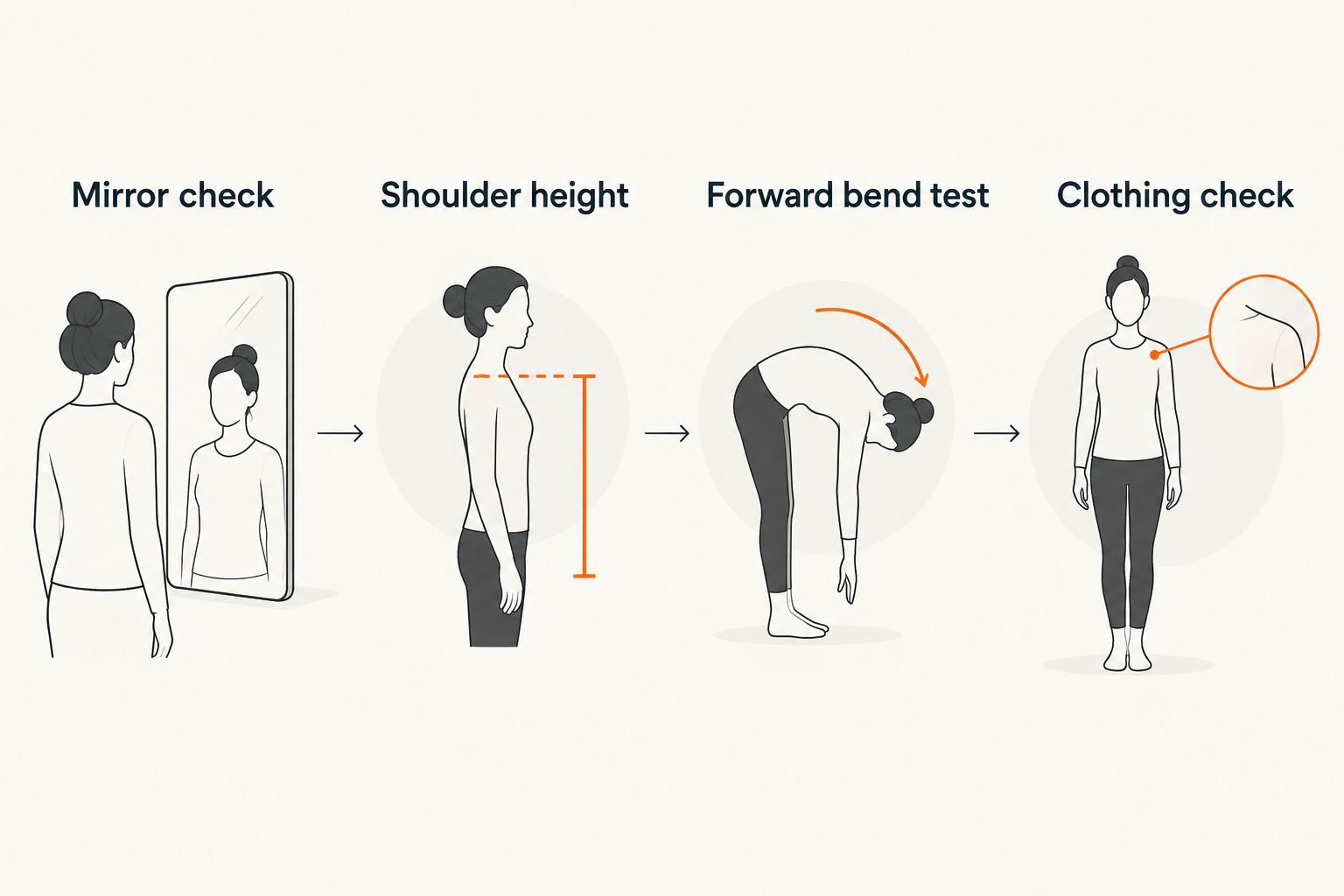
- Stand naturally, facing the mirror. Arms relaxed at your sides, feet together, looking straight ahead.
- Check shoulder height. One shoulder sitting noticeably higher than the other is one of the more common visible signs.
- Check hip and waist symmetry. Look for one hip riding higher, or a waistline crease on one side that isn't matched on the other.
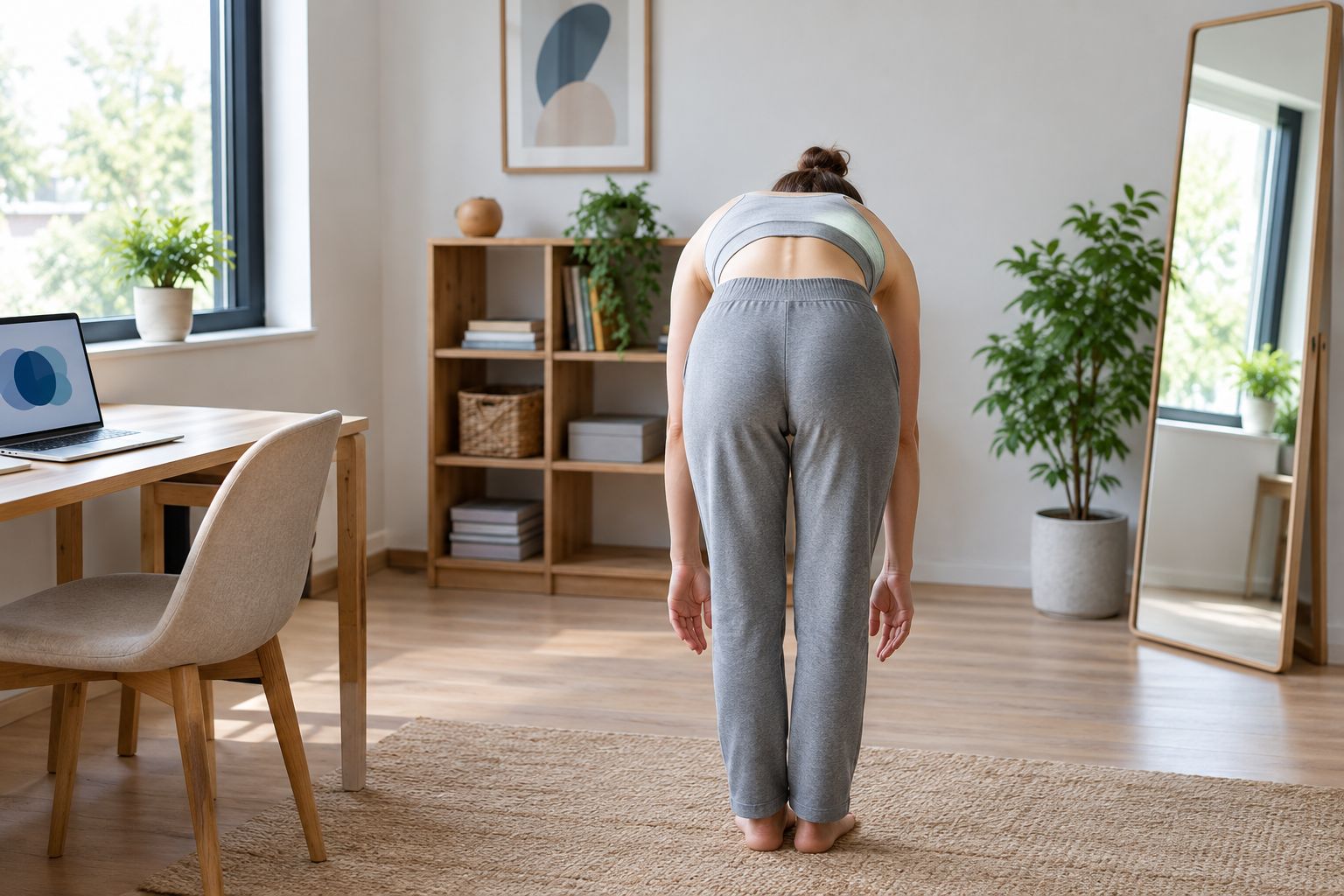
- Do the forward bend test (Adam's test). Bend forward at the hips with knees straight and arms hanging loose, as if reaching for your toes. Have someone look at your back from behind, or use a second mirror. A rib hump on one side, or one side of the back sitting higher than the other, is the sign this test is designed to catch.
- Check how clothing hangs. Hemlines, waistbands, and bra straps that sit unevenly over weeks or months are a secondary clue worth tracking.
- Take a photo for comparison. A front-on and back-on photo, taken every few months against a plain wall, makes small changes over 2026 easier to spot than memory alone.
Signs a home check should be followed by a professional assessment
- A visible rib hump during the forward bend test
- One shoulder or one hip sitting clearly higher than the other
- A noticeable curve or shift when the spine is viewed from behind
- Rapid growth in a teenager alongside any of the above
- Back stiffness or discomfort that persists for several weeks alongside a visible asymmetry
- A family history of scoliosis
These signs don't confirm anything on their own, but they're the point where a home check stops being enough. A GP referral for imaging is the usual next step, and a chiropractor at MyChiro's Bondi Junction clinic can talk through what a home check has shown and discuss onward referral where it's appropriate. Chiropractic techniques for adults with scoliosis sets out what that conversation can cover once assessment and imaging have confirmed a curve.
If you're unsure whether what you're seeing counts as a red flag, how to know when back pain needs a chiropractor vs a doctor walks through that decision in more general terms.
Can adults develop scoliosis after having a straight spine as a teenager?
Yes, adult-onset (degenerative) scoliosis can develop later in life, most often linked to disc and joint changes in the spine rather than the growth-related curves seen in teenagers. It tends to show up gradually through the 2026s and beyond rather than overnight, and the same mirror and forward bend checks apply, just with a lower bar for getting it assessed given the different cause.
Does scoliosis always cause visible signs or pain?
No, a mild curve can exist with no pain and only very subtle visible asymmetry, which is exactly why the forward bend test exists — it's designed to reveal a rib hump that plain standing posture can miss. Pain is not a reliable indicator either way; some people with a confirmed curve have none, and some with a straight spine have significant back pain from other causes.
How often should you repeat a home scoliosis check?
Every few months is reasonable for a teenager going through a growth spurt, since curves in that age group can progress within a matter of months. For adults without a known curve, checking whenever posture or clothing fit changes noticeably is a sensible trigger rather than a fixed schedule.
FAQ
What is the fastest way to check for scoliosis at home?
The forward bend test is the fastest home check: bend forward at the waist with arms hanging and look for a rib hump or uneven back shape from behind. It takes under a minute but only flags possible signs, not a confirmed diagnosis.
How do I know if my child has scoliosis?
Uneven shoulders, one hip sitting higher than the other, or a rib hump during a forward bend test are the signs worth watching in a child, particularly during a growth spurt. A GP or chiropractor can arrange imaging if any of these are present.
Can you see scoliosis in a photo?
A front-on and back-on photo taken every few months can reveal shoulder or hip asymmetry that’s easy to miss day to day. Photos are useful for tracking change over time in 2026 but can’t replace an X-ray for confirming a curve.
Is a rib hump always a sign of scoliosis?
A rib hump during the forward bend test is one of the more reliable visual signs of scoliosis, but it should be confirmed with imaging rather than treated as a diagnosis on its own. Muscle imbalance and posture can occasionally produce a milder version of the same look.
What angle counts as scoliosis?
Clinically, a spinal curve of 10 degrees or more measured on X-ray (the Cobb angle) is classified as scoliosis. Anything below that threshold is generally considered normal spinal variation rather than a structural curve.
Can scoliosis develop in adulthood?
Yes, degenerative scoliosis can develop in adults, usually linked to age-related changes in spinal discs and joints rather than the growth-related curves seen in teenagers. It tends to progress gradually rather than suddenly.
Do chiropractors treat scoliosis?
Chiropractic care does not cure or reverse scoliosis, and any care plan should follow a proper assessment and, where relevant, imaging. A chiropractor can discuss postural support and refer for further imaging or specialist review where appropriate.
Discuss a home check result
Talk through what a mirror or forward bend check has shown with a chiropractor.
One last thing
The forward bend test used at home is the same test used in school-based scoliosis screening programs for decades, because it needs no equipment beyond a mirror and a second pair of eyes. That's worth remembering if a home check turns something up: it's the same first step a school nurse or GP would use, not a lesser substitute for one. The next step from there is the same either way — a professional assessment, and imaging if that assessment says it's warranted.
Related guides


