

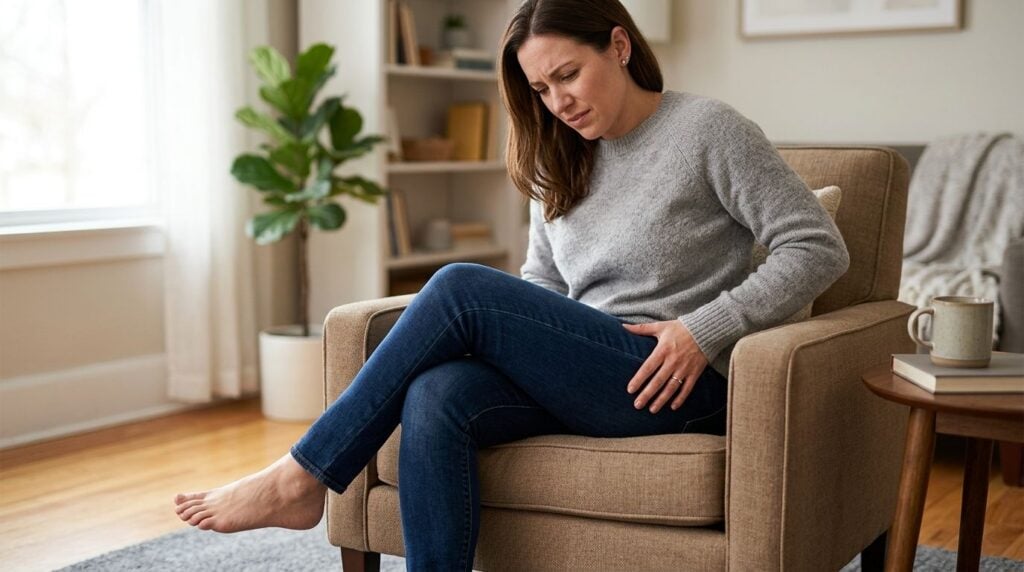
Hip pain that shows up after crossing your legs while sitting almost always traces back to uneven load on the pelvis and hip flexors, not joint disease or nerve damage. One side gets stretched, the other gets compressed, and if that pattern repeats for hours a day, five days a week, the muscles around the hip start to protest. The fix, in most cases, is mechanical: change the habit, loosen what's tight, and strengthen what's weak.
- Habitual leg-crossing loads one hip and hip flexor more than the other, which commonly triggers one-sided pain.
- Switching sides, stretching tight hip flexors, and adjusting chair height are the usual first steps in 2026.
- Pain that radiates down the leg or lasts beyond two to three weeks is worth having assessed by a health professional.
- MyChiro in Bondi Junction offers musculoskeletal assessments for ongoing hip or pelvic discomfort.
Why this matters
Most people who cross their legs while sitting don't do it evenly. One leg goes over the other far more often, and over months that asymmetry can shift how the pelvis sits and how the surrounding muscles fire. It's a mechanical habit with a mechanical consequence, which is also why it usually responds to mechanical changes rather than medication.
If you sit for long stretches at a desk, in a car, or on flights, the pattern compounds. A quick assessment at MyChiro can help work out whether the pain is coming from the hip joint itself, the surrounding muscles, or the lower back referring pain into the hip.
How to fix hip pain from crossing your legs while sitting
There's no single switch to flip, but a few changes address most of what's driving the discomfort. Work through these in order:
- Alternate which leg you cross. If you always cross the same leg over the other, deliberately switch sides through the day. This is the single biggest lever, because it stops the asymmetric load from accumulating.
- Sit with both feet flat more often than not. Crossing legs occasionally isn't the problem — doing it for most of an eight-hour shift is. Aim for feet flat on the floor as the default position.
- Stretch the hip flexors and outer hip daily. Tight hip flexors pull the pelvis forward and can aggravate the joint on the side you favour. A short set of hip flexor stretches after sitting for long periods can loosen this up.
- Check your chair height. If your knees sit higher than your hips, you're more likely to cross your legs to get comfortable. Raising the seat or lowering the desk can remove the urge.
- Strengthen the glutes on the tighter side. Weak glute medius muscles let the pelvis drop when you stand on one leg, which shows up as hip pain later in the day.
- Get it assessed if it's not settling. If pain persists past two to three weeks despite these changes, or if it's sharp, radiating, or waking you at night, book an assessment rather than pushing through it.
| Approach | What it addresses | Typical timeframe |
|---|---|---|
| Alternating sides | Asymmetric pelvic load | Immediate habit change |
| Hip flexor and glute stretching | Muscle tightness/imbalance | Days to a few weeks |
| Chair and desk adjustment | Root cause of the crossing habit | Immediate |
| Professional assessment | Underlying joint or nerve involvement | Varies by finding |
Why hip pain from crossing legs varies from person to person
- Pelvic asymmetry — a pelvis that's already slightly rotated tends to make one side of crossing far more comfortable, which reinforces the imbalance.
- Weak glute medius muscles — these stabilise the pelvis when you stand or walk; weakness on one side often maps directly to the hip that hurts.
- Tight hip flexors from prolonged sitting — many people in 2026 are still sitting six or more hours a day between desk work and commuting, which shortens these muscles regardless of leg-crossing.
- Previous hip, knee, or ankle injury — an old injury on one side can make crossing that leg feel easier, shifting habitual load toward the other hip.
- Chair and desk setup — a seat that's too low or a desk that's too high pushes people toward crossing legs to find a stable position.
- Leg length differences — even minor discrepancies change how weight distributes through the pelvis when seated.
“If one hip feels noticeably tighter than the other by the end of the day, that’s usually the cue to switch which leg you cross more often.”
Can crossing your legs cause sciatica?
Crossing your legs for long periods can compress or irritate structures near the sciatic nerve pathway, particularly the piriformis muscle, which sits close to the nerve in the buttock. This is different from disc-related sciatica, though the symptoms — pain running down the back of the leg — can look similar. If you notice tingling or numbness alongside the pain, that's a reason to get it looked at rather than guess.
Does crossing your legs cause uneven hips over time?
Repeated, one-sided leg-crossing can contribute to a pelvis that sits slightly rotated or tilted, especially when combined with weak stabilising muscles. It's rarely the sole cause on its own, but it's a common contributing factor that a musculoskeletal assessment can help identify alongside other habits like standing posture and footwear.
How long does hip pain from sitting cross-legged take to settle?
For most people, adjusting the habit and adding daily stretching brings noticeable change within one to three weeks. If there's no improvement in that window, or the pain is getting worse, it's worth having a chiropractor or physiotherapist assess the hip and lower back directly rather than continuing the same routine.
Get your hip and pelvis checked
Discuss ongoing hip discomfort with a registered chiropractor at MyChiro in Bondi Junction.
FAQ
Why does crossing my legs cause hip pain?
Crossing your legs repeatedly loads one hip and hip flexor more than the other, which over weeks can create muscle tightness and joint irritation on the favoured side. It’s a mechanical, load-based issue rather than a sign of disease in most cases.
Is crossing your legs bad for your hips?
Occasional leg-crossing isn’t a problem, but doing it for most of a working day, every day, can contribute to pelvic asymmetry and hip discomfort over time in 2026 as in previous years. Switching sides regularly reduces this risk considerably.
How do I stop hip pain from sitting cross-legged?
Start by alternating which leg you cross and sitting with both feet flat more often, then add daily hip flexor and glute stretching. If pain persists beyond two to three weeks, have it assessed by a health professional.
Can crossing your legs cause sciatica-like symptoms?
Yes, prolonged leg-crossing can irritate the piriformis muscle near the sciatic nerve pathway, producing pain that runs down the back of the leg. This differs from disc-related sciatica and usually needs a direct assessment to confirm the source.
What stretches help hip pain from sitting?
Hip flexor stretches, piriformis stretches, and glute activation exercises are the most commonly used for this type of hip pain. A short daily routine after long sitting periods is generally more useful than one long session per week.
Should I see a chiropractor for hip pain from crossing my legs?
If the pain lasts more than two to three weeks despite changing the habit and stretching, an assessment can help identify whether the hip joint, muscles, or lower back are involved. A chiropractor can discuss findings and appropriate next steps with you following assessment.
Does an office chair affect hip pain from crossing legs?
A chair that sits too low relative to the desk pushes people toward crossing their legs for comfort, which reinforces the load imbalance. Raising the seat height or adjusting desk height often reduces the urge to cross legs in the first place.
Can hip pain from crossing legs affect the lower back?
Yes, a pelvis that sits unevenly from repeated one-sided crossing can change how load moves through the lower back, sometimes contributing to lower back discomfort as well. Addressing the hip imbalance often helps the back symptoms settle alongside it.
One last thing
Most people assume the pain sits exactly where they cross their legs, but it's just as common for the ache to show up on the opposite hip — the one doing the extra stabilising work while the other leg rests. In 2026, with hybrid work keeping plenty of people at makeshift desks for long stretches, that stabilising-side pain is one of the more overlooked patterns worth mentioning if you do book an assessment.
Related guides


