

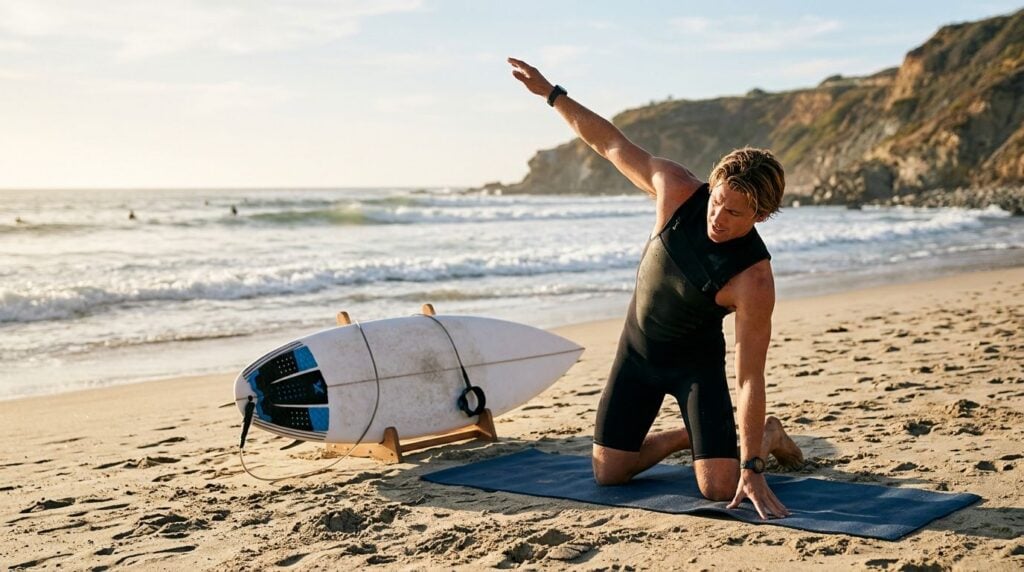
Surfer's shoulder is one of the most common overuse injuries seen in surfers who paddle for more than a few hours a week, and most cases trace back to weak rotator cuff and scapular stabiliser muscles combined with repetitive overhead paddling load. Reducing your risk in 2026 means pairing a structured warm-up with targeted shoulder strengthening and a technique check on how you paddle and duck-dive — not stretching alone.
- Rotator cuff and scapular strength matter more for preventing surfing shoulder injuries than pre-surf stretching alone.
- A 5-10 minute dynamic warm-up before paddling out is a practical first step for most surfers in 2026.
- Paddling technique and duck-dive mechanics are common contributors to shoulder strain that get overlooked.
- MyChiro’s Bondi Junction clinic can assess shoulder and scapular movement patterns as part of a broader plan.
- Ongoing shoulder pain after sessions is a signal to get a movement assessment, not to keep pushing through it.
Why this matters
Surfing loads the shoulder in a repeated overhead position that most other sports don't replicate in the same volume. A typical session involves hundreds of paddle strokes, each one placing the rotator cuff tendons and the scapular stabilisers under tension in a position where the joint has less natural bony support.
Shoulder and back pain in surfers is one of the more frequently discussed complaints among regular surfers, and the pattern tends to build gradually rather than appear after one bad wipeout. That gradual build-up is exactly why prevention habits matter more than reactive fixes once pain has set in.
How to prevent surfing-related shoulder injuries
The approach that reduces risk most consistently combines four elements, done in this order before and around a surf session:
- Warm up the shoulder joint dynamically for 5-10 minutes before paddling out — arm circles, band pull-aparts, and scapular wall slides raise blood flow to the rotator cuff and prime the stabiliser muscles.
- Strengthen the rotator cuff and scapular muscles on non-surf days, 2-3 times a week, focusing on external rotation and lower trapezius activation rather than heavy pressing movements.
- Check paddling and duck-dive technique — a low, hunched paddling posture or a duck-dive that relies on the shoulders instead of the torso adds unnecessary load to the joint capsule.
- Build in recovery time between long sessions, particularly after consecutive days of paddling in choppy or cold conditions, since cold water tightens the shoulder capsule and increases strain on fatigued tissue.
| Strategy | What it targets | Best for | Time commitment |
|---|---|---|---|
| Dynamic warm-up | Blood flow, joint mobility | Anyone paddling out cold | 5-10 min before each session |
| Rotator cuff strengthening | Tendon and joint stability | Surfers with 3+ sessions a week | 20-30 min, 2-3x weekly |
| Technique correction | Paddling and duck-dive mechanics | Surfers with recurring shoulder ache | One-off assessment, ongoing practice |
| Post-surf recovery | Tissue fatigue and cold-water tightness | Multi-day surf trips | Ongoing, session-dependent |
Dynamic warm-up: the first line of defence
A cold shoulder joint paddling into a cold wave is a common combination behind early-session strain. Spend 5-10 minutes on arm circles, resistance band pull-aparts, and scapular wall slides before you hit the water — this is a low-effort habit that most surfers skip entirely.
Rotator cuff and scapular strengthening
This is the strategy with the strongest link to reduced shoulder strain over a surfing season. Exercises like external rotation with a resistance band, prone Y-raises, and scapular retraction work the muscles that stabilise the joint during thousands of repetitive paddle strokes. If you already deal with tightness or restricted movement, reviewing core strengthening approaches that don't strain the lower back is worth doing alongside shoulder work, since a stable core supports better paddling posture.
Paddling technique and duck-dive mechanics
Many surfers paddle with their head down and shoulders rounded forward, which shortens the space the rotator cuff tendons move through and increases friction over time. Keeping the chest slightly lifted and rotating from the torso rather than yanking through the shoulder during a duck-dive reduces unnecessary joint stress on every wave.
Post-surf recovery and load management
Back-to-back big surf days without recovery time is a common pattern before shoulder pain shows up. Alternating harder paddling days with lighter recovery days, and paying attention to general warm-up habits before training sessions, applies just as well to a surf-heavy week as it does to a gym routine.
Why surfing shoulder injuries happen
- Repetitive overhead paddling load — hundreds of strokes per session with limited variation in movement pattern.
- Weak rotator cuff and scapular stabilisers relative to the demand placed on the shoulder joint.
- Poor paddling posture, particularly a rounded, head-down position that narrows the subacromial space.
- Cold water tightening the joint capsule, which increases strain during the first 10-15 minutes of a session.
- Inadequate recovery between sessions, especially during multi-day surf trips or competition blocks.
- Previous shoulder injuries that weren't fully assessed or rehabilitated before returning to the water.
The single biggest lever for surfers is rotator cuff and scapular strength — not stretching before you paddle out.
Can chiropractic care help with surfer's shoulder?
A chiropractor can assess shoulder and scapular movement patterns and discuss options that may be appropriate following that assessment, including joint mobility work and referral for strengthening exercises. This is one part of a broader plan that should also include a strength program and technique review, not a standalone solution.
How long should I warm up before surfing?
A 5-10 minute dynamic warm-up covering arm circles, band pull-aparts and scapular activation is a practical starting point before paddling out in 2026. Surfers heading into cold water or an early-morning session may benefit from extending this slightly, since cold tissue takes longer to loosen.
What exercises help strengthen the rotator cuff for surfing?
External rotation with a resistance band, prone Y-raises and scapular retraction are commonly used to build the stability surfing demands from the shoulder. These are typically done 2-3 times a week on non-surf days, separate from any warm-up routine used before paddling out.
If shoulder discomfort has been building over several weeks rather than appearing after a single session, it's worth discussing the pattern with a health professional rather than adjusting your surf schedule on your own. A movement assessment can help identify whether the issue is coming from the joint itself, the surrounding scapular muscles, or posture carried over from time spent at a desk.
Get a shoulder movement assessment
Discuss recurring shoulder strain with the Bondi Junction team.
FAQ
What’s the best way to prevent surfing shoulder injuries?
Combining a 5-10 minute dynamic warm-up with rotator cuff and scapular strengthening 2-3 times a week is the most consistent approach for reducing shoulder strain in surfers. Paddling technique and recovery time between sessions matter just as much as the exercises themselves.
Is surfer’s shoulder the same as a rotator cuff injury?
Surfer’s shoulder often involves rotator cuff tendon irritation from repetitive overhead paddling, though the exact structures affected vary between individuals. A movement assessment can help clarify which tissues are involved before deciding on next steps.
How often should surfers do shoulder strengthening exercises?
Most surfers benefit from rotator cuff and scapular strengthening 2-3 times a week on non-surf days, separate from any pre-session warm-up. Consistency over several weeks matters more than the intensity of any single session.
Can bad paddling technique cause shoulder pain?
Yes, a rounded, head-down paddling posture narrows the space the rotator cuff tendons move through and can contribute to shoulder strain over time. Rotating from the torso during duck-dives rather than pulling through the shoulder reduces this load.
Does cold water make shoulder injuries worse for surfers?
Cold water tightens the shoulder capsule, which increases strain during the first 10-15 minutes of a session before the joint warms up. A dynamic warm-up before paddling out helps offset this in cooler conditions.
When should a surfer see a chiropractor for shoulder pain?
If shoulder discomfort builds gradually over several sessions rather than resolving with rest, it’s worth discussing the pattern with a health professional for a movement assessment. Ongoing pain that affects daily activities, not just surfing, is a stronger signal to get checked.
How long does it take to build shoulder strength for surfing?
Most strengthening programs run 6-8 weeks of consistent 2-3 times a week training before surfers notice a meaningful difference in paddling endurance. Results vary depending on starting strength and how consistently the program is followed.
One last thing
Surfers who address paddling posture and scapular strength together tend to report fewer flare-ups over a season than those who only stretch before paddling out — stretching alone doesn't build the stability the joint needs under repeated load. If shoulder pain shows up after a change in board, wetsuit, or surf frequency, that timing detail is worth mentioning at an assessment, since it often points directly at the cause.
Related guides