
Manual therapy may be an option for selected musculoskeletal complaints. Its benefits and risks depend on the condition and technique, not pain duration alone.
- Recent pain: An assessment can help decide whether hands-on care, exercise, self-care or medical treatment is appropriate. Rapid relief is not guaranteed, and early manual therapy is not proven to prevent all persistent pain.
- Persistent pain: Care may focus on daily function, activity and coping as well as symptoms. Manual treatment can be one option, but results depend on the comparison and condition studied.
Many episodes of back pain improve over time, although recovery varies. Assessment and informed choice matter. Care from a qualified practitioner is not risk-free; discuss the technique, alternatives and possible adverse effects.
Key takeaway: Consider the whole care plan. For low back pain, guidance places manual therapy alongside suitable exercise rather than treating it as a necessary standalone course.
Manual Therapy for Recent Pain
Assessing a Recent Pain Episode
New back pain, neck pain or an ankle injury can need different assessment and treatment. Evidence for one body region or technique should not be used to promise benefits for all acute injuries.
A change in movement or comfort after manual therapy does not establish that blood flow, oxygen delivery or tissue healing has improved.
Small studies of inflammatory markers or pain-related chemicals cannot establish how much a patient will improve. Laboratory percentage changes should not be advertised as proof of rapid clinical pain relief.
Swelling after injury or surgery needs an appropriate explanation and care plan. Manual treatment should not be presented as preventing “pain memory” or avoiding all longer-term symptoms.
Research on Acute Pain Relief
Some research suggests short-term benefits for selected recent low back pain. Natural improvement, comparison treatment and study eligibility all matter when interpreting the results.
In a 2015 trial involving 107 adults with low back pain of less than 12 weeks, 94% of the manual-thrust group reported at least 30% pain reduction at four weeks, compared with 56% receiving usual medical care. This was one selected study population, not a success rate for all manual therapy or a prediction for an individual patient.[1]
That trial found no statistically significant differences between groups at three or six months. The short-term result does not establish lasting superiority, faster tissue healing or prevention of chronic pain.
sbb-itb-585d67d
Manual Therapy for Chronic Pain
Managing Chronic Pain with Manual Therapy
Persistent pain is commonly described as lasting longer than three months. An assessment considers the complaint, activities, health history and goals. Manual treatment may be one part of care, but pain duration alone cannot determine whether it will help.
A 2026 Cochrane review of chronic low back pain reported average one-month pain differences of 14 points out of 100 versus no treatment, 7 versus sham treatment and 4.7 versus other conservative care. Confidence in the evidence was limited. The larger comparison with no treatment should not be presented as the benefit over other appropriate care.
Different manual techniques have different purposes and evidence. A person may find short-term symptom relief useful, but it should not be promised to reduce medicine use or improve function over the long term. Discuss medicine changes with the prescribing clinician.
Guidance for low back pain includes active options such as exercise and self-management. Manual treatment is optional, and the plan should reflect your needs rather than assume ongoing hands-on care is necessary.
Combining Manual Therapy with Other Approaches
NICE guidance for low back pain allows consideration of manual therapy as part of a package including exercise. This does not guarantee an added benefit for every person or support a fixed improvement in return-to-work rates.
A care plan should explain the purpose of each component and how progress will be reviewed. Adding treatments without a clear goal can increase time and cost without ensuring a better result.
Persistent pain should not automatically be blamed on inactivity or posture. Review options in the context of your health and circumstances, without assuming fortnightly maintenance treatment is needed.
At MyChiro in Bondi Junction, new patients can book a free initial consultation to discuss back pain, neck pain or headaches. The consultation includes assessment and advice, not treatment. Optional same-day treatment is $125 if clinically appropriate, with no obligation to proceed.
Manual Therapy for the Management of Musculoskeletal (MSK) conditions
Comparing Acute and Chronic Pain Outcomes
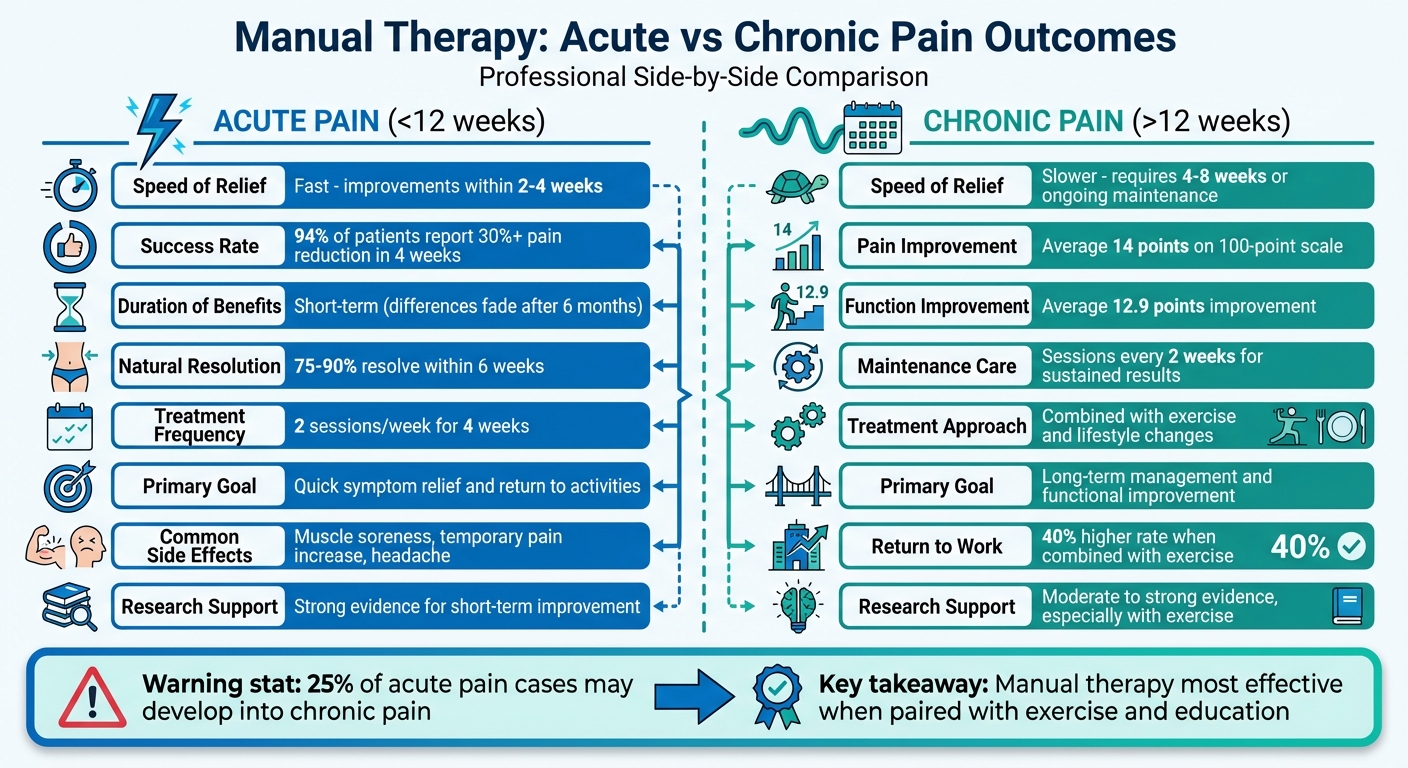
Illustration comparing pain durations; treatment effects and appropriate schedules depend on the individual complaint and evidence.
Acute vs Chronic Pain: Side-by-Side Comparison
Duration is one part of an assessment. The table below describes considerations rather than fixed treatment schedules or guaranteed results.
For recent pain, assess what happened and whether medical care is needed before choosing a technique. A study response rate is not an individual forecast. Symptoms may improve with time, appropriate activity and other care.
For persistent pain, the comparison group matters: benefit over no treatment is different from benefit over another appropriate treatment. The aim is a useful, affordable plan based on your needs and preferences.
Consider changes that matter to you, such as walking, sleeping or managing work more comfortably, alongside pain scores.
Use this comparison as a discussion guide, not a prescription:
| Feature | Recent Pain (Up to About 3 Months) | Persistent Pain (Longer Than About 3 Months) |
|---|---|---|
| Expected Response | Varies by diagnosis, technique and natural recovery; no fixed rapid-relief promise | Varies by diagnosis, goals and treatment; maintenance visits are not automatic |
| Review of Benefit | Assess changes in symptoms and everyday activity | Review useful function and whether benefits justify further care |
| Risks to Discuss | Soreness or a temporary flare can occur; risks also depend on the technique and health history | Duration of pain does not make a treatment risk-free; discuss alternatives |
| Evidence | Findings for selected low back pain should not be applied to every new injury | Confidence and benefit vary by treatment comparison; avoid universal claims |
| Treatment Aim | Support suitable activity and address the assessed complaint | Agree on realistic goals for function, symptoms and daily life |
What Affects Treatment Outcomes
An individual assessment considers more than how long pain has been present:
Duration can inform the assessment, but it does not reliably predict your response or show that longer-lasting pain requires a fixed course of treatment.
Location and symptoms help guide appropriate assessment. A sore spot or pain pattern alone cannot identify who will benefit or establish one manipulation technique as superior.
Psychological and social factors, such as sleep, worries and work demands, can be relevant at any stage of pain:
Considering these factors does not mean pain is imaginary or that the person is responsible for it.
Discuss concerns and barriers to activity in a supportive way. A plan may include medical, physical or psychological support as appropriate.
Current capacity helps guide exercise and daily activity. There is no need to assume that body size or fitness alone determines whether treatment will work.
Personal goals might include walking, lifting, sleeping or completing a workday more comfortably. Agree on how progress will be assessed and when to reconsider the plan.
Manual Therapy in Chiropractic Practice
How Chiropractors Use Manual Therapy
A chiropractor may consider manual techniques for an appropriate musculoskeletal complaint. Whether pain is recent or persistent is one factor alongside symptoms, examination, health history and your preferences.
For recent low back pain, manual-thrust manipulation may be one option for some people. A trial schedule such as twice a week for four weeks does not establish the right number of appointments for you. Treatment should follow assessment and informed consent.
For persistent pain, discuss the role of each proposed treatment and alternatives. A finding from a trial of recent low back pain should not be used to justify a chronic-pain care plan:
Evidence should match the condition, technique and outcome being discussed, rather than treating all manual therapy as interchangeable.
Ongoing appointments should depend on meaningful benefit, your goals and a review of options. Palpation does not guarantee identification of a root cause, and a fortnightly maintenance schedule is not a universal requirement.
If the plan is not helping, or symptoms change, reassessment or referral may be more appropriate than continuing the same treatment.
Tailored Care for Different Needs
Your daily tasks can help define useful goals. They should not be used to assume a particular diagnosis or create a need for preventive treatment:
- Office workers: Discuss neck discomfort, headaches and work demands without assuming a “tech neck” diagnosis. Headaches may need medical assessment, particularly when new or changing.
- Parents and carers: Explain which activities, such as lifting or carrying, are difficult. The goal is manageable function, with care chosen after assessment rather than a promise of long-term spinal health.
- People staying active: Suitable exercise and activity can support daily function. Feeling well is not, by itself, a reason to start regular manual treatment to prevent future problems.
At MyChiro in Bondi Junction, you can discuss your concerns and whether chiropractic assessment or another care pathway is appropriate. Online booking shows available appointment options. Ask about likely benefits, risks, costs and alternatives; you can decline treatment or seek another opinion.
Conclusion
Key Points
Manual therapy can be considered for selected complaints with recent or persistent pain. Evidence for recent low back pain should not be generalised to all new injuries, and no study can guarantee your result.
For persistent pain, an individual plan should consider useful activity, symptoms and your preferences. It does not automatically require ongoing adjustments or a fixed maintenance schedule.
Seek assessment when pain persists, worsens or limits daily activity. New bladder or bowel changes, numbness around the groin or severe/progressive leg weakness with back pain require emergency medical assessment. Call 000 for an emergency.
Manual treatment can cause temporary soreness, and serious complications have been reported. Neck manipulation has particular risks that should be discussed. Professional training and the absence of serious events in a small study do not make a technique risk-free.
Disclaimer
This information is general in nature and does not replace professional medical advice. Chiropractic care focuses on musculoskeletal health, and results may vary from person to person. Always consult a qualified healthcare professional before making decisions about your health.
[1] Schneider et al., Spine, 2015;40(4):209–217. PMID 25423308. Further evidence discussed: de Zoete et al., Cochrane Database of Systematic Reviews, 2026, CD008112; NICE guideline NG59.
FAQs
When should I consider manual therapy for a new injury?
Start with assessment of the injury and symptoms. Suspected fracture, major trauma, new neurological symptoms or other warning signs may need medical care before hands-on treatment. If manual therapy is an option, discuss the technique, benefits, risks and alternatives.
How many sessions are typically needed for chronic pain?
There is no standard number of manual-therapy sessions for all persistent pain. Agree on goals and a review point, and discuss whether further appointments are useful. Lack of progress should prompt reconsideration, not an automatic extension.
Who should avoid manual therapy?
Suitability depends on the specific technique and health history. Tell the practitioner about osteoporosis, fractures, cancer, infection, bleeding risks, medicines and neurological symptoms. Some techniques may be unsuitable or need medical clearance. A concerning new symptom should be assessed before treatment.