

When you're dealing with shoulder impingement syndrome, the goal is typically to reduce inflammation, build up strength, and restore correct joint movement. Think of it as creating more space inside the shoulder to reduce the pinching of the tendons.
What's Really Happening Inside Your Shoulder?

Shoulder impingement can be described as a mechanical issue within the shoulder joint. Your shoulder is a ball-and-socket joint, built for a wide range of motion. However, the space where your rotator cuff tendons and a small, fluid-filled sac (the bursa) pass through is naturally tight. This is known as the subacromial space.
Every time you lift your arm, especially overhead, that space gets smaller. This is normal. But if those rotator cuff tendons or the bursa are already inflamed and swollen, they can get pinched between the top of your arm bone (the humerus) and the bone forming the roof of your shoulder (the acromion). It is this repeated compression that can cause pain and weakness.
Why Does Shoulder Impingement Happen?
It is often not one single thing that causes impingement. Usually, it's a mix of factors that either shrink the subacromial space or irritate the structures passing through it. Identifying these is the first step in any suitable treatment plan.
Common contributing factors can include:
- Repetitive Overhead Work: Activities common to painters, electricians, swimmers, or tennis players involve constant overhead motion, which can lead to overuse and inflammation of the rotator cuff tendons over time.
- Poor Posture: This is a significant factor. Slouching or allowing your shoulders to roll forward can change the position of your shoulder blade. This shift may be enough to reduce that critical space in the joint, making impingement more likely.
- Individual Anatomy: Some people may be born with a smaller subacromial space or have a slightly hooked acromion bone, which can increase their risk.
- Muscle Imbalances: If the small stabilising muscles of your rotator cuff or the muscles around your shoulder blade are weak, your shoulder's movement pattern can be affected. This may put extra strain on the tendons, leading to irritation.
Shoulder pain is a common issue for many Australians. In fact, a large-scale Adelaide health study found that 22.3% of people reported dealing with shoulder pain, stiffness, or aching. The research highlighted how much this discomfort can disrupt both physical activities and social life. You can read more about the findings on shoulder pain prevalence in Australia if you're interested in the data.
The key thing to remember is that shoulder impingement is often a result of cumulative stress. It’s typically the combined effect of your posture, how you move, and what you do every day that brings on the symptoms.
Do You Recognise These Signs?
Identifying shoulder impingement early provides an opportunity to get it assessed and make changes before it becomes a more persistent problem. The pain can show up in a few classic ways.
You might be experiencing:
- A sharp, pinching pain when you lift your arm out to the side or front, especially in the middle range of motion (between 60 and 120 degrees).
- Pain when reaching behind your back—like trying to put on a coat.
- A nagging, dull ache deep in the shoulder that may worsen at night, especially if you lie on that side.
- A noticeable weakness in your arm, making it a struggle to lift things.
How these signs feel can vary from person to person. For some, it’s a minor annoyance. For others, it can be a debilitating pain that interferes with work, hobbies, or daily activities. Recognising these signs is the first step toward understanding the issue and finding a suitable way to manage it.
Getting to the Bottom of Shoulder Pain: How We Assess It

Before considering treatment for shoulder impingement, it is important to understand what is happening inside the joint. This involves a careful process, combining the information you provide with a hands-on examination.
The first step is a conversation. We need to hear the history of your shoulder pain.
During this discussion, we may ask:
- When did the pain start? Was it a sudden injury or something that developed over time?
- What specific movements or activities trigger it? Is it reaching up into a cupboard, lifting something, or trying to sleep on that side?
- What does the pain feel like? Is it a sharp, pinching sensation or more of a dull, constant ache that radiates down your arm?
- What does your day-to-day life look like? We'll ask about your job, sports, and hobbies to identify patterns or repetitive movements that could be contributing.
- Have you injured this shoulder before?
This initial discussion provides important clues that guide the physical assessment and helps form a working hypothesis about the cause of your discomfort.
The Hands-On Physical Examination
After we've talked, it's time for a hands-on physical exam. This involves assessing how your entire shoulder complex functions, observing your movement patterns, and carefully attempting to reproduce your symptoms in a controlled way to help pinpoint the source.
Here’s what a typical physical exam for shoulder impingement might look like.
Testing Your Range of Motion
We will guide your arm through its full range of movement—up, down, across, and around. We will have you move your arm on your own (active motion) and then we will move it for you (passive motion). This provides a lot of information. For example, if you can't lift your arm yourself but we can move it fully for you, it often points to a muscle or tendon issue rather than a stiff joint capsule.
Checking Muscle Strength
We perform specific tests to gauge the strength of your rotator cuff muscles and the muscles that control your shoulder blade (scapula). Weakness in these key stabilisers is a common factor in shoulder impingement, as it can affect the smooth, coordinated rhythm of the joint.
Using Specialised Tests
We also use what are known as orthopaedic tests. These are specific manoeuvres, like the Neer's or Hawkins-Kennedy tests, designed to gently narrow the space under your acromion bone. If these tests recreate your familiar pinching pain, it provides a strong indication that impingement may be occurring.
It's important to understand that we are not just looking at your shoulder in isolation. Your shoulder doesn't exist on an island. We will also assess your neck and upper back, because problems there can have a direct knock-on effect on your shoulder mechanics.
This integrated view is important. For instance, a slouched posture in your upper back often causes your shoulders to roll forward, which can shrink the space available for your rotator cuff tendons. You can read more about how poor posture may result in back pain and affect your whole body on our blog.
When Do We Need Scans?
In many situations, a clinical diagnosis can be made based on your history and a physical exam alone. The use of advanced technology like AI for medical diagnosis is growing, but a practitioner's hands-on assessment remains a standard approach.
However, there are times when imaging can be helpful to rule out other problems or to get a closer look.
- X-rays are used for seeing bones. They can show if you have bone spurs or arthritic changes that might be physically narrowing the subacromial space.
- Ultrasound is a common tool for looking at soft tissues. It allows us to see inflammation in the bursa or check the health of the rotator cuff tendons, including identifying tears.
Imaging is only recommended when it is clinically necessary. It is not a routine first step, but it can be a valuable tool to help confirm a diagnosis and refine a treatment plan.
Conservative Shoulder Impingement Syndrome Treatment
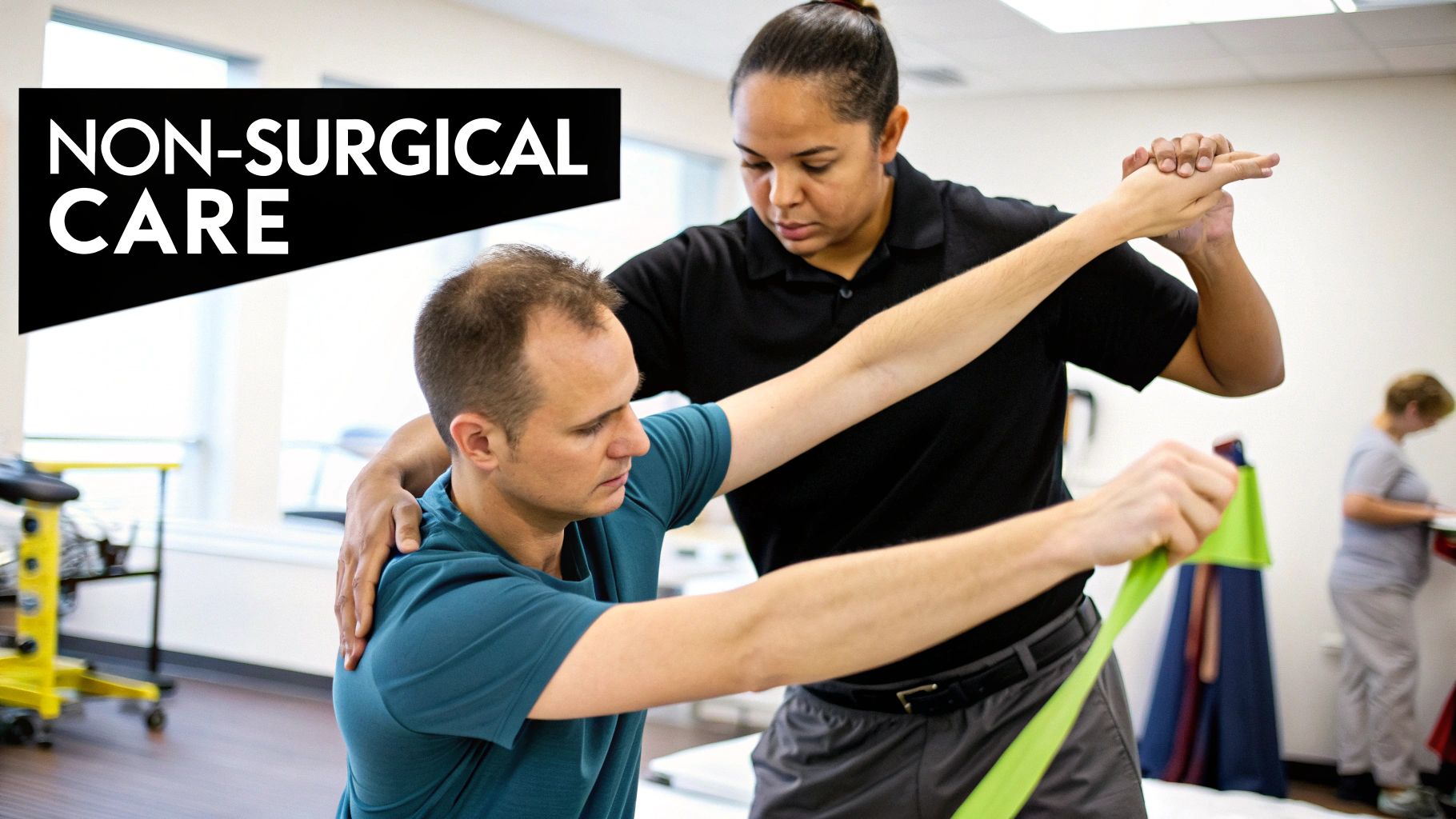
When you’re dealing with shoulder pain, surgery is not always the first or only option. For a condition like shoulder impingement syndrome, we typically start with a conservative, non-surgical approach. The idea is to address the underlying cause of the pain—not just mask the symptoms.
We focus on reducing inflammation, helping the shoulder joint move properly again, and strengthening the muscles that support it. This is a partnership between practitioner and patient, combining hands-on therapy with strategies you can use in your everyday life.
Making Smart Changes to Your Daily Routine
The first step is to identify what is aggravating your shoulder and make some adjustments. This doesn't mean you have to stop moving altogether—it’s about moving with more awareness.
Consider a common scenario: an office worker who plays social tennis on the weekends. The repetitive overhead serving motion is a classic trigger for shoulder impingement. In addition, spending the week hunched over a computer can cause the shoulders to roll forward, which can shrink the space where the tendons pass through.
Making a few simple tweaks can make a significant difference:
- Adjusting your desk and chair to encourage a more upright posture.
- Getting up every hour to stretch your chest and roll your shoulders back.
- Perhaps swapping overhead serves for an underarm serve for a few weeks, focusing on groundstrokes instead.
These small changes can take the constant strain off your shoulder, giving irritated tissues a chance to recover.
How Chiropractic Care Can Assist
Chiropractic care for shoulder impingement often looks at the bigger picture—the entire chain of movement that includes your neck and upper back (the thoracic spine). If those areas are stiff, your shoulder may have to work harder, potentially leading to problems.
A treatment session might include:
- Joint Mobilisation and Adjustments: We may work on improving mobility in the joints of your shoulder, collarbone, and spine. When your upper back moves better, for instance, your shoulder blade can glide more smoothly, creating more room for the rotator cuff tendons.
- Soft Tissue Work: We may also address tight muscles around your chest, neck, and shoulders. These can contribute to a slouched posture, so releasing them can be beneficial.
Our goal is to improve the overall mechanics of your shoulder girdle. As with any therapy, there are potential risks and benefits. It's vital to have a thorough discussion with your practitioner to determine if it's the right approach for you. You can learn more about our approach in our guide to chiropractic care for shoulder and elbow pain.
Key Takeaway: An integrated approach can be very helpful. Addressing a slouched posture is often one of the most powerful things you can do for long-term relief, as it directly addresses the space in your shoulder joint.
The Role of Cold Therapy
An ice pack can be useful when your shoulder is feeling particularly inflamed. The cold helps constrict blood vessels, which can reduce swelling and provide a numbing effect to ease the pain.
For best results, wrap a cold pack in a thin towel (never apply it directly to your skin) and place it on the most painful part of your shoulder. Leave it on for 15-20 minutes at a time. This can be done several times a day, especially after any activity that tends to aggravate it.
Why We Begin with Conservative Care
In Australia, while surgery like subacromial decompression is an option, conservative management is typically prioritised. The body has a capacity to heal, and our job is to provide support with non-invasive therapies.
A 2023 report from the Medical Services Advisory Committee highlighted that while complication rates for shoulder arthroscopy are low (between 0.65% and 1.17%), a portion of patients—from 10% to 57%—who start with non-surgical treatment may later opt for surgery.
This table gives a quick overview of how different conservative approaches fit together:
Comparison of Conservative Treatment Modalities
| Treatment Modality | Primary Goal | Typical Activities Involved |
|---|---|---|
| Chiropractic Care | Restore joint mechanics & function | Spinal and shoulder adjustments, soft tissue release, postural correction. |
| Activity Modification | Reduce strain & inflammation | Adjusting work ergonomics, avoiding overhead movements, changing sport techniques. |
| Cold Therapy | Manage acute pain & swelling | Applying ice packs for 15-20 minutes after activity or when pain flares. |
| Targeted Exercise | Strengthen support muscles & improve stability | Rotator cuff strengthening, scapular stabilisation exercises, stretching. |
This data indicates that while many people can achieve positive outcomes from these methods, there is no one-size-fits-all solution. A treatment plan should be tailored to you, your lifestyle, and your specific symptoms, with the aim of getting you back to your life with less pain and better function.
Foundational Exercises for Shoulder Rehabilitation
Active rehabilitation is a key component in treating shoulder impingement syndrome. It's about moving beyond passive treatments and taking an active role in your own recovery. This involves a carefully planned exercise program to improve mobility, strengthen the right muscles, and correct the movement patterns that may have contributed to the issue.
When your shoulder is inflamed, aggressive movements should be avoided. The initial goal is to restore a more comfortable range of motion and promote healthy blood flow to the area, which can support the natural healing process.
Beginning with Gentle Mobility
The first phase is about reintroducing movement without aggravating the condition. The focus is on coaxing the shoulder joint to move more freely and reducing stiffness.
A common starting exercise is the pendulum swing. You’ll lean forward, placing your non-symptomatic hand on a table for support, and let the sore arm hang straight down. Then, using your body, you create a gentle, passive swing—forward and back, side to side, and in small circles. This simple move helps to open up the joint space and boost circulation without actively using the shoulder muscles.
We also need to consider your upper back, or thoracic spine. A stiff upper back can force the shoulder to overcompensate and move inefficiently. Simple exercises like cat-cow stretches or using a foam roller can improve thoracic extension, helping your shoulder blade sit and move as it should.
Progress is not always a straight line. Some days will feel better than others. The key is to be consistent with gentle movements and listen to your body—never push into sharp pain.
Building Strength in the Right Places
Once the initial pain and inflammation have subsided, the focus can shift to building strength. This is about targeted strengthening of the specific muscles that stabilise and control your shoulder.
There are two main muscle groups to focus on:
- The Rotator Cuff: This group of four muscles is responsible for keeping the head of your arm bone centred in its socket. Strengthening them is important for the shoulder's dynamic stability.
- The Scapular Stabilisers: These are the muscles surrounding your shoulder blade. When they're strong, your scapula provides a solid, stable platform for your arm to move from, which can take pressure off the shoulder joint itself.
The image below gives a high-level overview of the typical journey if surgery becomes a consideration, showing the phases from initial assessment through to post-operative rehabilitation.
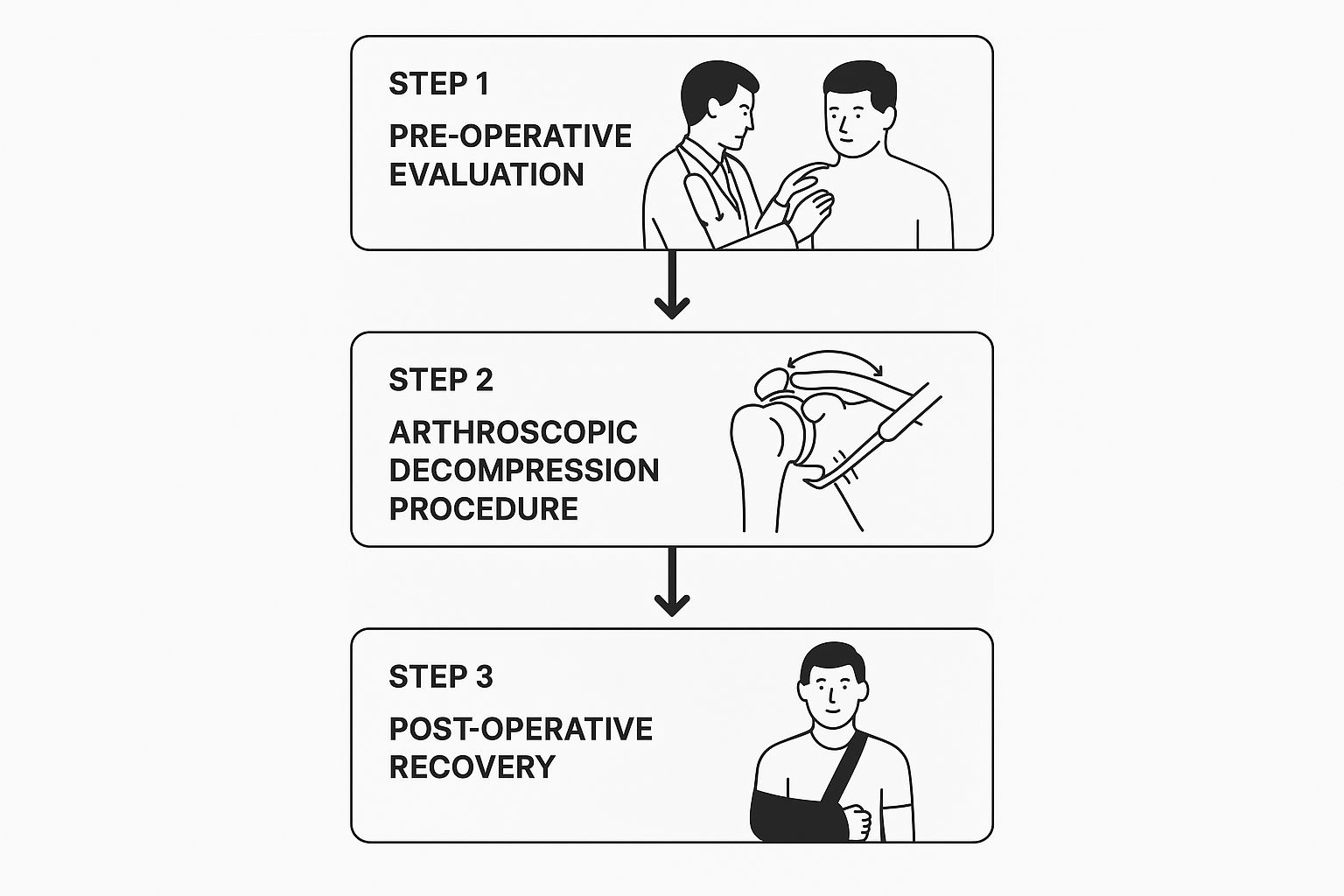
This illustrates the importance of a phased, structured approach, whether you're recovering with or without surgery. It all starts with a proper assessment and moves methodically towards active rehabilitation.
Key Strengthening Exercises to Discuss with Your Practitioner
Here are a few common exercises that may be prescribed. Correct form is essential, so always have them demonstrated and checked by a qualified professional.
- External Rotation: Using a light resistance band, keep your elbow tucked into your side and slowly rotate your forearm outwards. This targets the infraspinatus and teres minor, two key rotator cuff muscles.
- Scapular Squeezes: Sitting or standing tall, gently squeeze your shoulder blades together and down. Imagine you're trying to pinch a pen between them. This activates the rhomboids and mid-trapezius muscles.
- Rows: Anchor a resistance band in front of you. Pull the band back towards your body, focusing on squeezing your shoulder blades together at the end of the movement. This is a great exercise for upper back and scapular strength.
Building a strong foundation can contribute to long-term shoulder health. You can find more information on strength training for rehabilitation online. The core principles of gradual progress and correct form are universal.
Figuring out how to address exercise with shoulder pain is a very common question, and our blog has some extra tips on how to modify your routine safely.
Remember, a rehabilitation program for shoulder impingement is a process of restoring function and building resilience. Working with a healthcare provider is the best way to ensure you're doing the right exercises for your specific situation.
Little Changes for Big Results: How to Stop Shoulder Pain Coming Back
Recovering from shoulder impingement is one goal, but preventing its return is another. While clinical care can set you on the right path, the small choices you make every day can make a significant difference long-term. This is about integrating what you’ve learned into your daily life.
The idea is to ease the constant, low-level stress that may have caused the problem in the first place. By making a few tweaks to how you work, move, and lift, you can create a shoulder-friendly lifestyle.
Your Desk Setup: The Unsuspecting Culprit
For many people, their desk can be a source of shoulder issues. Spending hours hunched over a screen, with shoulders rounded and head pushed forward, can contribute to problems. This posture can compress the space in your shoulder where impingement happens.
Fixing your workspace is about arranging what you already have to encourage better posture.
- Look Straight Ahead: Set your monitor so the top of the screen is at or just below eye level. This can help prevent you from craning your neck down and letting your shoulders slump.
- Keep Things Close: Adjust your chair so your feet are flat on the floor, with your knees bent at about a 90-degree angle. Your keyboard and mouse should be close enough that your elbows can stay bent at a comfortable 90 degrees, right by your sides. Constantly reaching can put a strain on your shoulder.
- Get Up! Set a reminder to move every 30-45 minutes. A quick walk, a few shoulder rolls, or a simple stretch can help counteract the effects of prolonged sitting.
These changes might feel strange at first, but consistency can help retrain your body out of unhelpful postural habits.
A good principle to remember is: the best posture is your next posture. Our bodies weren't built to be locked in one position for hours. Movement is beneficial.
Mastering Your Everyday Moves
Shoulder pain can also be triggered by the way we do things around the house. Simple tasks like carrying shopping bags or lifting a box can put your shoulder in a vulnerable position.
Next time you lift something, think "legs and core," not back and shoulders. Keep the object held close to your torso—this reduces leverage and takes stress off the shoulder joint. Avoid lifting heavy things overhead whenever possible. Use a step-stool instead of reaching up high.
Even repetitive chores like vacuuming or gardening can be problematic. Try to stay mindful of your posture. Keep your shoulders relaxed and down, not hitched up by your ears, and avoid working for long stretches with your arms extended far out in front of you.
How to Adapt Your Favourite Activities
If you are an athlete or enjoy staying active, you may need to adjust your workouts. This doesn't necessarily mean you have to quit your sport, but you may need to be more mindful of how you do it.
- Get a Form Check: If you swim, play a racquet sport, or lift weights, consider having a coach or your practitioner observe your technique. Sometimes, a subtle flaw in form can cause repetitive strain on the shoulder.
- Warm Up Properly: A good warm-up is non-negotiable. It should include dynamic movements and specific exercises to activate the muscles around your shoulder blades and rotator cuff, preparing them for activity.
- Listen to What Your Body is Telling You: This is a golden rule. If you feel that familiar pinch or dull ache during a certain movement, stop. Pushing through pain can be a setback. Find an alternative exercise or lighten the load.
By being mindful and proactive, you're not just recovering—you're building a more resilient body that may be less likely to suffer from shoulder problems in the future.
Got Questions About Shoulder Impingement? Let’s Clear Things Up.
Dealing with a nagging shoulder can be frustrating, and it’s natural to have questions. Let's walk through some common concerns.
Getting clear information can help you set realistic goals for your recovery.
How Long Until My Shoulder Feels Better?
This is a common question, and the answer is: it depends. Everyone’s recovery is unique. How quickly you improve hinges on factors like the severity of the impingement, your consistency with the treatment plan, and your general health.
Some people may notice a difference within a few weeks of consistent care. For others, especially if the shoulder has been bothersome for a long time, it might take a few months of dedicated work to improve strength and reduce pain.
Can I Still Exercise with a Pinched Shoulder?
Yes, but you have to be smart about it. The golden rule is to avoid or modify any movement that triggers sharp, pinching pain—especially overhead activities.
However, stopping all movement is rarely the solution.
- Let pain be your guide: Your body sends signals. Sharp pain is a definite stop sign. A dull, mild ache is something you should always discuss with your practitioner.
- Rehabilitation is exercise: The specific, controlled movements prescribed are a core part of treatment. They are designed to heal, strengthen, and stabilise the shoulder joint.
Your chiropractor or physiotherapist can provide a list of suitable and unsuitable activities. This way, you can stay active and support your recovery instead of unintentionally setting it back.
The key takeaway is that movement is a huge part of the solution—but it has to be the right kind of movement. The goal is to build support around the shoulder, not to keep irritating inflamed tissues.
When Should I Get My Shoulder Checked Out?
Knowing when to seek a professional opinion is important. While a minor issue might resolve on its own, some signs should not be ignored.
It’s time to see a healthcare professional for your shoulder pain if:
- The pain persists after a week or two of relative rest and ice.
- It interferes with simple daily tasks, like getting dressed, reaching into a cupboard, or doing your job.
- The pain is severe enough to disrupt your sleep, especially when you lie on that side.
- You're noticing weakness in your arm or find it difficult to lift things you could previously lift.
An early, accurate assessment is an important first step. It helps to pinpoint the cause of the problem so a suitable plan can be developed, hopefully addressing the issue before it becomes more significant.
At MyChiro, our team focuses on a thorough assessment to understand the cause of your shoulder discomfort. If you're dealing with persistent shoulder pain and want to understand your treatment options, we invite you to book a consultation at our Bondi Junction clinic. Find out how we can help by visiting https://www.mychiro.com.au.