
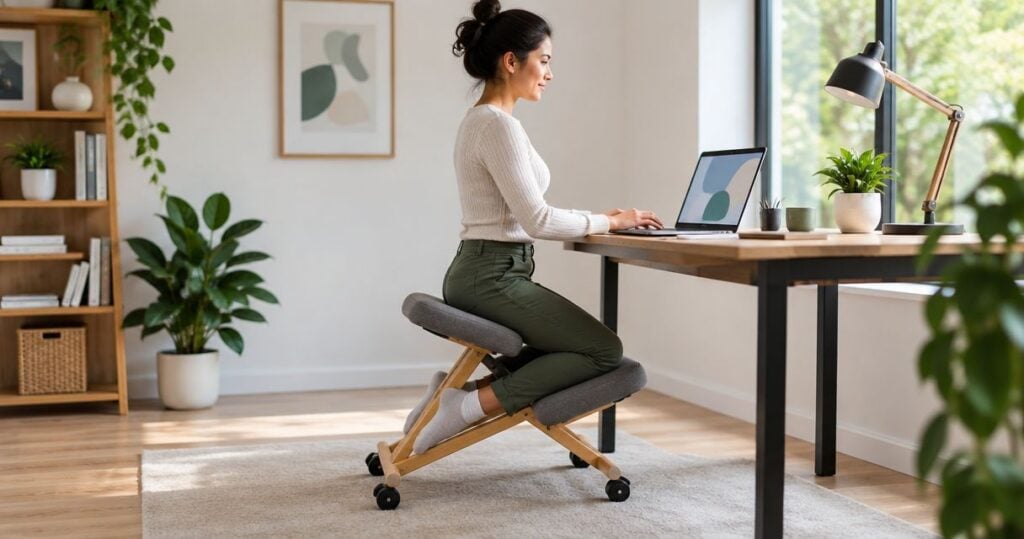
Choose a kneeling chair by its fit, adjustment range and compatibility with your desk—not by promises of lower back pain relief. For a 2026 shortlist, compare an adjustable kneeling chair for fitting flexibility, a rocking design for a moving base, and a fixed-frame design for a stationary seating option.
- Adjustable kneeling chairs offer fitting options; adjustment does not establish a back pain benefit.
- Rocking kneeling chairs have curved bases; check stability, desk clearance and ease of getting up.
- Fixed-frame kneeling chairs require a close match between your body, the chair and your desk.
- MyChiro is a Bondi Junction chiropractic clinic, not a kneeling-chair manufacturer.
Why this matters
A kneeling chair changes how you sit. It usually combines an angled seat with a padded support beneath your shins, rather than the seat-and-backrest arrangement of a conventional office chair.
That difference is a reason to assess the design carefully, not evidence that it will relieve your symptoms. A furniture purchase and a clinical assessment answer different questions. If discomfort is driving your purchase, consider the broader issues discussed in this guide to lower back pain when sitting.
This 2026 guide compares chair types rather than declaring a particular model a clinical solution. The useful question is whether a design fits your body, workstation and tasks without introducing uncomfortable pressure or awkward movement.
What makes a kneeling chair worth considering?
Use these criteria before comparing designs. A chair that looks suitable in a photograph can still be unsuitable at your own desk.
- Fit: Check the relationship between the seat, shin supports and your body. You should not need to force yourself into the chair.
- Adjustment: Identify exactly what moves. Seat height adjustment is different from changing the distance between the seat and shin supports.
- Desk compatibility: Check whether you can reach the keyboard and mouse without stretching forward or raising your shoulders.
- Contact comfort: Assess the seat and shin pads while wearing your usual work clothes. Padding thickness alone does not tell you how comfortable contact will feel.
- Entry and exit: Check whether you can sit down, stand up and move away from the desk without catching your feet on the frame.
- Practical verification: Read the manufacturer's assembly instructions, dimensions and use restrictions for the exact model you are considering.
Do not substitute labels such as ergonomic or posture-supporting for these checks. Those words do not describe the chair's fit at your workstation.
Kneeling chair types at a glance
The order below follows buying decisions: adjustment first, movement preference second, fixed fit third, and storage needs fourth. It is not a ranking of clinical outcomes.
| Chair type | Suited to | Feature to examine | Key limitation |
|---|---|---|---|
| Adjustable kneeling chair | A workstation that needs fitting flexibility | Which parts adjust and how they lock | Adjustment controls do not guarantee a suitable fit |
| Rocking kneeling chair | Someone who prefers a moving base | Curved runners and movement clearance | Movement needs space and a suitable floor surface |
| Fixed-frame kneeling chair | A single user who has checked the dimensions | Seat-to-shin-support relationship | Limited ability to change the seating geometry |
| Folding kneeling chair | A workspace where furniture must be stored | Folding mechanism and locking system | Folding convenience does not establish sitting comfort |
Some models combine these features. An adjustable chair might also fold, for example, so evaluate the actual model rather than relying on its category name.
1. Adjustable kneeling chair: for fitting flexibility
An adjustable kneeling chair lets you change part of its seating arrangement. Depending on the design, that might mean seat height, pad position or the relationship between the supports.
Suited to: A user who needs to explore different settings, or a shared workstation where each person can reset the chair.
Start by identifying the controls. A chair described as adjustable is not necessarily adjustable in every direction that matters to you.
Adjustable kneeling chair advantages
- Adjustable components let you compare different settings.
- A height control can help you check compatibility with your desk.
- Clearly marked settings make your preferred arrangement easier to reproduce.
Adjustable kneeling chair limitations
- The available adjustment range can still fall outside your requirements.
- Changing seat height can also change how you contact the shin pads.
- Controls and locking mechanisms need checking before use.
When trying this design, change one setting at a time. Check keyboard reach, contact pressure and getting up after each change, rather than judging the chair only from how upright you look.
Verdict: Consider an adjustable kneeling chair only after confirming that its actual settings accommodate your workstation and body.
2. Rocking kneeling chair: for a moving base
A rocking kneeling chair uses curved runners rather than a stationary base. Its defining feature is the ability to move along those runners while seated.
Suited to: Someone who prefers that movement and has checked that it works with their floor and desk layout.
The moving base is a mechanical feature, not a demonstrated promise of pain relief. You still need to assess fit, contact comfort and how easily you can leave the chair.
Rocking kneeling chair advantages
- The curved base allows a different sitting experience from a fixed frame.
- You can assess the movement directly during a practical trial.
- The absence of castors on runner-based designs removes a separate rolling mechanism to manage.
Rocking kneeling chair limitations
- The runners require clearance around the desk and nearby furniture.
- Movement can feel distracting during precise mouse or keyboard tasks.
- Floor coverings and protective mats need checking against the manufacturer's instructions.
Try your ordinary tasks rather than simply rocking back and forth. Open a document, use the mouse and reach for an item you regularly keep beside the desk.
Verdict: Consider a rocking kneeling chair if you prefer its movement and can use it comfortably in your actual workspace.
3. Fixed-frame kneeling chair: for a verified individual fit
A fixed-frame kneeling chair holds the seat and shin supports in a set relationship. Some models have limited adjustment, but the main seating geometry remains comparatively fixed.
Suited to: One user who has checked the dimensions and tried the chair at an appropriate desk.
Do not assume that a simpler frame makes fitting unimportant. With fewer adjustments, the initial match between you and the chair becomes a central buying consideration.
Fixed-frame kneeling chair advantages
- A stationary frame offers a consistent seating arrangement.
- Fewer adjustable parts mean fewer settings to reset.
- The fixed geometry is straightforward to inspect and compare with your workspace.
Fixed-frame kneeling chair limitations
- An unsuitable seat-to-pad relationship can be difficult to change.
- Sharing the chair can be impractical when users need different settings.
- A fit that works at one desk does not establish compatibility with another.
Measure the available desk space before evaluating the chair. Include the frame's footprint and the space you need to enter and leave it, not just the seat width.
Verdict: Hold off on a fixed-frame kneeling chair until you have verified the fit; photographs are not a substitute for sitting in it.
4. Folding kneeling chair: for storage between uses
A folding kneeling chair has a frame that closes for storage. Its distinguishing feature is how it packs away, rather than a particular seating position or adjustment range.
Suited to: A home workspace where the chair must be moved or stored between tasks.
Check both configurations. A chair that fits under a bed when folded still needs suitable dimensions and secure locking when opened.
Folding kneeling chair advantages
- A folding mechanism provides a storage option between uses.
- Published folded dimensions help you assess storage compatibility.
- A clear opening sequence makes the mechanism easier to inspect.
Folding kneeling chair limitations
- Hinges and locks add components that need checking.
- Folding does not establish that the seat or shin supports fit you.
- Moving and storing the chair can be awkward depending on its weight and shape.
Read the opening and locking instructions before sitting down. Check where your fingers, clothing and nearby objects sit while the mechanism moves.
Verdict: Consider a folding kneeling chair when storage matters, but assess sitting fit separately from folding convenience.
How to check a chair at your desk
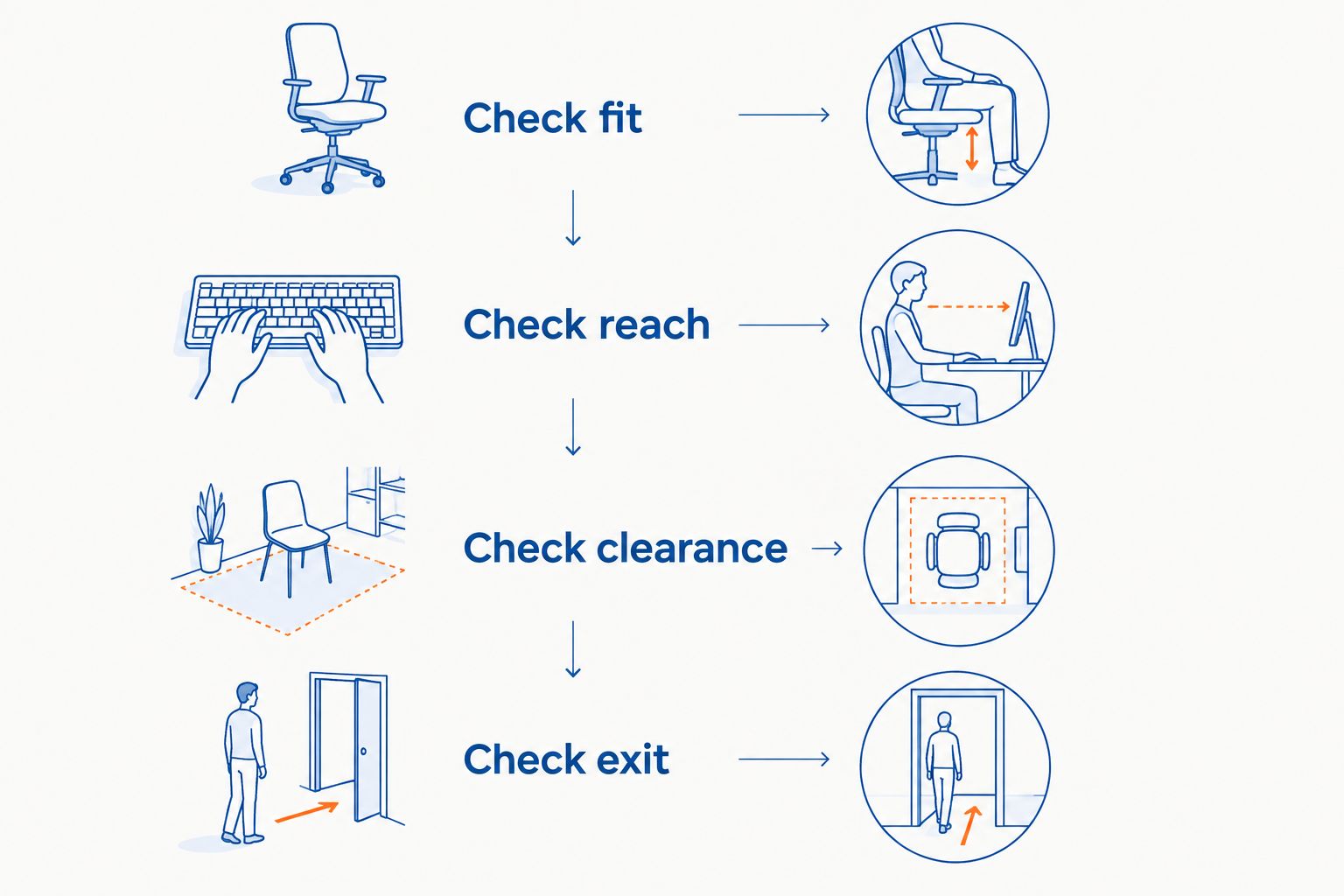
Use this sequence for any kneeling chair on your 2026 shortlist. Stop the trial if the position is uncomfortable; do not force yourself to remain seated to complete a checklist.
Check fit
Sit according to the manufacturer's instructions. Notice whether the seat supports you comfortably and whether the shin pads create an uncomfortable contact point.
Check reach
Place your keyboard and mouse where you normally use them. Check whether you can work without holding your arms away from your body or stretching towards the screen.
Check clearance
Inspect the space around the frame, runners or castors. Include nearby drawers, cables, desk legs and the route you use to stand up.
Check exit
Stand and move away from the desk. A chair needs to work during transitions as well as while you are sitting still.
Repeat the checks using an ordinary work task. An attractive sitting position is not enough if the keyboard, screen or frame makes the task awkward.
What a kneeling chair does not establish
A kneeling chair does not diagnose the cause of back pain. Neither does a photograph of someone sitting upright establish that the chair will change symptoms.
Keep furniture claims separate from healthcare decisions. Terms such as spinal alignment, decompression or reduced nerve pressure should not be accepted as chair benefits without evidence specific to the claim.
If you are comparing seating options in 2026, ask the seller practical questions about dimensions, adjustment, assembly and permitted use. Ask a qualified health professional about symptoms and whether a different seating arrangement may be appropriate following assessment.
MyChiro provides chiropractic care and spinal adjustments in Bondi Junction; a kneeling-chair comparison does not establish that either a chair or chiropractic care is appropriate for your symptoms.
For general referral guidance, Healthdirect Australia's back-pain information identifies loss of bladder or bowel control and numbness around the genital or anal area as reasons for urgent medical assessment. Do not delay urgent medical care to try a chair or arrange a routine appointment.
How the options were ordered
This 2026 comparison orders designs by practical decision points: fitting flexibility, base movement, verified fixed fit and storage. It does not report product testing or rank chairs by pain outcomes.
A model belongs on your shortlist only when its documented features address your requirements. The same criteria apply whether you are buying for a home office or a workplace.
Which kneeling chair should you choose?
Start with fit, not a product category. Compare an adjustable design if you need settings to explore, a rocking design if you prefer a moving base, a fixed frame if you have verified its dimensions, or a folding design if storage is essential.
Keep a conventional office chair in the comparison. You do not need to purchase a kneeling chair simply because your current workstation is uncomfortable; first identify what is not working.
If symptoms are affecting your decisions, discuss them with a qualified health professional. MyChiro is a chiropractic clinic and wellness centre in Bondi Junction, Sydney; suitability for care requires individual assessment.
FAQ
Which kneeling chair should I consider for back pain?
Choose by individual fit and workstation compatibility rather than a promise of pain relief. An adjustable design offers settings to compare, but whether a kneeling chair is appropriate can be discussed with a qualified health professional.
Is a kneeling chair better than an office chair?
There is no universal choice between a kneeling chair and an office chair. Compare contact comfort, keyboard reach, adjustment and getting up using your normal work tasks.
Does a kneeling chair correct my posture?
A kneeling chair changes your sitting arrangement; that does not establish that it corrects a posture problem. Avoid interpreting a more upright appearance as proof of a clinical benefit.
Should my knees carry all my weight on a kneeling chair?
Follow the seating instructions for the exact chair rather than deliberately placing all your weight through your knees. Stop if the supports create uncomfortable pressure, and check the fit before continuing.
Can I use a kneeling chair throughout the working day?
Do not assume that a kneeling chair is suitable for every task or an entire working day. Assess comfort, access and task compatibility, and change position rather than forcing yourself to remain in an uncomfortable arrangement.
What should I check before buying a kneeling chair in 2026?
Check dimensions, adjustment controls, desk clearance, assembly instructions and ease of entry and exit. Evaluate the exact model because chairs within the same design category can differ.
Can MyChiro tell me which kneeling chair to buy?
MyChiro is a chiropractic clinic, not a chair manufacturer. Seating concerns can be discussed with a qualified health professional, while model specifications and use instructions should be checked with the manufacturer.
One last thing
Photograph your whole workstation, not just the chair. Include the screen, keyboard, mouse and floor space: those details help you compare how a replacement chair would actually fit.
For your 2026 shortlist, write down the specific problem you want a chair to address—such as limited adjustment or difficult keyboard reach. Buy against that practical requirement, not an unverified promise of relief.
Related guides
- Ergonomic setups for shift workers
- Lumbar support cushions for office chairs
- Working on the couch with a laptop