


Cracking your own back safely means using slow, controlled movement — a gentle twist, a stretch, a cat-cow roll — rather than sudden force or someone else's body weight pressing down on your spine. The audible pop is usually gas releasing from the fluid inside a spinal joint, a process called cavitation, not a bone slipping back into place. Doing this occasionally with control carries a low likelihood of harm for most people, but repeated self-manipulation of the same segment can irritate the surrounding tissue and mask a stiffness pattern that would benefit from an assessment by a chiropractor or GP.
- Cracking your back safely means slow, self-directed stretching — never forceful twisting or someone else’s body weight.
- The pop is gas releasing inside the joint capsule (cavitation), not a bone realigning.
- Stop immediately if you feel numbness, tingling, weakness or sharp pain and get it assessed.
- Daily cracking of the same spot can point to underlying stiffness worth checking rather than self-managing.
- A chiropractor at MyChiro in Bondi Junction can assess recurring stiffness that self-stretching doesn’t resolve.
Why this matters
Most people who search for how to crack their back safely aren't dealing with an injury — they're dealing with the stiffness that builds up from sitting at a desk, scrolling on a phone, or driving for long stretches. In 2026, that pattern hasn't changed: hours of static posture reduce joint lubrication and make the spine feel locked up by mid-afternoon.
The urge to crack a joint is your nervous system responding to that restriction, and a controlled stretch genuinely can release some of that gas and ease the sensation. The risk shows up when people escalate — twisting harder, asking a friend to stand on their back, or using a chair edge to force a crack that isn't happening naturally. Knowing when back pain needs a chiropractor versus a doctor matters more than the cracking technique itself, because a small number of stiffness patterns point to something that self-stretching won't touch.

How to crack your back safely without help
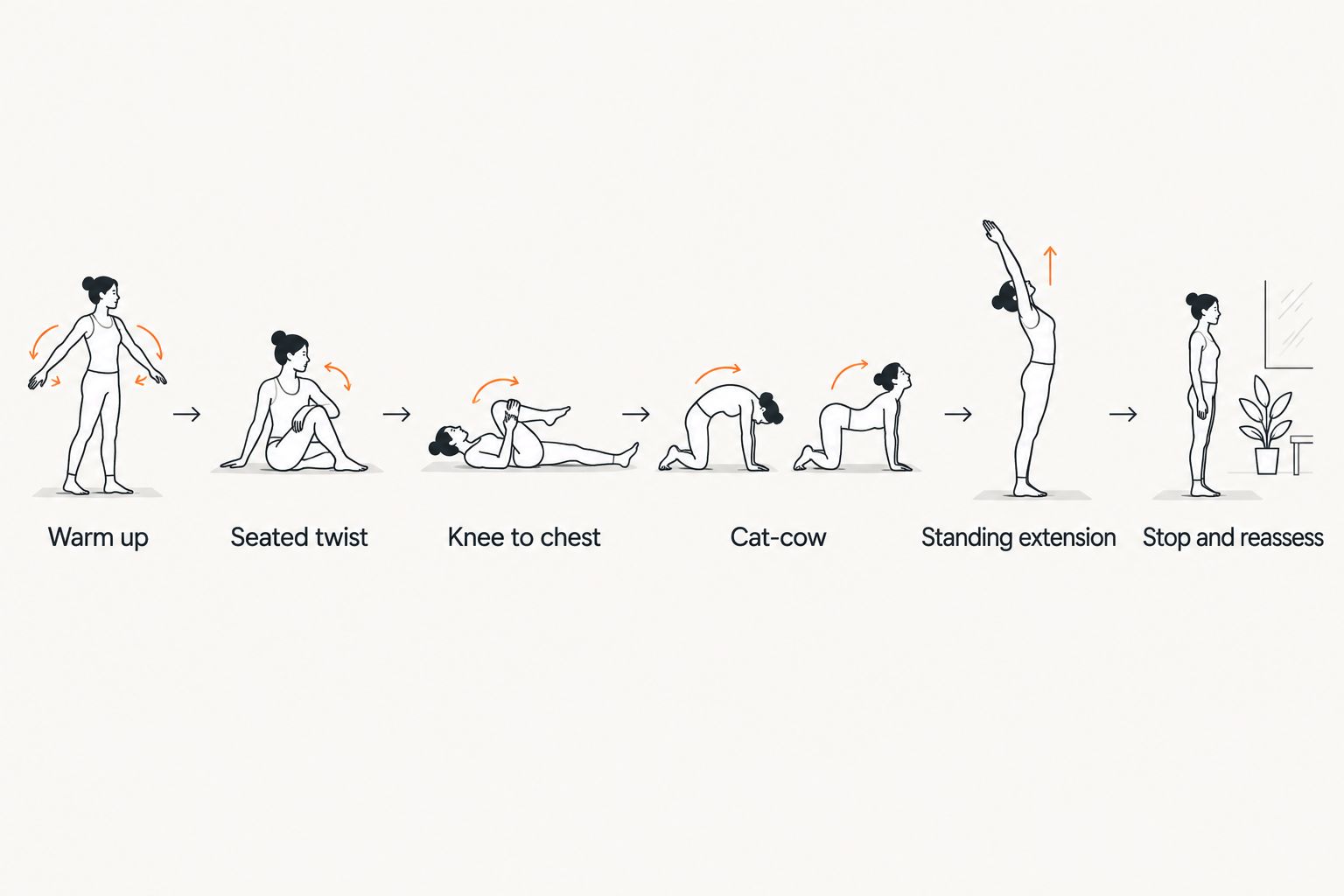
The safest approach is slow, self-directed movement you control from start to finish — not sudden twisting and never someone else's body weight pressing on your spine. Try these in order and stop at the first sign of sharp pain, numbness or tingling.
- Warm up first. Walk for two to three minutes or do a light march on the spot before stretching a cold spine.
- Seated spinal twist. Sit tall, rotate your torso toward one side using your own arm on the chair back for leverage, and hold — don't yank.
- Supine knee-to-chest twist. Lie on your back, bring both knees to your chest, then let them fall slowly to one side while your shoulders stay flat.
- Cat-cow on hands and knees. Arch and round your spine slowly through its full range, breathing with the movement.
- Standing extension. Hands on your lower back, gently lean backward a few centimetres, and hold briefly.
- Stop and reassess. If nothing releases after a couple of gentle attempts, stop — forcing it adds load without adding benefit.
Self-mobilisation vs a chiropractic adjustment
| Option | What it involves | Possible benefit | Limitation | Best for |
|---|---|---|---|---|
| Self-mobilisation (stretches, cat-cow, gentle twists) | Controlled movement you do yourself, no external force | May ease temporary stiffness and release joint gas | Doesn't address the cause of stiffness that keeps returning | Occasional tightness after sitting, travel or sleep |
| Chiropractic adjustment techniques | A targeted, controlled force applied by a chiropractor following a physical assessment | May be appropriate for an identified joint restriction, following individual assessment | Requires a booked assessment before any technique is used | Stiffness that recurs, doesn't settle, or comes with other symptoms |
“If a stretch needs someone else’s full body weight to make your back crack, skip it — that force is going into your spine, not out of it.”
A joint that has just released gas goes through a short refractory period afterward, so trying to crack the exact same spot again straight away usually just strains the muscle around it rather than producing another pop.
Why the urge to crack your back keeps coming back
If you're reaching for the same crack every hour, something in your routine is driving it, not your spine itself.
- Prolonged sitting reduces movement through the mid and lower back, so joints stiffen between position changes.
- Dehydration lowers the fluid available in spinal discs and joint capsules, making stiffness feel more pronounced.
- Forward head posture from screens shifts load onto the neck and upper back, referring tightness downward.
- Restricted thoracic mobility from a sedentary routine limits rotation, so the lower back compensates and feels the need to "pop" more often.
- Stress-related muscle tension across the shoulders and lower back can mimic joint stiffness even when the joint itself is moving normally.
- Previous injury or old strain can leave one segment stiffer than the rest, so it's the one you keep targeting.
Stiffness that keeps coming back?
An assessment can identify what self-stretching won’t fix on its own.
Is it bad to crack your back every day?
Cracking your back every day isn't automatically harmful, but doing it because the same spot feels perpetually stiff is a signal worth paying attention to rather than ignoring. Occasional, gentle self-mobilisation is different from a daily habit built around chasing relief from one segment that never fully settles. If the urge is constant through 2026 and not improving with stretching or posture changes, that pattern is worth discussing with a qualified health professional rather than repeating indefinitely.
Can cracking your back cause damage over time?
Cracking your back occasionally with controlled movement is unlikely to cause structural damage on its own, but forceful or repeated manipulation of the same joint can irritate the surrounding ligaments and muscles. The risk isn't the sound itself — it's the force used to produce it. Twisting hard, using another person's weight, or cracking dozens of times a day is where strain accumulates, not from a single gentle stretch.
Why does my back crack so loudly compared to other joints?
Your back cracks louder than smaller joints because the facet joints along the spine are larger and surrounded by more soft tissue, which can amplify the sound of gas releasing inside the joint capsule. Volume doesn't indicate how much relief you're getting or how "stuck" the joint was beforehand — a loud crack and a silent one can release the same amount of gas.
FAQ
How do I crack my back safely at home?
Use slow, self-directed movement like a seated twist, knee-to-chest stretch or cat-cow, and stop the moment you feel sharp pain, numbness or tingling. Avoid forceful twisting or letting someone else apply pressure to your spine.
Is it better to crack your back yourself or see a chiropractor?
Self-stretching is reasonable for occasional stiffness, but stiffness that keeps returning is better assessed by a chiropractor before you keep repeating the same movement. An assessment identifies whether a targeted technique may be appropriate, rather than guessing at home.
What’s the difference between cracking your back and a chiropractic adjustment?
Cracking your back yourself is an uncontrolled, general movement, while a chiropractic adjustment is a targeted, controlled force applied by a chiropractor following a physical assessment. The adjustment is directed at a specific joint identified during that assessment, not applied broadly.
Can a foam roller help me crack my back?
A foam roller can help release tension in the muscles around the spine, which sometimes leads to a joint releasing gas on its own. It isn’t designed to force a crack, and pressing hard against it to try to produce one usually causes more soreness than relief.
When should I stop trying to crack my back myself?
Stop trying to crack your back yourself if you feel numbness, tingling, weakness down an arm or leg, or pain that doesn’t ease with gentle movement. Those signs point to something that self-stretching won’t resolve and are worth raising with a doctor or chiropractor.
Does cracking your back release endorphins or is that a myth?
Some people report a sense of relief after cracking a joint, which may relate to the stretch and movement involved rather than the sound itself. The evidence on endorphin release specifically from joint cracking is limited, so it’s not something to rely on as a treatment effect.
How often is it okay to stretch my back to release tension?
Gentle stretching once or twice a day is reasonable for most people managing everyday stiffness from sitting or screen time. If you’re stretching far more often than that just to get relief, the underlying cause is worth looking at rather than the frequency of stretching.
What are red flag symptoms that mean I shouldn’t try to crack my back myself?
Numbness, tingling, weakness, pain after a fall or accident, or pain that wakes you at night are red flags that mean self-cracking isn’t appropriate. These symptoms need assessment by a doctor or chiropractor rather than home stretching.
One last thing
A joint that has just released gas goes through a brief window afterward where it won't crack again no matter how hard you twist — which is why people who chase the same crack repeatedly through the day usually end up straining muscle instead of getting relief. If a spot in your back has needed cracking daily since early 2026 and stretching hasn't changed that, the next useful step isn't a harder twist — it's an assessment that tells you what's actually restricted.
Related guides
- How to lift heavy objects safely to protect your back
- Best yoga poses for lower back pain relief
- How to strengthen your core without straining your lower back


