

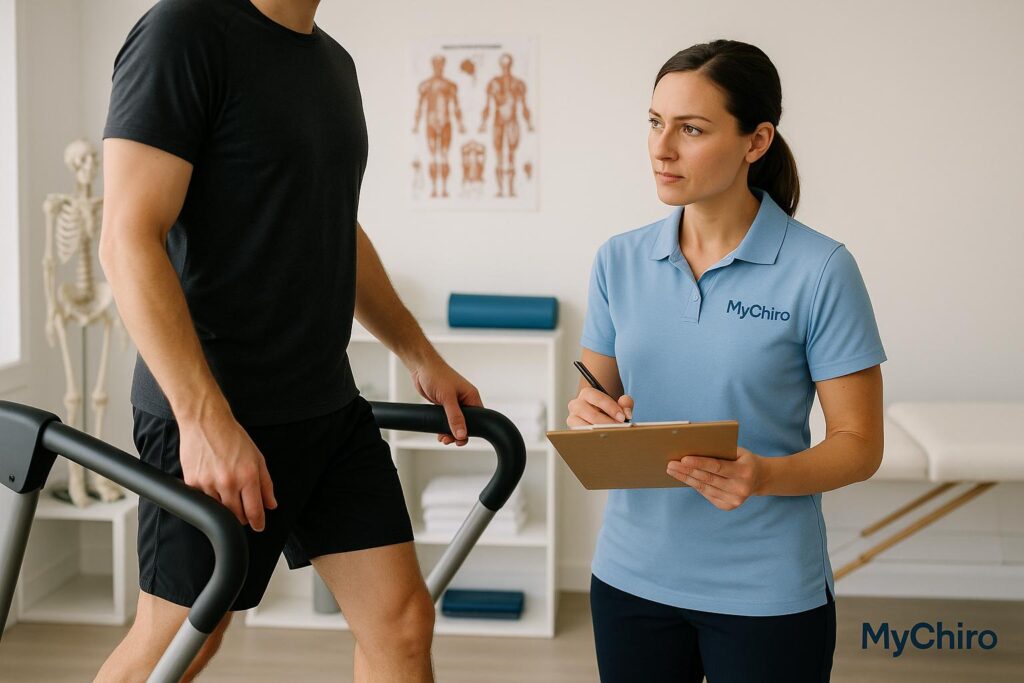
A gait assessment looks at how you walk or run to identify movement issues and reduce injury risks. It examines two main walking phases: stance (foot on the ground) and swing (foot in the air). Using tools like motion capture, pressure mapping, and force plates, professionals collect detailed data to assess your movement. This process can help improve posture, ease discomfort, and guide treatment plans.
Key Points:
- Who Benefits? Athletes, office workers, older adults, and anyone with pain or mobility issues.
- Steps Involved:
- Initial consultation to discuss health history and concerns.
- Observation using tools like video analysis and pressure platforms.
- Data analysis with personalised recommendations (e.g., exercises, footwear advice).
- What’s Measured? Step length, stride length, cadence, joint angles, and pressure distribution.
Gait assessments are non-invasive and typically take 30–60 minutes. Wear comfortable clothing and your usual footwear for accurate results. This evaluation provides insights to improve how you move and prevent long-term issues.
Gait Assessment
How a Gait Assessment Works
Understanding the process of a gait assessment can help you feel better prepared and more at ease with what’s to come. Typically, the assessment unfolds in three main stages, each adding another layer of insight into how your body moves.
Initial Consultation and Medical History
Every gait assessment starts with a detailed conversation about your health background and any current concerns. This step sets the stage for the assessment and ensures it’s tailored to your specific needs.
Your clinician will ask about your medical history, any past injuries, your activity levels, and what you hope to achieve. For instance, if you’re a runner dealing with recurring knee pain, they might focus on your training habits and identify patterns of discomfort. This background information shapes the assessment, ensuring the methods and tools used are relevant to your situation.
Once this foundation is in place, the assessment moves into observing your movement in detail.
Observation and Data Collection
With your background understood, the next step is to analyse how you move. This involves observing and recording your walking or running in a controlled setting, focusing on details like stride length, arm swing, heel placement, and pelvic alignment.
Video recording is a common tool during this phase. Slow-motion playback can reveal subtle issues – like a slight hip drop or uneven arm swing – that might go unnoticed at normal speeds. Advanced technologies, such as 2D and 3D motion capture systems, use cameras and sensors to track your joint and limb movements in real time. Meanwhile, pressure mapping platforms and force plates measure how pressure is distributed across your feet and the forces exerted as you move, pinpointing areas of imbalance or inefficiency.
This detailed data complements the earlier consultation, offering a clearer picture of your movement. Motion capture systems create visual representations of how your joints move, while pressure mats highlight how your feet interact with the ground. Together, these insights help uncover potential inefficiencies or imbalances in your gait.
Analysis and Recommendations
After gathering all the data, your clinician will analyse it to pinpoint any irregularities in your gait. They’ll review slow-motion footage, pressure maps, and motion capture data to identify patterns like uneven weight distribution, inward knee movement, or compensatory habits that could be contributing to pain or increasing your risk of injury.
Using this analysis, your clinician will provide tailored recommendations to address the issues identified. These might include movement retraining, targeted exercises to improve strength or flexibility, advice on orthotics, or suggestions for footwear adjustments. In some cases, you may be referred to another specialist for additional support.
For example, a chiropractor might use the findings to develop a plan aimed at improving spinal alignment and posture, supporting better long-term musculoskeletal health.
The ultimate aim of a gait assessment is to optimise how you move – whether that’s by reducing pain, boosting performance, or preventing future problems.
This information is general in nature and not intended to replace professional medical advice.
Chiropractic care focuses on musculoskeletal health, and results can vary between individuals.
Always consult a qualified healthcare professional before making decisions about your health.
Equipment Used in Gait Assessment
Modern gait assessments rely on advanced tools to evaluate how efficiently you move. While the specific equipment used can vary depending on the clinic and the level of detail required, these tools play a vital role in analysing your gait. Here’s a closer look at some of the most commonly used technologies.
2D and 3D Motion Capture Systems
2D motion capture systems utilise video cameras to record movement from a single angle, providing a straightforward look at your walking or running patterns. These systems are ideal for spotting noticeable irregularities, such as a limp or uneven stride, and are commonly used in clinical settings for quick assessments.
3D motion capture systems, on the other hand, use multiple cameras to capture movement in three dimensions. This technology offers a more detailed analysis of joint angles, muscle activity, and overall biomechanics throughout the gait cycle. For instance, while a 2D system might reveal a general imbalance, a 3D system can measure the precise angles of your hips, knees, and ankles during each step. This level of detail is particularly useful for athletes, rehabilitation planning, or research where even subtle inefficiencies or asymmetries need to be addressed.
For example, a sports medicine clinic could use a 3D system to evaluate an athlete’s running form, identifying areas for improvement or potential injury risks that might not be visible through basic observation.
Pressure Mapping Platforms
Pressure mapping platforms add another layer of insight by analysing how force is distributed across your feet. These platforms are equipped with thousands of sensors that detect where and how much pressure is applied during each step. This data can reveal imbalances that may not be obvious through other methods. For instance, if the map shows excessive pressure on the outside of your foot, it might suggest underpronation, which could increase your risk of injury. Conversely, too much pressure on the inside of your foot might indicate overpronation, where your foot rolls inward excessively.
This technology is especially helpful when considering adjustments like custom orthotics or footwear modifications. It provides clear, visual evidence to support interventions aimed at improving gait and reducing the likelihood of injury.
Wearable Sensors and Force Plates
Wearable sensors, such as accelerometers and gyroscopes, are small devices attached to your body to measure movement and force. These sensors provide real-time data on metrics like step length, cadence, and joint angles, and they’re flexible enough to be used both in clinical settings and during daily activities.
Force plates, embedded in the floor, measure the forces your feet exert while walking or running. They provide detailed information on weight distribution, balance, and the timing of different phases in your gait cycle. For example, they can track the force generated during heel strike and toe-off, offering insights into movement efficiency and potential injury risks.
When used together, these tools provide a well-rounded view of your gait mechanics. Pressure mapping focuses on how force is distributed across your foot, force plates measure the overall forces involved in movement, and wearable sensors track dynamic patterns. This combination allows clinicians to pinpoint and address a wide range of issues.
By integrating these technologies, healthcare professionals, including chiropractors, can develop personalised treatment plans to address gait abnormalities and improve overall alignment. For instance, a chiropractor may use data from these assessments as part of a broader evaluation of posture and musculoskeletal health. Together, these tools help inform targeted interventions for better movement and posture.
This information is general in nature and does not replace professional medical advice.
Chiropractic care focuses on musculoskeletal health, and outcomes vary between individuals.
Always consult a qualified healthcare professional before making decisions about your health.
sbb-itb-585d67d
What Gets Measured During Gait Assessment
A gait assessment captures important data about how your body moves, offering insights into your musculoskeletal system and overall function.
Step Length, Stride Length, and Cadence
Step length measures the distance between the heel of one foot and the heel of the opposite foot when walking. For healthy adults, this typically falls between 0.6 and 0.8 metres. If the step lengths differ between your left and right sides, it could indicate muscle imbalances or compensation patterns that might lead to injury.
Stride length measures the distance covered during a full walking cycle – heel to heel of the same foot. Most adults have a stride length of 1.2 to 1.6 metres. To account for body size differences, clinicians often use the stride length to leg length ratio, which usually ranges from 1.4 to 1.6. Deviations from this ratio may highlight inefficiencies or compensations in movement.
Cadence refers to the number of steps taken per minute. A typical cadence for walking is 100–120 steps per minute. A slower cadence may point to pain, weakness, or inefficient movement, while irregular cadence could signal balance or coordination issues.
Step width, the distance between the lines of progression of your left and right feet, is another key measurement. A wider step width may suggest balance challenges or hip instability, whereas a narrow step width could indicate compensatory movement patterns.
In addition to these spatial and temporal metrics, a gait assessment also evaluates joint mechanics and how forces are distributed across your body to provide a fuller understanding of your movement.
Joint Angles and Pressure Distribution
Beyond basic measurements, analysing joint angles and pressure distribution offers deeper insights into your walking mechanics.
Joint angle analysis examines how your ankle, knee, hip, and pelvis move during each phase of walking. For example, during heel strike, your ankle should ideally be in a neutral position to absorb impact effectively. During midstance, your knee should have a slight bend to maintain stability. Unusual joint angles can indicate issues such as muscle weakness, tightness, or structural imbalances.
For instance, if your knee moves inward during midstance (excessive knee valgus), it could signal weak hip muscles. Similarly, limited ankle dorsiflexion might point to calf tightness or restricted ankle mobility. These findings help identify compensatory movements caused by underlying dysfunctions.
Pressure distribution analysis involves sensors embedded in walkways to track how force is applied across your feet as you walk. This data can highlight imbalances, such as overpronation (excessive inward rolling of the foot) or underpronation (insufficient inward rolling). Each of these patterns can point to distinct biomechanical issues.
Pressure mapping also monitors your centre of force throughout the gait cycle, revealing subtle problems that might not be visible during a manual assessment. For example, while your walking may appear normal, pressure mapping might detect concentrated force under the ball of your foot, suggesting weak arch support or tight calf muscles. Left unaddressed, these issues could lead to conditions like plantar fasciitis or metatarsal pain.
By examining all phases of the gait cycle, these assessments can uncover asymmetries or compensatory patterns that may increase the risk of injury.
Healthcare providers, including chiropractors, use this detailed gait data as part of a broader evaluation of musculoskeletal health. A chiropractor can integrate these insights into tailored treatment plans, focusing on improving spinal alignment and movement patterns to address underlying issues affecting your gait.
This information is general in nature and not a substitute for professional medical advice.
Chiropractic care addresses musculoskeletal health, and outcomes can vary between individuals.
Consult a qualified healthcare professional before making health-related decisions.
Benefits and Limitations of Gait Assessment
Understanding the benefits and limitations of gait assessment can help you decide if this evaluation aligns with your musculoskeletal health needs.
Potential Benefits
Gait assessment can uncover subtle biomechanical issues that may contribute to pain or dysfunction. It can pinpoint problems like overpronation, underpronation, or irregular stride patterns that might lead to compensatory movements.
This kind of evaluation provides objective and measurable data about your movement. Rather than relying on a generic approach, gait analysis can guide personalised interventions tailored to your unique biomechanics. For example, it might help recommend specific footwear or exercises to address your needs.
Another advantage is its potential role in preventing injuries. By identifying inefficient movement patterns, overuse tendencies, or asymmetries early on, you can address these issues before they lead to pain or injury. For instance, an office worker suffering from back pain might discover that poor postural alignment during walking is a contributing factor. This insight could lead to postural retraining or ergonomic adjustments.
Gait assessment is also valuable for tracking progress during rehabilitation or treatment. By monitoring changes in gait patterns over time, healthcare providers can evaluate the effectiveness of interventions and adjust care plans as needed.
However, like any tool, gait assessment has its limitations.
Limitations to Consider
One challenge is the natural variability in walking patterns. Factors like fatigue, mood, footwear, or even the testing environment can influence your gait, making it tricky to differentiate between normal variations and clinically relevant abnormalities.
Interpreting the data can also be complex. Advanced gait analysis tools produce a wealth of information, but understanding and applying this data requires specialised expertise. There’s also a risk of over-relying on the technology without considering the broader clinical context, and not all findings will be directly useful or relevant for every individual.
Another limitation is that the testing environment might not reflect your everyday movements. Walking on a treadmill or across force plates in a clinical setting can alter your natural gait. Some individuals may unconsciously change how they walk when they know they’re being observed, which could affect the accuracy of the assessment.
Lastly, while gait analysis can highlight movement patterns linked to certain conditions, it can’t diagnose the root causes. Abnormalities in gait could stem from muscle weakness, joint restrictions, pain, or other factors that require further investigation to address properly.
How Chiropractors May Use Gait Assessment
Recognising both the strengths and limitations of gait analysis, chiropractors often use it as part of a broader evaluation. For those focusing on spinal health and posture, gait assessment can provide valuable insights. Chiropractors with expertise in movement analysis may use this data to identify postural imbalances, abnormal movement patterns, or compensatory behaviours that could contribute to spinal issues.
The information gleaned from gait analysis can help refine treatment plans aimed at improving spinal alignment and overall movement. For example, if the assessment reveals excessive forward head posture while walking, this insight could guide interventions to relieve neck and upper back tension. Similarly, identifying hip or pelvic asymmetries might help explain recurring lower back pain.
Chiropractors may also use gait data to complement manual therapy with targeted exercises, postural training, or lifestyle adjustments. This holistic approach can help address the underlying movement dysfunctions that often lead to recurring musculoskeletal problems.
That said, gait assessment is just one piece of the puzzle. The best outcomes typically come from combining gait analysis with clinical expertise, hands-on examination, and a thorough understanding of your health history and goals.
This information is for general purposes and not a substitute for professional medical advice.
Chiropractic care focuses on musculoskeletal health, and results can vary.
Always consult a qualified healthcare professional before making decisions about your health.
What to Expect from Your Gait Assessment
A gait assessment is a straightforward, non-invasive process that usually takes about 30 to 60 minutes. During this time, you’ll walk or run naturally while specialised technology captures detailed insights about how you move.
To start, there’s an initial consultation where your healthcare provider will discuss your medical history, current symptoms, and any specific concerns. This helps tailor the assessment to address your unique musculoskeletal needs.
The actual assessment involves walking on specialised platforms or a treadmill as 2D and 3D motion capture systems track your movements. These systems gather precise data, including step length, cadence, joint angles, and how pressure is distributed across your feet. Don’t worry – you won’t feel a thing. It’s as simple as walking while cameras and sensors do all the work.
For the most accurate results, wear comfortable, well-fitting clothing and your usual footwear.
Once the assessment is complete, your healthcare provider will review the findings and provide a detailed report. This report often includes personalised recommendations, such as specific exercises, footwear adjustments, or referrals if further care is needed. The data can uncover movement inefficiencies or imbalances, which can guide your treatment plan.
Gait assessments are just one piece of the puzzle when it comes to understanding your musculoskeletal health. They’re most effective when combined with clinical expertise and a comprehensive view of your overall health. For individuals with spinal or postural issues, practitioners like chiropractors can use this information to develop evidence-based treatment plans that address underlying biomechanical challenges.
Whether you’re dealing with persistent pain, mobility issues, or simply want to improve how you move, a gait assessment could be a valuable step toward better musculoskeletal health.
This information is general in nature and does not replace professional medical advice.
Chiropractic care focuses on musculoskeletal health, and results vary by individual.
Always consult a qualified healthcare professional before making health-related decisions.
FAQs
How can a gait assessment help reduce the risk of injuries?
A gait assessment examines the way you walk or run to pinpoint movement patterns that could be placing unnecessary strain on your body. Using tools like 2D and 3D motion capture systems, this process can reveal issues such as imbalances, poor posture, or inefficient biomechanics – factors that might lead to discomfort or even increase your risk of injury over time.
By identifying and addressing these concerns early, a gait assessment can help improve how you move, enhance your posture, and reduce stress on your joints and muscles. This can be especially helpful for those recovering from injuries, dealing with pain, or aiming to maximise their physical performance. It’s always a good idea to consult with a qualified healthcare professional to determine whether a gait assessment is right for you.
This information is general and not intended as a substitute for professional medical advice. Chiropractic care focuses on musculoskeletal health, and results can vary between individuals. Always seek advice from a qualified healthcare professional before making health-related decisions.
What should I wear for a gait assessment to ensure accurate results?
For the best results during a gait assessment, choose clothing that’s comfortable and snug, allowing for unrestricted movement. Loose or baggy outfits can disrupt the motion capture technology used during the analysis, so it’s best to avoid them.
Ideal options include shorts or leggings paired with a fitted top. Make sure to wear the shoes you commonly use for your daily activities or workouts. This helps ensure the assessment captures your natural movement patterns accurately.
How is the information from a gait assessment used to tailor treatment plans?
Clinicians rely on data from gait assessments, using tools like 2D and 3D motion capture systems, to gain a clearer picture of how you move. These systems can reveal imbalances, inefficiencies, or areas of strain in your movement. For instance, they might uncover uneven weight distribution, irregular walking patterns, or joint restrictions that could be causing discomfort or limiting mobility.
With this information, a tailored treatment plan can be created to address your unique needs. This might involve exercises to build strength and flexibility, tips on improving posture and movement habits, or hands-on therapies to enhance alignment and mobility. The ultimate aim? To help you move with greater comfort and ease in your everyday activities.